



‘Leviticus’: This Aussie Social Horror Is Unashamedly Queer And Quite Effective

Image: Source: Causeway Films
Anyone seriously tapped into the horror genre can tell you that queerness has always played a major role in it, though for much of film history has had to exist as subtext. Leviticus is part of an ongoing wave of Australian horror that puts a queer spin on the haunting and social horror subgenres to great effect.
By mixing a genuine queer romance in with an upsetting social horror premise, director Adrian Chiarella’s debut feature takes a look at the societal violence we continue to inflict upon young queer people and the way we quite literally demonise desire. Yet despite the horror, it never loses hope for its main characters to find a better tomorrow.
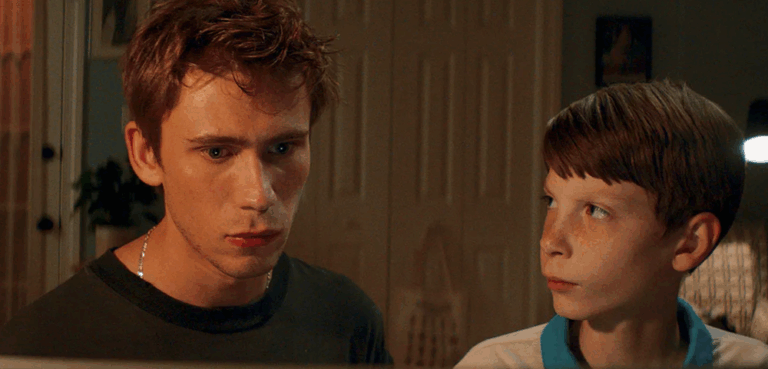
In a steel town somewhere in Victoria, Naim (Joe Bird) is having trouble fitting in. After moving there with his icy, zealously religious mother (Mia Wasikowska), Naim’s only real connection is with Ryan (Stacy Clausen), a boy from school with whom he’s struck up a bit of a romance.
Yet soon, people find out about Ryan and Naim’s queerness and both are subjected to a mysterious ritual that effectively curses them both. Now, a mysterious entity is out to get both of them, which takes the form of who they desire most: Naim sees Ryan, and Ryan sees Naim.
Although the mechanics of its supernatural leanings may be familiar to horror veterans, Leviticus feels refreshingly original in its presentation and for having an unapologetically queer take on its material. Not only does it present young, queer boys in a sincerely vulnerable light, it also captures the feeling of constant fear and anxiety that comes from living in a place where being who you truly are is what endangers you the most.
Through the scares, Leviticus is quite hopeful
Yet despite the danger, Naim and Ryan are drawn to one another, and it’s not hard to see why. Joe Bird and Stacy Clausen play Naim and Ryan with a youthful sense of queerness that’s rarely seen on our screens, and there are many points where the film feels sincerely sweet in its depiction of young queer love – it’s so easy to root for these boys to overcome the situation they’re in.
Counter-balancing the romantic undertone is the horror aspect, which is more conceptually terrifying than actively attempting to scare the audience (although there is the occasional jumpscare). The horror comes more from realising what exactly has been done to these boys and how it will affect them for the rest of their lives.
Thus, Leviticus is also a salient metaphor for the religious trauma (hence the title) that many queer people experience at a young age that they must spend their whole lives contending with. We mostly follow Naim’s perspective in the film, and the way Chiarella squares in his perspective by making us as viewers intensely distrustful whenever Ryan appears on screen is some extremely intelligent horror filmmaking.
It makes the film an excellent horror outing in its own right, yet I found my favourite part of Leviticus was that, through the religious oppression and queer trauma, that the spark of hope never extinguishes. Naim and Ryan realise that they would rather be themselves together than simply conform to what their town wants of them, and that kind of queer rebellion against oppressive systems feels more important now than ever to be shown on our screens.
Leviticus is playing at Sydney Film Festival before releasing in Australian cinemas on June 18th.











Leave a Reply