
The Ongoing Fight Against Queensland’s Trans Youth Healthcare Ban
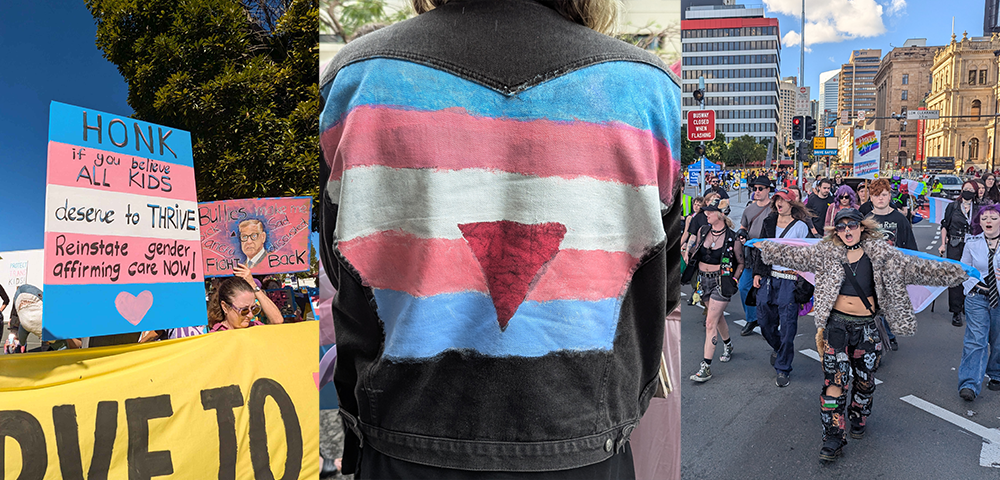
Image: All photos: Tina Eastley
What began as a “pause” on gender affirming healthcare for trans youth in Queensland has become one of the most controversial and legally contested healthcare battles in the country — leaving families caught in the middle.
Here’s how it unfolded, and why this fight matters – and the support of our entire community is desperately needed.
In January 2025, Queensland’s Health Minister Tim Nicholls announced an immediate halt on access to puberty blockers and hormone therapy for new public-system patients under the age of 18 who were experiencing gender dysphoria.
The government said the decision would apply to new patients only, while “patients who are already on a treatment plan with the Queensland Children’s Gender Service (QCGS) will be exempt,” Nicholls said at the time.
“The pause will remain in effect until such time as the government considers and acts on the outcomes of the broader review.”
The government linked the decision to alleged “unauthorised” provision of hormones at the Cairns Sexual Health Service, despite the Brisbane-based clinic being more than 1,700 kilometres away.
On 28 January, Queensland Health Director-General Dr David Rosengren issued a health service directive halting access to care for “new patients” — a term that would later become central to ongoing legal disputes.
Medical bodies, including the Australian Medical Association, and advocacy groups swiftly condemned the decision, warning it would place trans young people at risk. Equality Australia described Queensland as becoming an “outlier state”, warning the policy would have “catastrophic impacts on the health and wellbeing of trans and gender diverse young people”.
One Queensland mum is leading the charge, for her daughter
For one Queensland mother, who cannot be named, the impact was immediate and deeply personal. Her daughter had been a patient of the QCGS for six years and was waiting to see a paediatric endocrinologist when the ban came into effect.
“My daughter’s health is my top priority,” she told Star Observer. “Once it was confirmed that puberty had commenced and that treatment in the public system wasn’t available to us, I was forced to seek private treatment for her.”
Those private treatments came at significant cost. She said that each puberty blocker injection cost hundreds of dollars — and in one case nearly $2,000 — expenses that would not have existed had care continued in the public system.
Crucially, evidence later revealed the January decision was made without consultation with clinicians who specialise in treating trans young people. During Supreme Court proceedings, it emerged that the Cabinet submission and subsequent directive were prepared at speed, and without input from the multidisciplinary gender clinic team employed by the government, located just kilometres from Parliament.
“15 days is all it took in January 2025 for the Crisafulli Government to strip my daughter and other trans young people of their human right to access health services without discrimination,” the mother said. “Other young Queenslanders can and do receive the free treatment in the public health system that the Government has denied my daughter and other trans young people ever since then.”
“The Crisafulli Government’s decision to exclude the input of anyone with expertise in treating trans young people was clearly deliberate and shows they have never been motivated by a genuine concern for trans young people’s safety and wellbeing,” she said.
In March, the government announced an external evidence review into Stage 1 and Stage 2 gender affirming treatments. As the review progressed, pressure mounted for its findings to be released publicly.
Meanwhile, the ban drew national attention. Federal Health Minister Mark Butler announced a separate federal review to establish nationally consistent guidelines, with interim advice expected in mid-2026.
Despite this, Queensland pressed ahead.
The issue reached the Supreme Court in October, when the mother challenged Dr Rosengren’s directive through a judicial review. On 28 October, Justice Peter Callaghan found the directive unlawful, ruling the required consultation process had not been followed and that the decision involved improper political interference. The directive was quashed.
Outside court, the mother said she was “incredibly relieved”.
That relief lasted just six hours — after which, Nicholls issued a new ministerial direction reinstating the ban.
“While it took 15 days the first time… they needed just 6 hours the second time,” the mother said. “The Crisafulli Government has shown us they can move at lightning speed when ideology is their motivation.”
In December, the government announced the ban would remain in place until at least 2031, pending the results of the UK Pathways Trial. The Northern Territory also followed in Queensland’s footsteps, implementing a near identical policy.
Days later, facing further legal pressure, the government amended the directive’s definition of a “new patient” to explicitly include trans young people who accessed private care between January and October.
“It’s not clear from the direction whether the ban on gender affirming care applies to my daughter,” the mother said. “The Gender Clinic has refused to treat her.”
That question is now before the Supreme Court again, with further hearings scheduled in early 2026. For families and advocates, the stakes remain unchanged.
The mother put it plainly to Star Observer: “If the Court finds that the ban does apply to my daughter,” she said, “our fight against the Crisafulli Government’s ban on gender affirming care will continue.”