


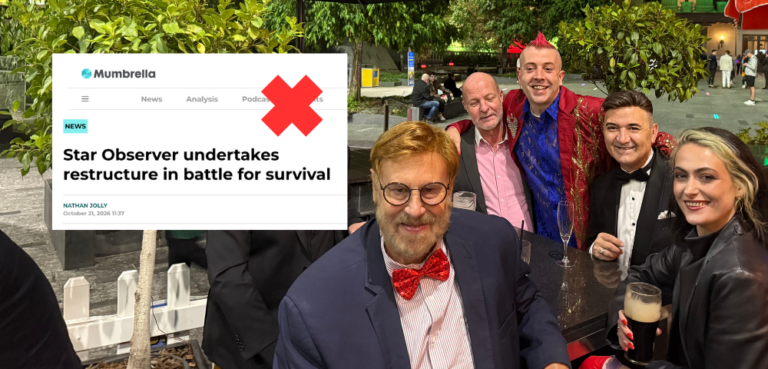
From Star Observer To The Screen: Andrew Mercado Celebrates Australia’s Queer TV History

Image: Image: Composite Supplied
Before Andrew Mercado became a familiar face on Australian television, he was a Sydney Star Observer columnist with a passion for TV and some questions that Channel Seven apparently didn’t want to answer.
Those questions sparked a boycott campaign, an unexpected invitation onto a late-night music show and a career that allowed him to become the kind of openly gay television personality he would have loved to see growing up.
Now, Mercado is celebrating the performers, characters and programs that helped pave the way in Outrageous: The Queer History of Australian TV.
Featuring a foreword by Number 96 star Joe Hasham, the book explores a television landscape where Australian audiences encountered gay, lesbian, bisexual and trans lives long before many international counterparts caught up.
There are plenty of surprises along the way, including an appearance by future Home and Away favourite Ray Meagher in a largely forgotten drama about trans women.
But speaking with The Star Observer, Mercado makes it clear that his own contribution to queer television history owes something to the newspaper where he once wrote about it.
“None of it would have happened if I hadn’t been writing for the Sydney Star Observer.”
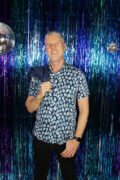
From The Star Observer To Channel V
Mercado’s connection with the publication began while he was working as a publicist for Pacific Drive.
With Melissa Tkautz playing an HIV-positive character and Libby Tanner appearing as unapologetic lesbian Zoe, Mercado recognised that the late night soap had stories worth bringing to queer audiences.
“I was working a lot with the gay press to promote this little show that was screening at 11 o’clock at night,” he recalls.
“And so that’s how I first came into contact with the Sydney Star Observer.”
When the show’s future began looking uncertain, Mercado decided to move to Sydney. Foxtel was still finding its feet, and he could see an opportunity to enter an industry with room to grow.
Before he secured a publicity role at music channel Channel V, however, the The Sydney Star Observer needed someone to take over its television column.
“And so I went, oh my God, I could write a TV column. I’m obsessed with TV. So I applied and I got the job.”
It became a role he loved, and one that would soon put him at the centre of a campaign over queer visibility.
According to Mercado, an anonymous source at Seven told him the network had permanently shelved Ellen following news of its planned lesbian coming-out storyline.
“This was months and months before it actually happened on TV,” he says.
Mercado began asking the network questions. He says those questions went unanswered.
“I was just writing for a free gay newspaper in Sydney, right? Who needed to respond to me?”
“So they ignored me. So I got furious.”
He called for a month long boycott and encouraged readers to write to the program manager asking why the sitcom wasn’t screening.
The campaign attracted attention, including from colleagues at Channel V, where someone suggested he come on a late night program to talk about it.
That appearance led to another invitation.
“Why don’t you come next week and talk about something else gay?”
Before long, Mercado was bringing lesbian DJ Kate Monroe onto the program, along with Sydney drag performers including Chelsea Bun and Tess Tickle.
“And so we made that show very, very gay.”
It was fun, but Mercado also understood what it meant to the teenagers watching.
“We were broadcasting to teenagers and I thought, wow, this is really fantastic that those kids are getting to see some gay stuff on TV.”
With management supporting his appearances, his role eventually changed.
“Look, we’re going to get ourselves a new publicist and you’re going to become our entertainment reporter” they told him.

Being Openly Gay From Day One
Mercado describes himself as one of the first people to begin a regular Australian television career openly gay.
He believes he may have been the first, while acknowledging the possibility of someone he hasn’t accounted for.
The distinction matters to him. Gay people had worked on television before, but being able to arrive openly and talk about queer issues was another experience entirely.
“As far as I can tell, I was the first person to appear regularly on TV. And from day one say, hey, I’m gay. I’m here to talk about gay issues.”
He is careful about judging those who had worked under different circumstances.
“It was a different time. I’m not judging anybody.”
For Mercado, the opportunity came with a responsibility to the young people watching.
“I thought this is my chance to be a positive role model to those kids.”
He knew what that could mean because he had once been a young viewer in Brisbane, watching Number 96 and discovering that a gay man could be liked and accepted by the people around him.
Hasham’s character Don Ross offered a future Mercado could imagine for himself.
“Gee, maybe one day I could grow up and move to Sydney,” he remembers thinking.
“So, I had that as a kid and then I was able to do it in real life.”
His own audience would later remind him just how much that openness mattered.
After a few years on television, Mercado felt he didn’t need to mention his sexuality quite so often. Surely everyone already knew.
Some viewers worried the change meant something else.
“Are you pretending you’re not gay anymore because you can’t do that,” he recalls being asked in emails.
They thought he might be preparing to present as straight to help his career.
“So I had to go back to saying it more on air, by the way, I’m gay, you know.”
Bringing Number 96 Back
Mercado’s affection for Number 96 also helped shape his work as a television historian.
When he began working at Foxtel, he noticed channels filling their schedules with older American and British programs while Australian television nostalgia was harder to find.
“I could never understand why we weren’t being more patriotic about the TV we made.”
He began approaching channels and asking them to bring Number 96 back.
Eventually, TV1 agreed. Mercado would select 20 episodes and introduce them, explaining why they mattered.
That project led to an approach from Pluto Press and his first book, Super Aussie Soaps.
“So everything was sort of leading into the next thing,” he says.
The inspiration for Outrageous sharpened in 2019, during the 50th anniversary commemorations of Stonewall.
Mercado kept encountering international accounts of queer screen history that, he felt, overlooked what Australian television had achieved.
“I was looking at these lists going, um, hello? We did all of that first on Australian TV before the rest of the world and nobody knows this.”
He believes part of the problem was that the very things making programs such as Number 96 and The Box distinctive also made them difficult to sell overseas.
Other broadcasters weren’t necessarily ready for the stories Australian audiences were already watching.
“You could’ve cut out the nudity from the show, but you couldn’t cut out those gay characters.”
The result, he argues, was an extraordinary chapter of television history that remained unfamiliar to many international audiences.
“So we were just this little island being extremely progressive on TV.”
Carlotta And Authentic Casting
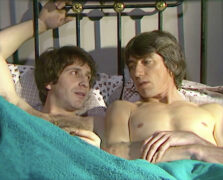
One of the stories Mercado is particularly passionate about is Carlotta’s appearance in Number 96 in 1973.
For him, casting a trans performer in a trans role was an achievement worth remembering, especially when authentic casting remains a topic of discussion today.
“I just think that that’s incredible that we were doing authentic casting back then.”
He is equally impressed by the way Carlotta was involved in shaping her character’s dialogue.
“They didn’t just write that for her,” he says.
“They actually sat her down and said, what, how will we do this? And they talked about all these different ways to do it. And basically let her write her lines.”
For viewers who may have known little about trans people, the program offered a chance to encounter a trans character within a familiar television world.
“Here we were just putting it on TV, casually putting it on TV.”
Mercado sees those moments as evidence that audiences could be more receptive than broadcasters or commentators might assume.
While some religious groups objected to the programs, he says many viewers embraced their queer characters.
“They loved those gay characters and we know that because those actors got the most fan mail out of everybody in the show.”
Ray Meagher And A Forgotten Trans Television Story
For anyone who thinks they know Australian television history, Mercado has a particularly intriguing recommendation: Pig in a Poke.
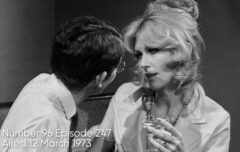
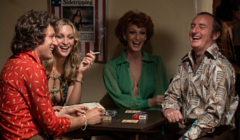
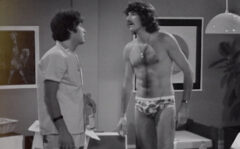
The 1970s ABC drama followed a doctor working in Redfern and included a storyline about two trans women.
Mercado describes it as a strikingly honest portrayal of trans showgirls’ lives.
“It was the most incredibly honest and truthful show.”
Yet, in his account, awards recognition did little to ease the broadcaster’s discomfort with its content.
He says the episode screened in a later timeslot, the series wasn’t renewed and the program wasn’t repeated.
“They didn’t even repeat it after it won all these awards.”
For Mercado, that makes it a piece of television deserving of another audience.
“One of my missions is to try to find out a way that we could maybe screen that again because that is the most remarkable piece of TV.”
Then there is the detail that might surprise even dedicated Home and Away fans.
Years before becoming Alf Stewart, Ray Meagher appeared as the boyfriend of one of the trans women in a guest appearance on the show.
“And [he] gets out of bed, bares his bum,” Mercado says.
His reaction to discovering the scene is understandably delighted.
“Oh my God, I’m even seeing Alf Stewart’s bum in this” he laughs.
The unexpected appearance provides a memorable way into the story, but Mercado’s enthusiasm extends well beyond the novelty of recognising a future Summer Bay star.
Here was an Australian drama making space for trans women’s lives decades ago, with material he believes audiences should have the opportunity to rediscover.
“That’s something that I think needs to be recovered and re-screened.”
The More Complicated Parts Of The Story
Mercado’s account also examines the moments Australian television got wrong.
Alongside its groundbreaking characters, the industry reproduced stereotypes, including police dramas where gay men appeared as vulnerable victims of violence.
Looking back at those programs, however, Mercado found another story within them.
Television policemen audiences were encouraged to admire could also express casual homophobia, revealing attitudes that queer Australians encountered beyond the screen.
“Although they sometimes didn’t portray queer people in a great light, they actually showed a truth to some policing.”
It is a reminder that this history contains contradictions.
A television landscape capable of progressive casting and beloved gay characters could also reinforce prejudice.
But Mercado says looking closely reveals moments that still surprise him.
“Even then if you really drill down, as I’ve done in this book, you do find these remarkable moments.”
“Wow, I can’t believe that that character did that, said that on TV in the late 60s and the 70s.”
Outrageous extends that examination across programs including Prisoner, A Country Practice, The Flying Doctors, Homicide, The Box, Fast Forward, Blue Heelers, Water Rats and Four Corners.
Together, they provide a much broader picture of where queer Australians appeared on screen and how audiences responded.
Bringing The Documentary Back To Audiences
Before Outrageous: The Queer History of Australian TV came to life as book, it was first a documentary that came together around an opportunity Mercado couldn’t resist.
Joe Hasham was coming to Australia for WorldPride, and Mercado asked whether he would attend a Number 96 screening.
“And he was like, I’d be delighted because he’s the loveliest man.”
Mercado and his collaborators had been developing a larger screen project. With Hasham’s visit approaching, they decided to make a short documentary focusing on some of those television milestones.
“We just threw it together in record time.”
Contributors included Shane Jenek, Benjamin Law, Michael Kirby, Carlotta and Sarah Walker.
Mercado also approached Keiynan Lonsdale, whose work included playing a gay dancer in Dance Academy and the iconic gay love film, Love, Simon.
He wanted a younger queer actor to reflect on the people who had helped make his career possible.
“He just recorded this beautiful message for us and sent it back,” Mercado says.
The contribution helped connect the trailblazers in the documentary with a new generation of performers.
Now, the film accompanies the book’s launch events, giving audiences a chance to see some of the history Mercado has spent years researching.
The Melbourne launch takes place at the Victorian Pride Centre on November 9, with further tour stops in Sydney on November 16, Brisbane on November 23 and Newcastle on November 30.
Mercado also has his eye on Adelaide, Perth and regional visits in 2027.
Outrageous: The Queer History of Australian TV by Andrew Mercado, with a foreword by Joe Hasham, is released in November 2026 through Rainshadow.
The Melbourne book launch and documentary screening takes place at the Victorian Pride Centre on November 9, from 7pm, followed by a Q&A. Melbourne event details and tickets.


Support the Star Observer… while you still can
LGBTQIA+ media is under threat. Queer content is censored by tech conglomerates who amplify bigotry and push out AI slop — so we receive less financial support than ever.
When our community is muzzled and intolerance intensifies, we need queer media more than ever. Your donation means we can continue paying queer journalists to write queer news.
Don’t rely on the straight lies of big tech – support Star Observer instead and donate now.



Leave a Reply