
5 Arrows: How Christopher Gurusamy Is Queering Classical Indian Dance
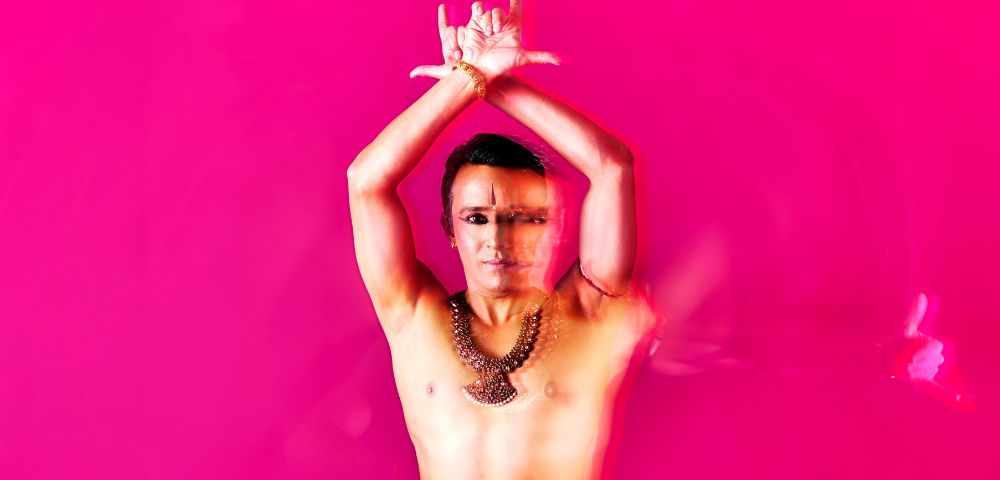
In just a few short days, “5 Arrows” will ensorcel Sydney audiences with an embodied story of yearning, lust, and desire. The work is part of Sydney Dance Company’s 2026 INDance season, and will see internationally acclaimed dancer and choreographer Christopher Gurusamy put a contemporary queer spin on the tradition of Bharatanatyam.
Gurusamy, a biracial gay man born in Perth, traces the seeds of his illustrious career back to his mother.
“My mum danced with me when she was pregnant,” Gurusamy recalled, “so I’ve literally been dancing since I was -9 months old.”
Little did his mother know, Gurusamy would move to India a mere 18 years later to study a classical form of the art. After being accepted into the prestigious Bharathanatyam conservatorium Kalakshetra, Gurusamy became the only Australian to graduate from the institution’s gruelling six-year course.
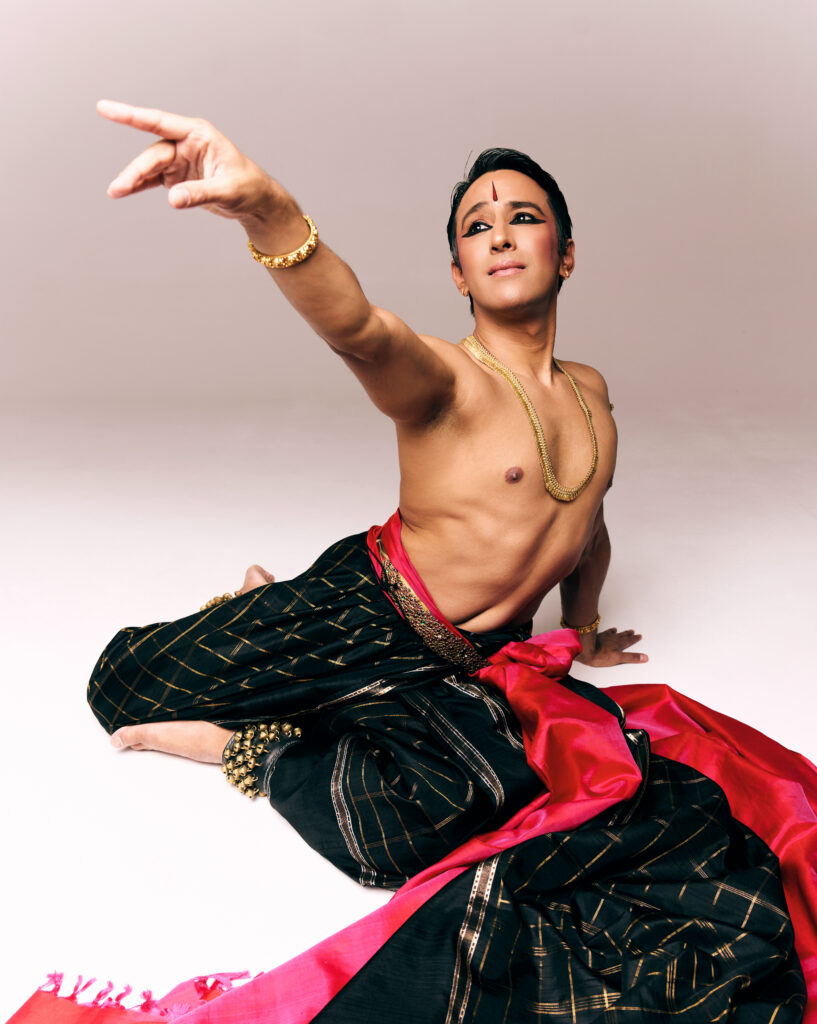
“I think that Bharatanatyam is not exactly an easy sell,” Gurusamy said of the classical dance form native to Tamil Nadu, South India. “But you know what it is. It’s almost like lip-sincing, without the lip movement. It’s how much you can embody a song while not singing the lyrics yourself. When you see the amount of make-up I wear [in 5 Arrows], I mean, I’m just one breastplate away from drag.”
Where Pop Meets Tradition: The Inspiration Behind 5 Arrows
According to Gurusamy, 5 Arrows draws inspiration from a number of popular queer anthems, notably “I will survive” by Gloria Gainer, “Crazy in Love” by Beyonce, and “Part of My World” from The Little Mermaid. Alongside these contemporary influences, Gurusamy’s own love life among them, South Asian traditions ground the work.
Notably, “Mohamana”, an 18th century piece of Carnatic music composed by the Tanjore Quartet, underpins the entire performance. Meanwhile, the narrative draws heavily from the seminal lore found in the work’s title.
“Within Hinduism,” Gurusamy explained, “the five flower tipped arrows of Cupid, or “Māran” in Tamizh, are what hit a person when they’re in love. One hits your lips and it makes you want to kiss someone. One hits your eyes and it makes you cry. One hits your heart and it makes you yearn. One hits your mind and makes you delirious.
“The fifth arrow is supposed to create death,” Gurusamy mused. “Supposedly, it hits you in the genitals.”
Of the performance, Gurusamy explained he is not simply following fixed choreography. Instead, the work is improvised. He is evoking real emotions from his past – desperation, limerence, yearning – and responding to them in real time. That is, he is being pierced by all five of Cupid’s flower-tipped arrows live.
“You have to have been in a devastating relationship,” Gurusamy said, “and know what it is to be touched. You can’t make that up. You use memories of what it felt like to be touched, and activate them through the performance.”
Unsurprisingly, Gurusamy credits this use of lived memory with giving 5 Arrows its visceral power.
“It makes the work have a potency that is really electric,” Gurusamy said. “While I stand on stage, the entire room can feel how I feel.”
Indeed, Gurusamy’s embodiment of past love, queer love, seems to resonate with LGBTQ+ audiences.
“When I performed this piece last year,” Gurusamy recalled, “I had a lot of queer people come up to me afterwards and go like ‘I feel like I watched my story of me and my lover through you’. I found that really remarkable.”
How 5 Arrows is Queering Gender
While much of the queerness of 5 Arrows stems from Gurusamy expressing his own lived experience, this is only enhanced by the fact that the piece itself is an act of gender play. In it, Gurusamy does not play a hero, but a heroine.
“The Nayika is a woman who is in complete control of her sexuality,” Gurusamy said. “She has agency, and she has a voice. There are poems from 8th century Tamil Nadu that [describe her]. We’re talking about a time where, in England, women weren’t even allowed to write books. Meanwhile, the Nayika represents a woman completely liberated.”
“I allow both myself and the Nayika to come at the same time through one body. So there’s a duality of perspective that is happening. I am both Chris and the Nayika at the same time.”
Gurusamy explained that it is precisely his queerness that enables him to hold both a masculine and feminine perspective in one body. For him, channeling the Nayika transcends the gay impulse to admire powerful female characters. More than that, it is an act of queer rebellion.
“I think as a queer person that has done the work to understand who they are, standing in your own knowledge of who you are and not being afraid of that is so powerful. I know a lot of cultural work is about finding yourself. About ‘who am I?’. But this isn’t that. This is a celebration of knowing exactly who you are.”
Somewhat paradoxically, Gurusamy explains that embodying the Nayika has allowed him to step into his own power.
“I am a terrible flirt in a club. But on stage? I am the best flirt in the entire world. I have no shame. That’s why I feel like it’s almost like drag, because you’re the best version of yourself. No one can touch you. That diva comes out, where I’m still Chris, but I’m the ultimate diva Chris.
“In that sense, 5 Arrows is the antithesis to Andrew Tate and the manosphere. It represents a world where being ‘fem’ is not a bad thing.”
It’s Giving Opulence: Saris, Glamour, & Camp.
Of course, Gurusamy’s passion for dance extends far beyond advocating for gender deconstruction and self-expression. When asked what keeps the soloist dancing, Gurusamy’s answer was surprising.
“The saris,” Gurusamy sighed, rather dreamily.
Returning to a more serious tone, Gurusamy explained that these traditional South Asian garments, one of which can be seen draping elegantly over his legs in 5 Arrows, are truly a sight to behold.
“The gold that’s on a sari is actual gold. It’s stunning. It comes from a tradition of silk and gold and rubies and diamonds and emeralds. The jewelry is huge. The eye make-up is huge. It’s opulent. It’s not exoticised, but it is exotic. It’s colour, joy, and all those things that India is, that queerness is. It’s about being bigger than yourself and celebrating being exactly who you are.”
Admittedly, this also makes 5 Arrows camp as hell.
In this spirit of radical sincerity and fearlessness, Gurusamy encourages audiences not to be deterred by all the pretence that often shrouds classical dance. According to Gurusamy, no knowledge of technical jargon or stylistic literacy is required to enjoy 5 Arrows. Rather, the only thing you need to enjoy this dance, or any other, is the will to connect with the dancer.
“There is no right or wrong way to watch dance,” Gurusamy explained. “You could come and sit in the audience and know absolutely nothing about [Bharatanatyam], and still feel some form of emotion. And that’s enough.”
“All you have to do is let the form wash over you, and take away from it what you will.”




Don’t let them set the record straight
Donate now to support real queer news by real queer journalists
Anti-LGBTQIA+ sentiment is growing, algorithms are censoring queer content, and AI slop replacing credible journalism has affected web traffic to all news outlets.
In the face of countless obstacles, we’re asking for your support.
Please donate now, so Star Observer can continue providing daily news that impacts our community, championing LGBTQIA+ rights, and telling our stories the way they deserve to be told.