
A Transgender Woman On The Internet, Crying: A Sincere & Gloriously Queer Must-See Hyperpop Riot
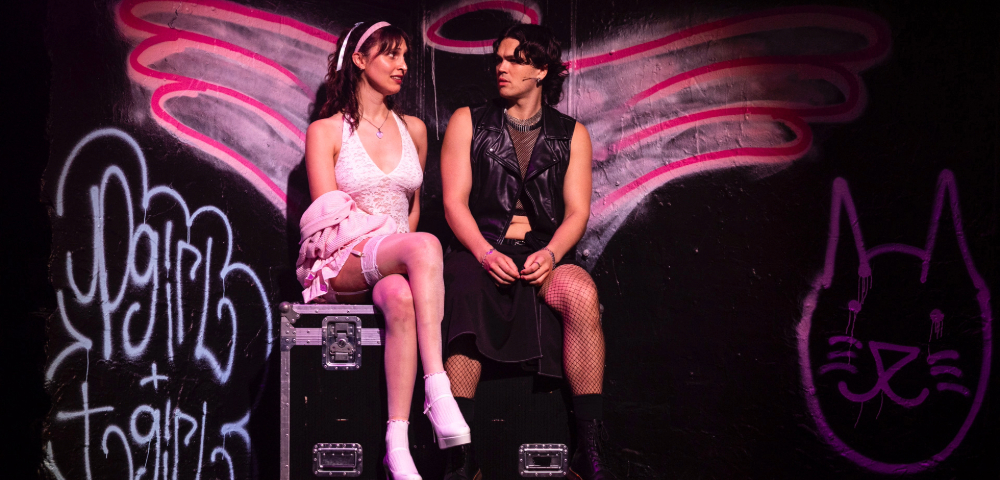
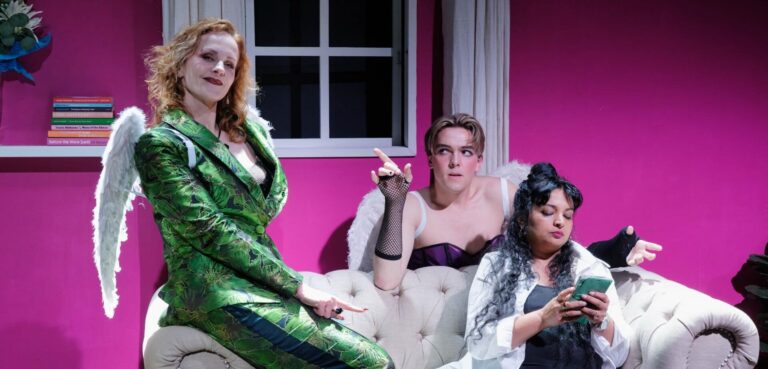
Image: Cassie Hamilton and Blake Appelqvist in 'A Transgender Woman On The Internet, Crying', playing at The Old Fitz Theatre. Source: Supplied / Credit: Brett Boardman.
A darkly funny queer hyperpop whirlwind exploring identity, performance and the ‘right kind of trans’ in an unapologetically online world, A Transgender Woman On The Internet, Crying is catchy and genuinely singular theatre that’s sharper than it first pretends to be.
Written and composed by Cassie Hamilton, who also stars, and directed by Jean Tong, this highly anticipated world premiere from Green Door Theatre arrives at The Old Fitz Theatre with a burst of overstimulation.
Set inside a hyper-online trans influencer ecosystem, the play follows trio of friends: Corrin Verbeck, a left-tube takedown queen, DJ Mouthfeel, a jaded transfemme DJ with a voice modulator that’s never addressed, and clout hungry would-be influencer Sasha.
Together, in a case of classic internet warfare, they sets their sights on Avis O’Hara, aka @theDIYDoll: a glossy hyperfeminine transmedical influencer ruled by her followers/Dollmakers on how to become their perfect trans woman—the ‘wrong kind of trans’ that even JK Rowling might just get on board with.
The plan is to fake a friendship, gather the receipts, and promptly cancel her, until Corrin begins to catch feelings, of course.
Yes, it’s tropey, it’s enemies to lovers, and damn if it isn’t a compellingly subversive ride for it.
The ensemble operates and commits as a genuine collective, each performer a magnetic and distinct triple threat, even if their costumes might say more than the script affords them.
Blake Appelqvist brings tightly controlled swagger and a quietly fracturing softness to Corrin. By contrast Hamilton’s ditzy Avis is charismatic and contradictory, constructed and oddly sincere all at the same time.
She’s someone you’re not supposed to root for and absolutely will, while you also can’t help but laugh at and feel bad for, and then laugh at again.
Their dynamic anchors the show, shifting convincingly from antagonism to intimacy without ever losing bite.
Teo Vergara injects chaotic energy as Sasha, constantly recalibrating her position inside the group, and landing beats with sharp timing that repeatedly resets the room when the show threatens to spill over its own intensity.
Rosie Rai brings a grounded emotional core to Mouthfeel, cutting through the overload and becoming one of the show’s most intriguing presences.
Tong’s direction holds it together with a deceptively light touch, grounding the chaos by trusting the messy energy.
The music is the driving engine, propulsive, playful and covering enormous ground without feeling repetitive.
From Grindr-triggered beats to cyber warfare anthems, to the disarmingly tender Falling in Love With Someone, the score carries electrifying humour and sincerity all at once.
Serving C*nt, a darkly playful techno number about bottom surgery also stands out, landing between gag and statement, capturing the show’s tongue-in-cheek edge.
Structurally, it rides a hyperpop aesthetic that suits its subject matter perfectly: saturated, overstimulated, emotionally spiky.
Songs hit with urgency, while Dan Ham’s choreography snaps between precision and jarring fragmentation.
In the intimacy of Ruby Jenkins’ graffiti-splashed set, the production feels almost invasive in the best way, like being inside a live feed you can’t mute, while Em-Jay Dwyer‘s sound design, all FaceTime calls and notification sounds, echoes a world that feels permanently mid-scroll.
The dialogue, steeped in terminally online references, moves at a relentless pace, often to its own detriment, as emotional detail and even jokes tend to blur, with music sometimes overpowering.
The overload does feel intentional in a world of constant competing noise, but it does mean clarity slips, while the hilarious slew of quips keeps things alive and specific, if not at risk of aging in real time.
But these are the growing pains of a show still finding the ceiling of what it can and should do.
At its best, the show captures the crushing anxiety of being online and queer: the way identity becomes armour, performance as survival, and how quickly ideological certainty can dissolve when real people enter the frame.
It keeps circling the idea of the right kind of trans only to dismantle it in real time, leaving something looser and far more honest (if not a bit cheesy): the freedom to be contradictory, vulnerable, annoying and sincere all at once, and still be held.
And crucially it’s joyful, not in a neat resolved way but in the way queer spaces actually are, or at least should be, loud and messy, full of feeling and deeply affirming.
Tumblr-coded, transportive, and possibly a future cult classic for queer teens, A Transgender Woman On The Internet, Crying is a surprisingly comforting laugh-out-loud banger of a love letter to trans joy, community and the validation that was right beside you the whole time.
A Transgender Woman On The Internet, Crying is playing till 11 April at The Old Fitz Theatre.

Support the Star Observer… while you still can
LGBTQIA+ media is under threat. Queer content is censored by tech conglomerates who amplify bigotry and push out AI slop — so we receive less financial support than ever.
When our community is muzzled and intolerance intensifies, we need queer media more than ever. Your donation means we can continue paying queer journalists to write queer news.
Don’t rely on the straight lies of big tech – support Star Observer instead and donate now.