
Meet The Polyamorous Bookbinder Bringing His “Flehr” To The Ancestral Craft
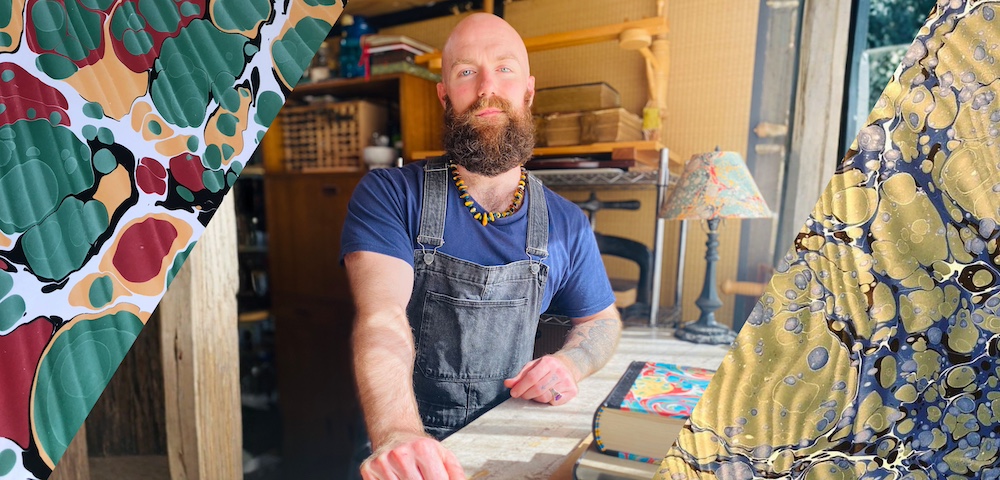
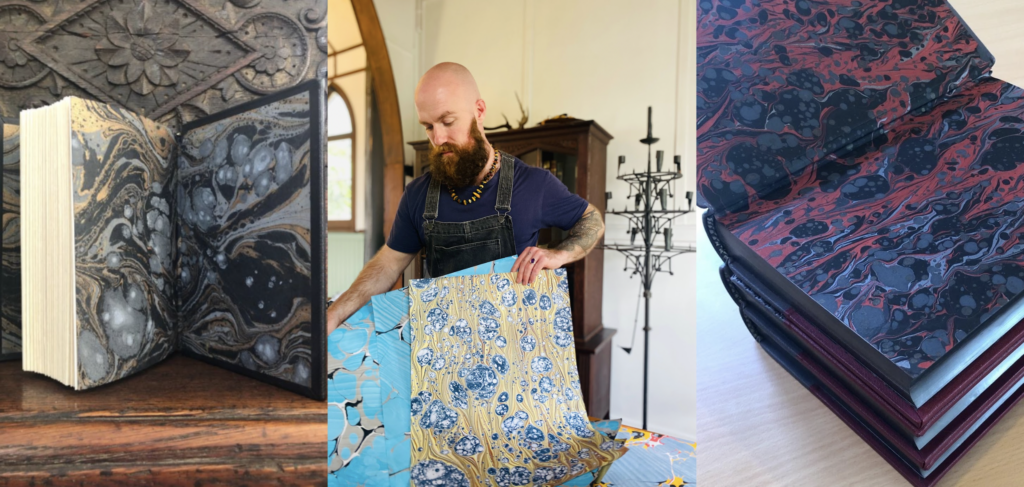
Image: Robert Flehr in his studio, with custom marbled papers framing the image on the left and right. Supplied
Robert Flehr is many things. Among them, a bookbinder, leatherworker, paper marbler, calligrapher, plant daddy, herbalist, amateur bodybuilder, former contemporary dancer, collector of amber, and father to two delightful rescue tabby cats, ‘MaMa’ and ‘Oot’. He also makes a to-die-for Moroccan spiced chicken.
“My dear friend,” Rob mused, “whenever she introduces me, even in professional contexts, she’s like ‘this is Rob, he’s an amazing bookbinder, alchemist, he makes his own dyes and inks and paints and all of that kind of thing.’”
The more exacting question might ask what Rob isn’t known for.
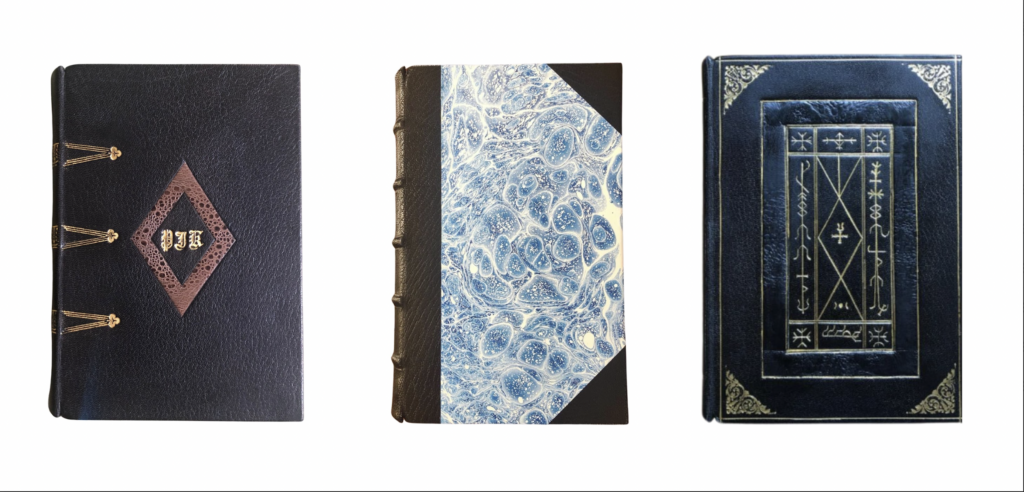
That said, one thing is for certain: being “into leather” is a claim this man can back up. From his home studio in the Huon Valley in the heart of Tasmania’s apple country, Rob creates beautiful artworks of leather, paper, gold, dye, and paint – the word “book” doesn’t even begin to describe them.
“[Bookbinding] was originally in my family,” Rob explained. “My Pop’s uncle was a vellum binder, and I was fortunate to grow up with some of the books that were made by him and that paired with my love of fantasy inspired me to start making my own.”
Self-taught, Rob credits a host of video tutorials and instructional books for helping him realise his passion for bookbinding.
“I made my first proper book when I was around 15,” Rob said. “And then they progressively got more sophisticated as I increased my skills.”
Though Rob’s bookbinding experiments began in his teenage years, it was the COVID-19 pandemic that gave him the extra push to turn his passion into the modish business it is today.
“I was stuck at home,” Rob recalled, “and I had all these materials that I’d been collecting for years with nothing but time on my hands, so that’s when I started producing really polished books, and started to refine my bookbinding practice.”
Jack of all trades
Despite Rob’s persistence that he will always be a mere student of the tradition, his unique “Flehr” for the craft has not escaped recognition. Today, Rob has produced books for high end galleries and museums (including the MONA shop), created marbled paper inventories for the Artery store in Hobart, and his restoration talents have been commissioned by antiquarian book collectors.
Though Rob rejects claims he has attained any kind of bookbinding “mastery”, there is a commission he credits with helping him feel some pride in his talents.
“It was a full leather binding with gilt edges, toad skin inlay, and custom gold tooling,” Rob reminisced. “When I finally managed to do an entire solid gold edge – full gilt edges are a fiddly and difficult process – I was very proud of myself.”
The client, sharing this delight, was quick to commission a second book.
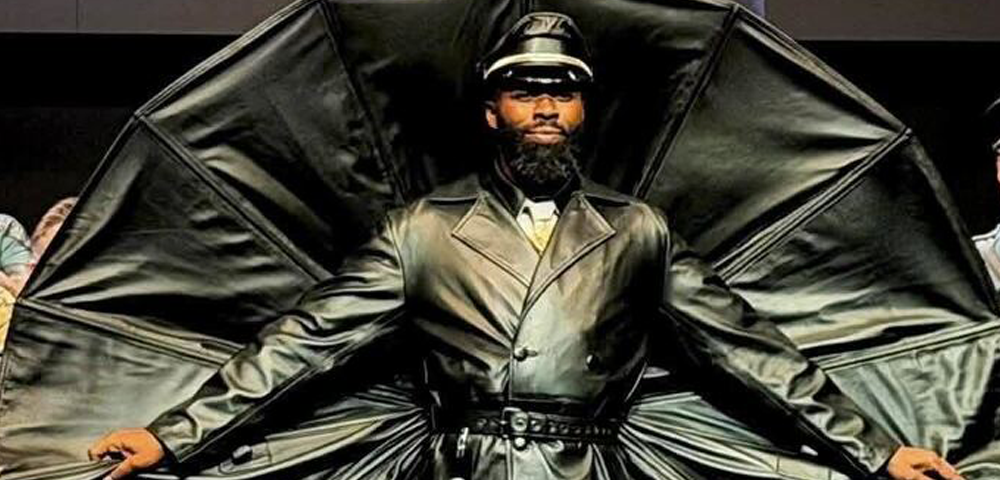
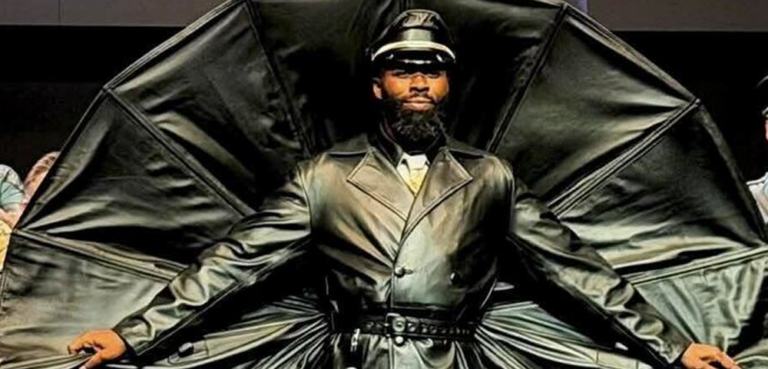
While Rob’s commissions consist mostly of custom journals, sketchbooks, albums, business logbooks, esoteric grimoires, and book restorations, the scope of his practice is much broader. He has created leather masks, leather accessories and partywares, and his marbled paper has been known to grace anything from lampshades to interior home wallpapers.
View this post on Instagram
Perhaps the reason Rob has cultivated so many talents is because bookbinding is not a single profession.
“You’re doing the marbling yourself,” Rob explained. “You’re preparing the paper, you’re sewing the book together, you’re preparing the leather, you’re doing the gold tooling and edge gilding.
“All of these things would once have been held as separate positions. So when it comes to commissions, what you can individually accomplish is quite extensive because you’ve developed all of these other skills.”
One such skill, paper marbling, involves making a bath solution from the seaweed extract, carrageenan. Due to the thickness of the solution, paints can be applied to the surface of the water, which in turn can be layered, needled, and raked to create unique patterns.
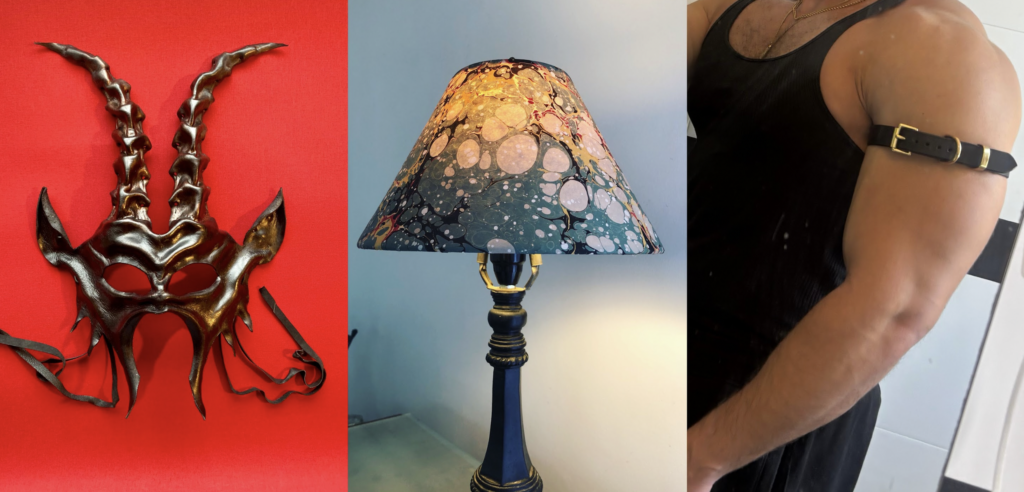
“So what you’re looking at when you look at marbled paper is actually the surface of a liquid, a surface that has been transferred to the paper.”
But perhaps the more interesting revelation is how Rob’s contemporary dance background has informed his approach to marbling:
“You need to do it quite quickly,” Rob explained, “and to apply the droplets of colour consistently, I find playing some kind of good percussive music that I can get a groove to helps. In other parts of it, the rhythm in removing the paper is actually really important to create certain effects, like in the case of a Spanish ripple or Moiré paper. Being able to involve rhythm and music – usually 70s disco or some kind of samba – I find quite enjoyable.”
View this post on Instagram
Preserving tradition
When asked what inspires him most in his practice, Rob had no shortage of answers. Among them, the honour of book restoration.
“I think it’s quite a privilege to repair a book that’s been really precious to someone, especially if that book has been in their family for a long time. Often you’ll come across things pressed in pages, notes, bits of hair – you know – little memento moris. I think there is a gravity to it – a reverence that the process requires.
“Other times, pages are filled with [a client’s] family history. Before the repair, these pages are often being held together by sticky tape, and some of them are quite difficult to read. But after the process of cleaning the paper and removing the tape and stabilising the paper, a lot of that information becomes legible. And that is quite impactful, because it’s bits of information that they previously wouldn’t have had. And now they can pass it on to future generations and it’s not going to disintegrate.”
While the appeal of restoring a family heirloom is apparent, Rob highlights that all old books were once new, and commissioning a new book is where the process of creating a treasured heirloom often starts.
View this post on Instagram
“A bound book is for anyone wanting to preserve special information,” Rob said. “Things like art, journal entries, photographs, documents, recipes, visitor logs, guest books, entries from family and friends. It’s for anyone that wants to record thoughts, feelings, ideas, or precious moments with the people that are special to them.
“For an inanimate object, there’s a lot of potential community involvement in a book. That’s a beautiful thing to give someone, or to participate in.”
Rob also points out that a book’s beauty is not just visual.
“I like emphasising the kinaesthetic appeal of a bound book,” Rob said. “You know, it’s how the leather smells, how the paper feels. It contains the handwriting of the people who came before, more personalised parts of history and practice. There’s a warmth to a well-used book, I think, that you just can’t get through a screen.”
To commission Rob or find out more about his work, email rflehrbindery@gmail.com, or message him via his Instagram page.
Support the Star Observer… while you still can
LGBTQIA+ media is under threat. Queer content is censored by tech conglomerates who amplify bigotry and push out AI slop — so we receive less financial support than ever.
When our community is muzzled and intolerance intensifies, we need queer media more than ever. Your donation means we can continue paying queer journalists to write queer news.
Don’t rely on the straight lies of big tech – support Star Observer instead and donate now.