
Sir Ian McKellen Leads Protest Against Anti-LGBTQIA+ Laws Across The Commonwealth

Sir Ian McKellen Leads Protest Against Anti-LGBTQIA+ Laws Across The Commonwealth
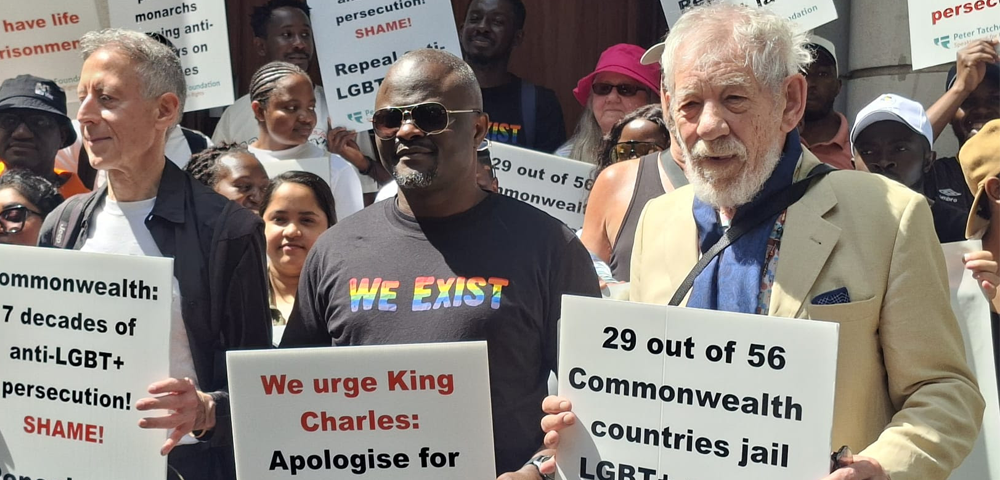
Image: Image: The Peter Tatchell Foundation
Sir Ian McKellen has joined activists and LGBTQIA+ refugees in London to protest the continued criminalisation of LGBTQIA+ people across much of the Commonwealth.

The veteran actor and long time equality advocate launched the “Commonwealth Walk of Shame” on May 30 outside the Nigerian High Commission.

The demonstration highlighted the ongoing impact of colonial era anti-LGBTQIA+ laws that remain in force in 29 Commonwealth member nations.

Sir Ian McKellen joins activists demanding Commonwealth action

Organised by The Peter Tatchell Foundation alongside Out and Proud Africa LGBTI, Let Voice be Heard Bangladesh, Gay Indian Network and the African Equality Foundation, the march targeted eight Commonwealth High Commissions in London representing countries that continue to criminalise same sex relationships.

Among them were Nigeria, Uganda, Papua New Guinea, Trinidad and Tobago, Ghana, Jamaica, Bangladesh and Sri Lanka.

Campaigners say many of the laws used to target LGBTQIA+ people were originally imposed during British colonial rule and remain in place decades after independence. According to organisers, six Commonwealth countries still allow life imprisonment for same sex relations, while Uganda, Brunei and some northern Nigerian states can impose the death penalty.

The Commonwealth comprises 56 member nations representing around one third of the world’s population. Human rights groups have long criticised the organisation for failing to address anti-LGBTQIA+ laws despite commitments to equality and non discrimination contained within the Commonwealth Charter.

Many participants in the march were LGBTQIA+ refugees who had fled persecution in Commonwealth nations.

Speaking at the launch of the protest, Sir Ian McKellen said:

“No one should face prison, violence or death simply for being themselves and loving another person. Yet across most of the Commonwealth, LGBT+ people are still treated as criminals.”

“Many of these laws are relics of the British Empire. The least we in Britain can do is stand in solidarity with those fighting to overturn criminalisation. I am proud to support this march and the brave activists leading the struggle for LGBT+ equality.”

Deborah Birunji Nabisere, a Ugandan lesbian who fled persecution, told the crowd:

“I know what it means to live under laws designed to erase your humanity. We are marching because silence has protected persecution for far too long. Commonwealth leaders cannot celebrate unity while millions of LGBT+ citizens live in fear.”

“For many LGBT+ people across Africa and the Commonwealth, these laws are not abstract. They shape every part of daily life: whether you can speak openly, whether you can find work, whether you are safe walking home.”

Human rights campaigner Peter Tatchell also called on new Commonwealth Secretary-General Shirley Ayorkor Botchwey to prioritise LGBTQIA+ rights.

“For decades, Commonwealth leaders have failed to end the persecution of LGBT+ people. We urge the new Commonwealth Secretary-General, Shirley Ayorkor Botchwey of Ghana, to begin her tenure by making clear that anti-LGBT+ victimisation is incompatible with Commonwealth values.”

“Twenty-nine Commonwealth countries still criminalise homosexuality, mostly under British colonial-era laws, in direct violation of the Commonwealth Charter’s commitment to equality and non-discrimination. Across the Commonwealth, millions of LGBT+ people continue to face arrest, imprisonment, violence and discrimination in employment, housing, education and healthcare.”

Leave a Reply

Your email address will not be published. Required fields are marked *