


LGBTQIA+ Orgs Demand Action After Inquiry Finds Right-Wing Extremism Is Targeting Us
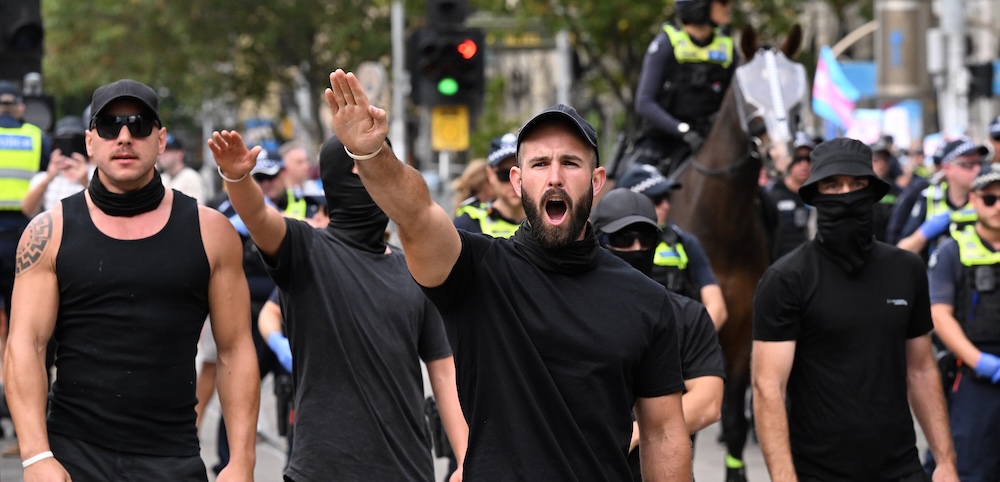
Image: AAP Image/James Ross
LGBTQIA+ organisations are calling for urgent action after a major New South Wales parliamentary inquiry confirmed what many in the community have already known for a long, long time – that right-wing extremism is active, organised, and increasingly targeting and harming queer people.
The Measures to combat right-wing extremism in New South Wales report, handed down this week, found that LGBTQIA+ people are among the communities most directly impacted by extremist hate, alongside Jewish communities, women and other minority groups.
The report outlines a growing and coordinated threat, rooted in ideologies including homophobia and transphobia, and fuelled by both offline networks and online radicalisation pipelines.
Equality Australia has welcomed the findings, particularly the recognition that LGBTQIA+ people are being deliberately targeted.
“Importantly, the inquiry makes clear that LGBTIQ+ people are deliberately targeted within extremist narratives that seek to normalise hate in public discourse,” said Equality Australia CEO Anna Brown.
The report itself reinforces this, finding that right-wing extremism “poses a threat to all NSW communities” but has a particular impact on marginalised groups, including LGBTQIA+ people.
It also makes clear that this hate is not happening in isolation,, extremist groups are actively working to spread and normalise prejudice, often through online platforms where disinformation and propaganda can be massively amplified.
“It also recognises that addressing extremism requires more than law enforcement — it must include action on the social drivers that enable it,” Brown said. “These recommendations reflect a clear understanding that hate and extremism are driven by broader systems of discrimination and exclusion. They must now be implemented in full.”
While it acknowledges the role of policing and legislation, it puts a really strong emphasis on prevention, community response, and addressing the conditions that allow extremism to grow.
“We were pleased to see our submissions reflected in the report, and LGBTIQ+ people explicitly recognised among communities targeted by hate and extremism,” Brown said.
“This is an important acknowledgement of the scale and impact of anti-LGBTIQ+ hate within broader extremist activity in NSW.”
The report details how extremist groups use intimidation, harassment and public stunts to instil fear, including targeting LGBTQIA+ events and spaces. It also notes that this behaviour contributes to an environment where queer people and their families feel unsafe participating in public life.
For Brown, the findings should now translate into concrete action.
“The NSW Government must act to ensure that LGBTIQ+ people and other targeted communities are safer, better supported and no longer exposed to preventable harm,” she said.
The ‘combatting right-wing extremism’ report recommendations
The inquiry argues that tackling right-wing extremism requires both immediate protections and long-term change
Key recommendations include:
Better reporting and tracking of hate crimes
The report recommends funding community-based reporting services for hate crimes experienced by LGBTQIA+ people and other targeted groups. This is designed to make it easier for people to report incidents safely and ensure data reflects the true scale of harm – something advocates have long said is underreported.
Early intervention and prevention programs
A major focus is on stopping radicalisation before it escalates. The report calls for investment in prevention programs co-designed with affected communities, recognising that those most impacted by hate are best placed to shape solutions.
Support for people at risk of radicalisation
The inquiry recommends expanding disengagement and support services for individuals being drawn into extremist networks. This includes programs that offer pathways out of extremism, particularly for young people who may be recruited online.
Cracking down on online hate and algorithms
The report identifies social media as a key driver of radicalisation, noting that algorithms can amplify extremist content and normalise hate. It recommends stronger efforts to remove harmful content and address how platforms promote it.
Education that tackles homophobia and transphobia
School-based programs are also a priority, with recommendations to expand education that directly addresses discrimination – including homophobia and transphobia – alongside racism, misogyny and other forms of prejudice.
Support for regional communities
Recognising that extremism is not limited to metropolitan areas, the report calls for expanded, coordinated prevention efforts in regional and rural NSW, where access to support services can be more limited.
“This is not an issue that affects only one community. When hate goes unchecked, it undermines safety, cohesion and trust for everyone,” said Brown.
Support the Star Observer… while you still can
LGBTQIA+ media is under threat. Queer content is censored by tech conglomerates who amplify bigotry and push out AI slop — so we receive less financial support than ever.
When our community is muzzled and intolerance intensifies, we need queer media more than ever. Your donation means we can continue paying queer journalists to write queer news.
Don’t rely on the straight lies of big tech – support Star Observer instead and donate now.



Robert, I sympathise with your sentiments. But unfortunately none of this can happen. In sending photos to the media, there is a good chance you could face legal liability for doing so. As for the police, including the Federal Police, they don’t care. There have been examples in NSW and Vic in which the police have allowed neo-Nazi presence. As for the Federal Police, their role will be in policing now-proscribed groups. Since the neo-Nazi groups disbanded in anticipation of the new laws, it will be harder to monitor them.
As for Equality Australia (mentioned several times in this article) – in my opinion, they have a poor track record on hate speech. I wrote to them about anti-vilification laws a few times about 3yrs before they supported them. They never even acknowledged my emails or responded to them.
After the appearance of neo-Nazis in Melbourne, they did nothing to seek to punish police for their inaction and refusal to utilise existing laws against the neo-Nazis. Those men not only vilified trans women, but called for their mass-murder. I believe EA responded by continuing to lobby for anti-vilification laws in Victoria. But they did nothing to address the wrong that had occurred – even though there were existing laws to deal with it.
I don’t have much hope for the NSW report. From what I recall, anti-vilification laws in NSW are outdated, not-inclusive, and too high threshold. Perhaps Minns might endorse the Report, bc it seems to recommend ‘low-hanging fruit’. However, he has a singular obsession with silencing pro-Palestinian efforts, which he clearly, and wrongly, regards as hateful.
The thing that really gets me about these neo-Nazi thugs is their blatant Cowardice. Almost without exception they hide their faces behind balaclavas, masks and dark glasses and do everything that can to remain anonymous. Maybe its now time for members of our communities to quietly follow these louts after their marches and watch until they remove those covers, photograph them and publish on social media, send copies to the newspapers such as The SMH, Fin Review, The Guardian, The Age, The Adelaide Advertiser, the Police across Australia including the Federal Police and put them up around the cities, towns, suburbs, on notice boards in Shopping Centres, Laundromats etc.. Until they are exposed they will continue their Campaigns of Hate.