


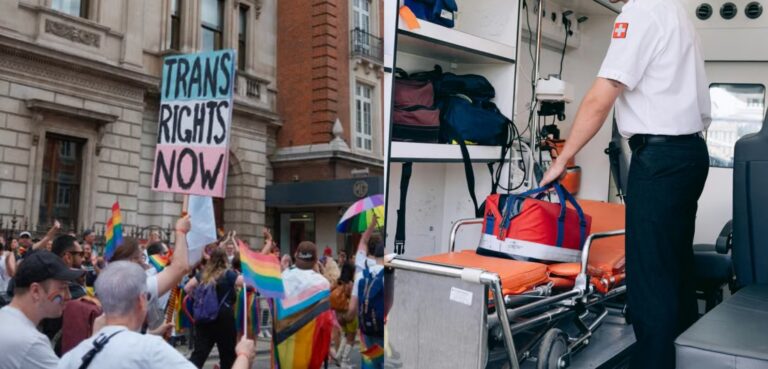

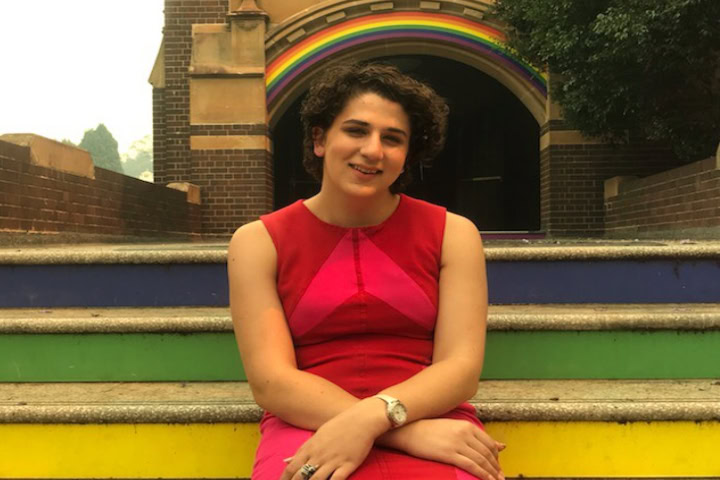
Image: Image: Gold Coast Pride Collective
I come to you first as a student of social work, an ex-swimmer who once wore the green and gold, a daughter to two wonderful parents, an auntie to four nieces and nephews I adore.
I live the same ordinary life as everybody else. I go to lectures. I show up for my family. I get tired, I get hungry, I fall asleep in front of the television more often than I’d like to admit. And at some point, without my consent and without a single conversation with me, my life became debatable. My existence became a question mark. Not because of anything I’ve done. Not because I’m bad. Just because of who I am. My everyday experience became something for strangers to print their feelings about, week after week, in newspapers I never asked to be featured in.
When you read a headline about a trans person, what is it actually asking you to believe? Not what it says on the surface; that’s rarely the real question. What it implies underneath the words. Am I a real person, or am I a threat?
Someone’s daughter, someone’s sister, someone building a life, or a problem to be managed, a debate to be had, a line drawn somewhere just short of where I’m standing.
I won’t answer that for you. I want it to sit there, uncomfortable, the way it sits with me every time I step outside my front door.
This isn’t a feeling I’ve conjured out of thin air. It’s a documented decade, a pattern with a paper trail, and I’m going to show you exactly where it lives.
Start in 2016. Researchers behind the Translating Transphobia study worked through 6,896 articles, over eight million words of Australian print and online media, and found significant negative bias in how transgender people were covered. Not occasional negativity. A structural skew, identified by people whose job was to read the data without an agenda either way. Three years later, a separate analysis of The Australian alone found more than ninety percent of its coverage of trans people was negatively framed. Nine articles in ten, built to make you afraid of me, or angry at me, or suspicious of me, before you’d ever met me.
It wasn’t spread evenly, either. An investigation covering 2019 and 2020 found that just three outlets, The Australian, the Herald Sun, and the Daily Telegraph, produced roughly half of all Australian coverage of trans people: 1,319 articles in two years, overwhelmingly negative. That isn’t journalism responding to public interest. That’s three newsrooms manufacturing it.
It hasn’t slowed. It has accelerated. Tracking in 2026 shows Australian media now publishing on trans people at a rate of around sixteen stories a week. Sixteen. Every week. About my body, my healthcare, my right to exist in public, whether I asked for the coverage or not. The Australian Human Rights Commission’s own 2026 reporting notes a rising trend of media using and repeating dehumanising language toward trans and gender diverse people, language the Commission itself states may be sustaining and normalising prejudicial attitudes across the wider population. That isn’t an activist’s claim. That’s the nation’s own human rights body, saying it plainly.
This has been tested, formally, by the very bodies whose job it is to hold the press to account, and it has failed those tests. The Australian Press Council upheld a complaint against The Australian for breaching its own standards of fairness and accuracy in its transgender coverage, a complaint that ran to forty-two pages before the Council agreed the paper had got it wrong. A United Nations expert has publicly criticised the state of anti-trans coverage in this country, on the international record. The Press Council did release an advisory guideline in 2023 for reporting on people with diverse sexual orientation, gender identity and sex characteristics. But it’s advisory. Non-binding. A polite suggestion an outlet can read, nod at, and ignore entirely, with no consequence for doing so.
So when someone tells me I’m too sensitive, that I’m imagining a pattern that isn’t there, I want them to sit with the actual numbers. Six thousand eight hundred and ninety-six articles. Ninety percent negative in a single major masthead. Three outlets producing half the national coverage. Sixteen stories a week and rising. A formally upheld breach complaint. A UN expert on the record. This isn’t a feeling. It’s a decade of data, and it was building long before I ever noticed it happening to me specifically.
Numbers are easy to skim. So slow down on that one for a second. A decade. Before I ever felt it, it was already being written.
None of this is abstract. Every manufactured debate, every cycle of coverage, every “concern” dressed up as public interest, has a real person attached to the other end of it. A body. A life. Someone standing in a room somewhere, having to explain, again, why they deserve to exist without a caveat. I know that room intimately, because I stand in it constantly.
On an innocuous evening, one of many, I find myself defending rights that are already legally protected in this state and this country. Not new rights. Rights I already have, on paper, settled, decided. And no one in the room engages with that fact. Instead it gets dressed up as a safety concern, dressed up as discomfort, someone’s discomfort, always someone else’s, never mine. I stand in front of committees and community meetings and strangers with strong opinions just to protect my right to access public space the way everyone else already does, without a second thought. And the toll doesn’t stop with me. It gets recycled. It lands on every trans person who hears about it secondhand, who reads the report the next morning, who walks into their own version of that room a week later. It takes something out of every interaction we have to navigate, every day, with everyone else.
These questions were never actually open. Most were settled in law years, sometimes decades, ago. What’s happening instead is media manufacturing doubt where none legally exists, reopening a case that was already closed, over and over, because there’s something to be gained from keeping it open.
Nothing this persistent, this well-funded, this repetitive, happens by accident. Three groups benefit from keeping it alive, and none of them are the women or children the coverage claims to protect.
The first is media itself. Outrage-framed content drives dramatically higher engagement than calm, informational coverage, and under an advertising model built on attention, engagement is revenue. Anger holds a reader’s eye longer than reassurance does. Algorithms amplify whatever provokes the strongest reaction, which means the angrier a story makes you, the further it travels, and the more money it makes for the outlet that ran it. My existence, reduced to a growth strategy.
The second is politicians. There is a well-documented pattern in Australian politics of using anti-trans and “gender ideology” rhetoric as an electoral wedge, running from the Howard government through to today, mobilising socially conservative voters regardless of the actual scale of whatever “issue” is being raised. Trans participation in sport gets raised again and again with real urgency in press conferences and parliamentary speeches, despite affecting under one percent of sportspeople in this country, despite major sporting bodies already running inclusive policy frameworks. The urgency was never about sport. It’s about what the topic does for a campaign.
The third is structural distraction. While attention is fixed on me, on us, on whatever manufactured panic is running that month, it is not fixed on housing, on wages, on the resources tax that could genuinely change people’s lives. Trans people become the scapegoat, cheap and endlessly renewable, while the material questions that would cost someone real political capital go quietly unaddressed.
And underneath all of it, three separate things are happening at once. Set them side by side and the whole design gives itself away.
The first is settled protections attacked anyway, purely to keep the outrage cycle turning. Whether I can access a bathroom. Whether I can hold a passport or licence that reflects who I am. Passports have permitted gender marker changes since 2011. The federal Sex Discrimination Act added gender identity as a protected attribute in 2013. Victorian law has allowed self-nominated sex descriptors on birth certificates since 2020. None of that is new. None of it is contested in any courtroom. And yet it gets dragged back into headlines as though it were a live, terrifying question, because reopening a settled matter is easier content than reporting on one that’s actually still moving.
The second is exemptions that already exist, which media pressure keeps working to widen further. Sport is the clearest example. An exemption already sits in seven of eight states and territories, and federally, covering an issue that affects under one percent of sportspeople. That isn’t enough for the coverage cycle. It gets dragged out again and again, not to defend something under threat, but to erode ground already carved away. Superannuation carries the same exemption, the same pressure to widen it rather than question why it exists at all. This isn’t protection under attack while it stays where it is. It’s already-diminished ground, pushed back further, every cycle.
The third is exemptions that simply sit there, doing damage, completely unexamined. This is the part that gets no airtime at all. Sections 37 and 38 of the Sex Discrimination Act let religious bodies, including hospitals, aged care providers, schools and shelters, lawfully discriminate in who they employ and serve. More than fifty-six percent of trans Australians report healthcare discrimination, and that figure exists because the law allows it to exist. I can be turned away from care I need, not for anything about my health, but because of an organisation’s religious opinion. That isn’t a loophole. That’s the law, working exactly as written. The same structure sits underneath employment, where thirty-three percent report discrimination and unemployment sits near nineteen percent, three times the national rate, and beneath education, where trans students remain largely invisible in curriculum material despite policy stating otherwise, while religious schools retain a lawful carve-out to hold a lesser standard. Not one headline. Not one urgent panel discussion. The energy never flows toward the exemptions actually causing harm, because there’s no outrage cycle to be built from closing a loophole nobody’s been told to be angry about.
This is where the real cost lands, in custody and in housing, the places where everything converges. Gendered custodial settings carry documented safety risk for trans people. Trans Australians face markedly higher rates of homelessness, including documented rejection from women’s shelters and share houses, for being trans, not for anything they’ve done. These aren’t separate problems. They’re what happens when settled protections get attacked instead of defended, when existing exemptions get pushed wider instead of questioned, and when the exemptions doing the most damage are never examined at all.
The things that are genuinely fine get treated as controversial. The things already compromised get pushed further open. The things actually causing harm get left completely alone, because there’s no profit in fixing them. That imbalance is no accident. It tells you exactly what this coverage was built to protect, and it was never trans people.
That is the whole mechanism. Not confusion, not a genuine debate that hasn’t quite resolved. A manufactured cycle, kept spinning because three groups profit from its spinning, at the expense of every trans person out there right now, battling harder than most people just to exist, in every room, not only the ones with a microphone in it. And every one of these manufactured debates has a body attached to it. Mine, more than once.
I don’t tell this next part often. But you should hear it, because it’s the thing all those numbers actually mean.
I have been assaulted in bathrooms. It wasn’t inside where it happened. It was on the way out, from someone who had already decided, before I said a word, that the bathroom wasn’t mine to use. It was never about their safety. It was about what they’d read that week, and the certainty that gave them. I never reported it. I know exactly what I would have been told: that it’s a safety concern, that I need to think of the other side, that a stranger’s discomfort matters more than what happened to my body. If it had made the media, I know exactly who would have been vilified in the retelling. Not them. Me. So I made a conscious decision to stay silent, to go uncounted, because the cost of speaking would have been greater than the cost of staying quiet, and I couldn’t afford to pay it twice.
This isn’t only my experience. It happens constantly to trans people across this country, and almost none of it is counted anywhere. It doesn’t have to be physical to leave a mark. It can be a young nonbinary kid, barely out, pulled aside in a shopping centre bathroom by a security guard misreading a policy through a lens built entirely out of headlines he’s absorbed without ever noticing. This happens at every stage of life, in every kind of public space, and it happens at this scale for a reason.
What happened to me wasn’t the beginning of anything. It was one step on a pathway, and every step of that pathway is documented. It starts with media hostility. A 2022 study in JAMA Network Open, by Pang, Hoq and Steensma, found a direct link between negative media coverage events on trans healthcare and measurably reduced healthcare access for trans children and adolescents in the real world that followed. Not a cautious correlation. A direct, event-linked drop, tracked against the coverage itself.
Withheld healthcare doesn’t stay contained. It becomes mental health decline, and minority stress research consistently links that chronic stress, the stress of living under sustained public hostility, to depression and suicidality. It compounds into social withdrawal too. Research on trans Australians in relationships found that secrecy driven by stigma, the pressure to hide, to stay invisible, to keep a life private for safety, measurably corrodes wellbeing, not just for the trans person but for everyone who loves them.
Then the financial cost. Thirty-three percent report workplace discrimination. Unemployment sits near nineteen percent, three times the national rate. Trans and gender diverse Australians work fewer hours on average and are concentrated away from stable, well-paid industries, not for lack of ability, but because of who is willing to hire them. For every person pushed out of work entirely, there’s someone else who refuses to be pushed out, who works twice as hard to hold a job a cisgender colleague would never have had to fight for in the first place. That extra effort never shows up on a payslip. It doesn’t disappear from the body carrying it.
And at the furthest point of this pathway sits the outcome we don’t like to say plainly. National trans health survey data shows a lifetime suicide attempt rate of around forty-three percent among Australian trans adults. The Australian Institute of Health and Welfare confirms disproportionately high rates of suicidal ideation and attempts within this population. This is not framed, by the people who study it, as something inherent to being trans. It is framed explicitly as a manifestation of discrimination, stigma, and barriers to healthcare, stacked until some people cannot carry the weight any further.
I need you to sit in that number for a moment, because it isn’t a number to me. I have stood at the furthest edge of that road myself. I know how quietly it opens under your feet, how reasonable it can start to sound, how close a person can come before anyone around them has any idea. I am still here. Not everyone who reaches that edge is.
But death isn’t the only cost worth naming, and treating it as the only measure erases something just as serious. A life lived in hiding, shrunk down to fit inside what feels survivable, is its own devastating outcome, whether or not it ends in a coroner’s report. Someone who stops leaving the house. Someone who stops applying for the job they’re qualified for. Someone who stays in a relationship that requires secrecy because visibility feels like too great a risk. None of those people show up in a suicide statistic. All of them have still lost something enormous.
And even where death is the outcome, we don’t see it clearly.
The Coroners Court of Victoria has explicitly acknowledged its own LGBTIQ+ suicide data is likely an undercount, stating plainly that it is often difficult to identify LGBTIQ+ people among the deaths it investigates in the first place. Peer-reviewed analysis of Queensland’s own suicide register confirms the same pattern nationally: gender identity and sexual orientation are seldom recorded at the point of death at all. Even at the most extreme outcome this pathway can produce, the system fails to see us clearly. We are undercounted in life, and undercounted in death, and both of those are choices, made by systems that could count us properly and simply don’t.
So let me ask you something, and I want you to actually answer it, not just read past it.
What if it’s your child who is trans?
What if it’s your brother, or your sister?
What if it’s the person you’ve built a life alongside, the one you’d walk through fire for without a second thought.
This may not touch you directly, not yet. But it will touch somebody you already love, whether you know it about them yet or not.
Don’t wait until it’s your child, your brother, your sister, your partner, sitting across from you carrying this exact pain, before you decide it’s worth fighting for. Don’t let someone you love become the price of your attention.
You don’t need it to be personal for it to be worthy of your outrage.
Care now, before the cost has a face you recognise.
So here is what you can actually do, starting today, and it maps directly onto everyone who profits from keeping this going. Stop feeding the machine. Every subscription, every click, every share, even the angry one, even the one where you clicked only to argue in the comments, is revenue for outlets that have built a business model out of my existence being treated as a controversy. The click is the product. Withdraw it. And vote accordingly. Don’t reward politicians who reach for this as a wedge, who treat people like me as a convenient distraction from the things that would actually cost them something to fix.
But the most important thing I can ask of you is also the hardest, because it will cost you something, and that is exactly the point. I pay a social cost every single day just to walk through the world. A small tax on every room I enter, every form I fill in, every stranger who decides who I am before I’ve spoken. I am asking you to pay a fraction of it, so I am not carrying all of it alone. Speak up when you hear it happen, at the dinner table, in the comments section you were about to scroll past. Ask one question: where did you read that, and who benefits from you believing it? And when it happens inside your own organisation, when there’s a risk assessment that quietly frames people like me as a hazard, a policy that singles us out, a clause nobody has ever questioned because questioning it is awkward and expensive and easier to leave alone, be the one who asks why. Most harm done to us isn’t loud. It isn’t a slur shouted in the street. It’s a line in a document that no one wanted to be the person to challenge. Be that person. Say something in the rooms I’m not in, the rooms where you have a voice and I have none. Pay a little of the cost I pay every day, just help me carry it. That is what changes things. Not sympathy. Someone choosing to bear a little of the weight who never had to pick it up at all.
I stayed silent for a long time, and I understand exactly why.
But I am not asking you to stay silent with me.
I am asking you to be loud where I couldn’t afford to be.
Not because it’s inevitable that this will one day touch someone you love.
Because it is already touching someone I love, someone you might love too, and none of us should need that proximity before we decide we’re willing to stand up.
Sources: Ansara (2016), Translating Transphobia in the Media, ACON/Rainbow Rights Watch; analysis of The Australian’s transgender coverage (2019); investigation of Australian trans media coverage volume and framing (2019–2020); Australian Human Rights Commission (2026); Australian Press Council complaint outcomes regarding The Australian’s transgender reporting; Australian Press Council Advisory Guideline on reporting on people with diverse sexual orientation, gender identity and sex characteristics (2023); research on outrage-driven engagement and algorithmic amplification in digital media; Australian political science research on anti-trans and “gender ideology” rhetoric as electoral strategy, Howard government to present; Passports Act and DFAT gender marker policy (2011); Sex Discrimination Act 1984 (Cth), including ss.37–38; Births, Deaths and Marriages Registration Amendment Act 2019 (Vic); PLOS One cohort study on TGD Australians’ employment (2026); state and federal sport and superannuation exemption provisions, e.g. NSW Anti-Discrimination Act ss.38P–38Q; Australian Human Rights Commission, Equal Identities report (2026); Queensland scoping review on TGD student visibility in curriculum (2026); Pang, Hoq & Steensma (2022), ‘Association Between Media Coverage and Health Care Use Among Transgender and Gender-Diverse Youth’, JAMA Network Open; minority stress systematic review and meta-analysis literature; Schuler et al. (2025), Frontiers in Global Women’s Health; Gamarel et al. (2019); national trans health survey data on lifetime suicide attempt rates; Australian Institute of Health and Welfare; Coroners Court of Victoria, LGBTIQ+ suicide data acknowledgement; peer-reviewed analysis of the Queensland Suicide Register.


Support the Star Observer… while you still can
LGBTQIA+ media is under threat. Queer content is censored by tech conglomerates who amplify bigotry and push out AI slop — so we receive less financial support than ever.
When our community is muzzled and intolerance intensifies, we need queer media more than ever. Your donation means we can continue paying queer journalists to write queer news.
Don’t rely on the straight lies of big tech – support Star Observer instead and donate now.





Great article Dylan, thank you.
We should not be surprised by the right wing agenda pushed by The Australian and others. After all that’s their target market for spin to raise revenue. One has simply to read the commentaries to realise the level of uniformed and parochial opinion its audience has on the transgender communities. Look it took forty plus years for society to accept our LG communities, so let’s accept that only through our ongoing effort in supporting and telling our stories will be bring meaningful change. In parallel with this is the urgent need for quality peer reviewed research and scientific findings. Anecdotal evidence should continue to be shared, but when backed with fact so much harder to present us negatively.
I see everyday as an opportunity to share and educate who we are….. let’s keep going my brothers and sisters.
Hugzzzz Jules