
It’s Bi Visibility Month! Here’s Why LGBTQIA+ Awareness Weeks Are More Popular Than Ever

Image: intitupac / Pexels
September is Bisexual Visibility Month! Look at our pink, purple and blue flag – bloody gorgeous, isn’t it?
Within it sits Bisexual Awareness Week, from September 16 to September 23, culminating in Bi Visibility Day on September 23. A month, a week and a day is, admittedly, quite a lot, and does little to dispel that tired old stereotype that bisexuals are simply just greedy lil demons. (I am JOKING obviously! Although personally, I very much am a greedy little bisexual demon – but I am the exception not the rule).
I adore Bi Awareness Month/Week, and have used it to demand presents from my straight friends and lovers, to make them show appreciation for their favourite bisexual. In fact, I will be sending this story to my boyfriend to remind him (hi, handsome!).
I strongly encourage every bi person reading this to do likewise, and all other queers on their relevant awareness day/week. Presents!
Anyway, moving on.
Pride Month celebrates unity; visibility weeks celebrate difference
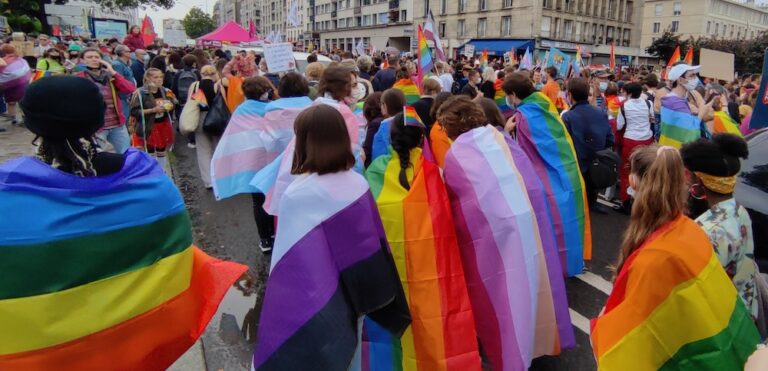
Every June, Pride Month gives our big ol’ family a chance to stand together, celebrating what we have in common, and remembering the battles that have bound us: criminalisation, discrimination, censorship, violence, and the stubborn insistence that our lives should be smaller and quieter.
That unity is huuuugely important, particularly while anti-LGBTQIA+ villains are trying to split us apart. But an umbrella big enough to cover everybody can often make individuals harder to see beneath it, and some letters end up getting more attention than others, which can have not-great roll-on effects, like some letters geting healthcare funding and some not.
Identity-specific weeks are not about carving Pride into competitive little portions. They let us talk about what broad rainbow branding can smooth over. Just a few examples off the top of my head: the horrific political targeting of trans people, the disappearance of lesbian nightlife venues spaces, bi erasure and biphobia even within our own community — there’s a zillion more obviously.
Pride Month lets us say “we”; visibility weeks give each letter room to speak in full sentences.
Online searches for LGBTQIA+ awareness weeks are soaring
Australia’s Google Trends data is fascinating. It does not show raw totals — 100 marks the highest relative interest on this graph — but the growth is unmistakable.
There’s obvious a huge amount of visibility and awareness days 0 but I’ll use some of the more well-known ones as an example: Bisexual Awareness Week, Transgender Awareness Week, and Lesbian Visibility Week.
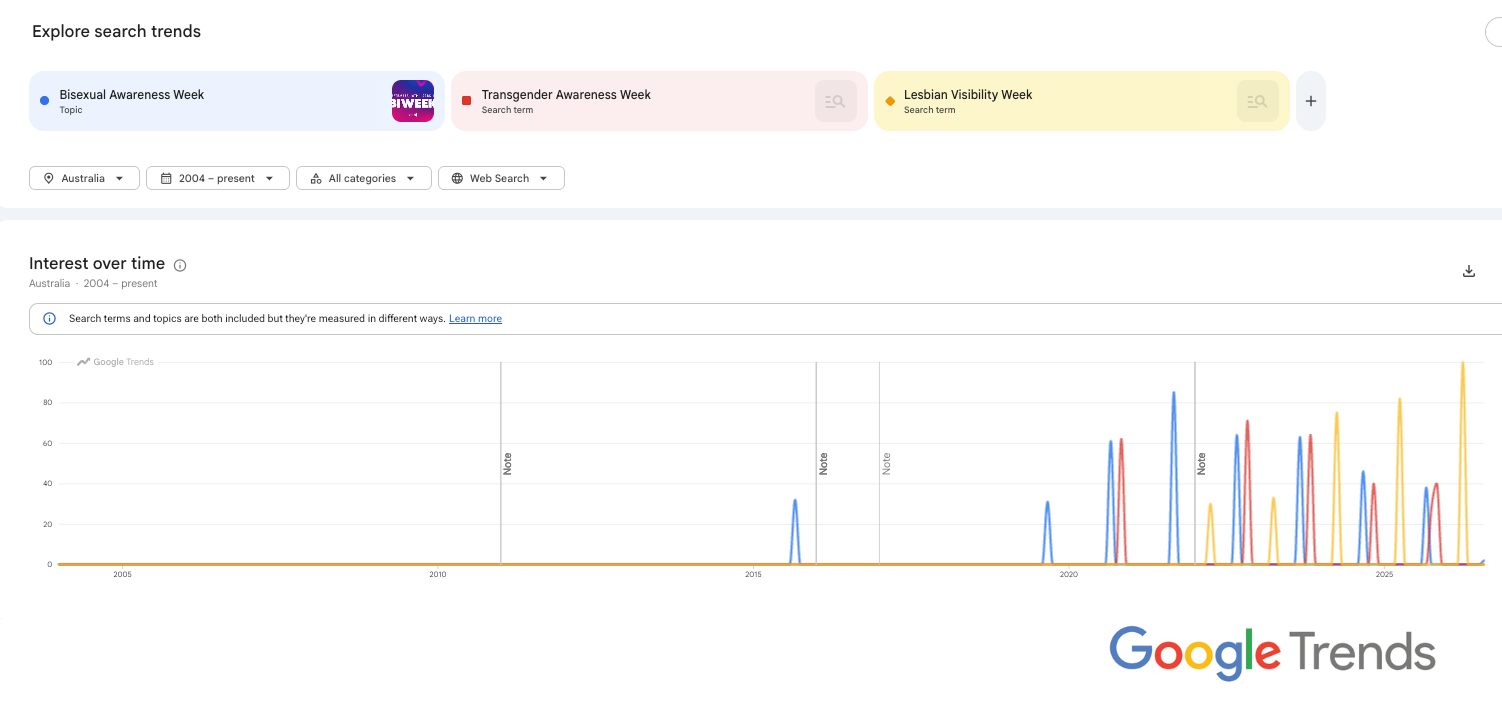
Bisexual Awareness Week was created in 2014 by GLAAD and BiNet USA, but online searches for it barely register until 2016. Then it rises significantly in 2019, then surges in 2020 and 2021.
In 2020, bi+ organisations across Australia and New Zealand launched the first Stand Bi Us conference, with 37 free online and in-person events, then returned in 2021 after its success. Lockdowns were miserable, but moving community education online meant someone in regional Australia could attend an interstate event.
According to GLAAD, Transgender Awareness Week started around 1999, but it only shows first major Australian spike in online searches in 2020 and reaches its high point around 2022.
Search data obviously cannot tell us whether people arrived with love, hostility, or to get their questions answered – and 2022 was the year trans lives were dragged through an ugly federal election culture war, with Scott Morrison backing co-founder of Save Women’s Sport Australasia, Katherine Deves, as a candidate for Warringah – so the election featured plenty of ranting about excluding trans women from sport. Of course, the spikes in search popularity does not mean solidarity, but those recurring peaks suggest Transgender Awareness Week has very much entered public consciousness.
Lesbian Visibility Week has the most dramatic trajectory — it began in West Hollywood in 1990, but the modern global iteration came as a revival of sorts by lesbian mag DIVA Magazine in 2020. Online searches in Australia, however – virtually nothing before 2022, then steep climbs in 2024 and 2025, reaching the comparison’s peak in 2026.
Visibility is not liberation — but it can open the door
Why the boom? More people have the language and safety use names and labels for who they are, in my opinion.
We all obviously just completed the Census that included questions about our community for the first time, but that data hasn’t bee released just yet – but the current ABS data (2022) estimates 4.5 per cent of Australians aged 16 and over are LGBTQI+. Butthe young’uns are queerer than ever – LGBTQI+ identity rises to 9.5 per cent among 16-to-24-year-olds. And bisexual Australians alone outnumber gay and lesbian Australians combined.
These days, social media turns a date into hashtags, explainers and events. Workplaces publish diversity calendars. Queer people search for language, history and one another; allies want to learn; corporations want to know which flag to slap on LinkedIn five minutes before posting. When an identity is lied about on television or turned into a political problem, people go looking for answers, too.
No, of course a visibility week can’t fund healthcare, reform a law or keep somebody safe by itself. But it can interrupt erasure, focus attention and give people a doorway into community. We need the enormous “us” of Pride Month, and smaller rooms where particular stories can breathe.
Our similarities and differences do not weaken each other. Personall I think of these awareness weeks a resource, and if we celebrate who we are together and separately, it only makes us stronger. I celebrated the lesbians I adore in April, and I’ll celebrate the transgender folks I love in November, just as hard as I celebrate who I am in September.
Celebrate all of it — and if you know and love a bisexual, buy them a present. It is September, after all.
Support the Star Observer… while you still can
LGBTQIA+ media is under threat. Queer content is censored by tech conglomerates who amplify bigotry and push out AI slop — so we receive less financial support than ever.
When our community is muzzled and intolerance intensifies, we need queer media more than ever. Your donation means we can continue paying queer journalists to write queer news.
Don’t rely on the straight lies of big tech – support Star Observer instead and donate now.