


OPINION: Now That Drag Race UK Is Axed From The BBC, Is Queer Visibility Behind A Paywall The Same?

Image: Photos: BBC
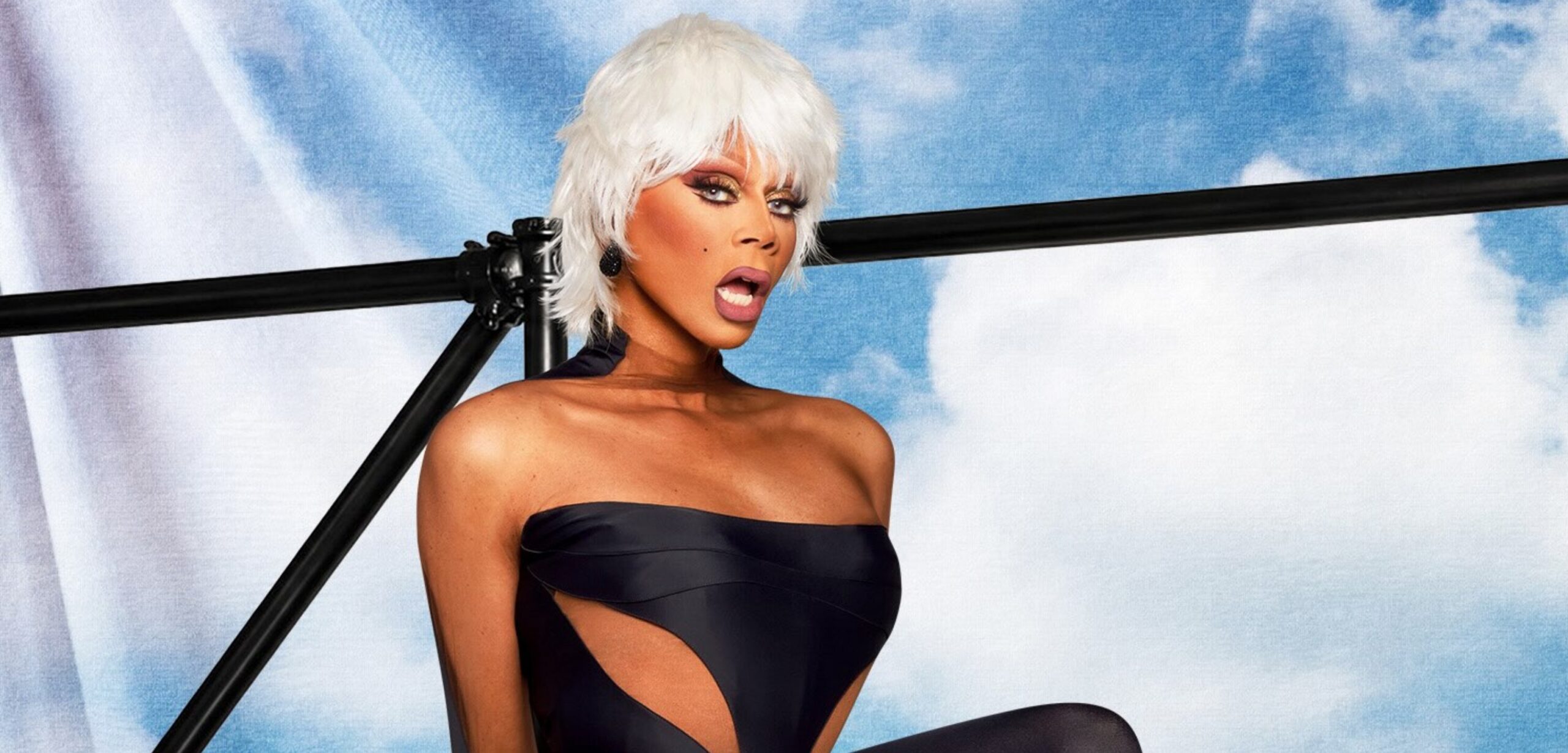
When RuPaul’s Drag Race UK’s first season was announced as being on the BBC, everyone was kinda shocked. Would the format change? Would the more crude jokes stay in? But people fell in love – yes, there was no cash prize, but the world got to learn the very very particular (and often a little dark) humour of drag queens from Manchester to Cardiff to Belfast to London and beyond, and watch them make television magic.
That’s Drag Race UK has done on the BBC since 2019: sat there amid news bulletins, panel shows, crime dramas and whatever on earth is happening on EastEnders, making drag part of the ordinary rhythm of British life.
Now, after its eighth series, that is ending.
The BBC says “significant financial pressures” have forced “very difficult choices”, and the show will move to World of Wonder’s queer-focused subscription service WOW Presents Plus. Drag Race UK itself is not dying. But pretending nothing important is being lost because the franchise technically survives misses the entire bloody point.
Queer people who love Drag Race will hunt it down; we know how to find our own stories because, for most of our lives, we have had to. We will work out whether another subscription fits beside the six already bleeding our bank accounts dry and follow the queens there.
The people who will not follow are precisely the people public broadcasting can reach: the parent who would never choose a “queer platform” but sees the show because it’s on after their favourite program, and ends up charmed by a queen from their hometown. The grandparent learning new language; the teenager quietly watching on a family television, not yet ready to explain why what they’re watching matters to them. People who’d never seen a drag queen in their lives probably decided to go to a drag bingo night for the first time, because Drag Race UK introduced them to our culture.
A specialist streamer like WOW Presents Plus reaches the already converted. The BBC allowed queer culture to wander into the national lounge room, kick off its heels and become familiar.
The interest in Drag Race UK is very much still there
And the audience was still there. Recent series have reportedly averaged around one million viewers each week — down from a high of about 1.5 million, yes, but hardly a corpse requiring a tasteful closed-casket funeral.
The Google Trends data tells much the same story. From the start of 2004 to now, tracking both the television-series topic RuPaul’s Drag Race UK and the search term “drag race uk”. The numbers are relative — 100 marks peak interest on this chart, not a literal search total — but the shape is striking.
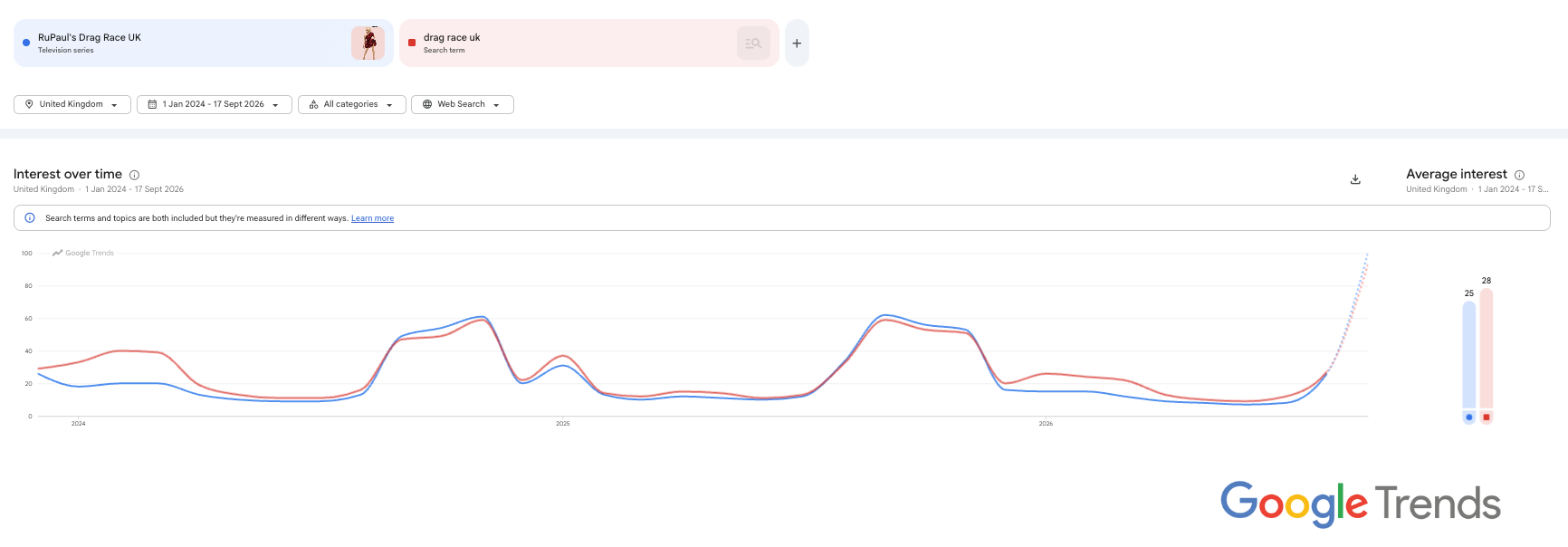
Interest follows the broadcast calendar, obviously. There is a clear lift in early 2024, when the second UK vs the World aired, followed by a much larger climb around series six in September. After the finale, interest drops into the normal quiet between series. The pattern repeats in late 2025: series seven begins, both measurements climb to around 60, then ease again. Another smaller rise arrives with the third UK vs the World in early 2026.
Then comes September 2026. You can still see the line shoots towards 100. That final stretch is dotted because the period is incomplete, so only partial data is accessible, but the direction is unmistakable: series eight premiered on 3 September, and the BBC news arrived less than a week later. People are looking for the show and its future at the very moment the broadcaster is showing it the door.
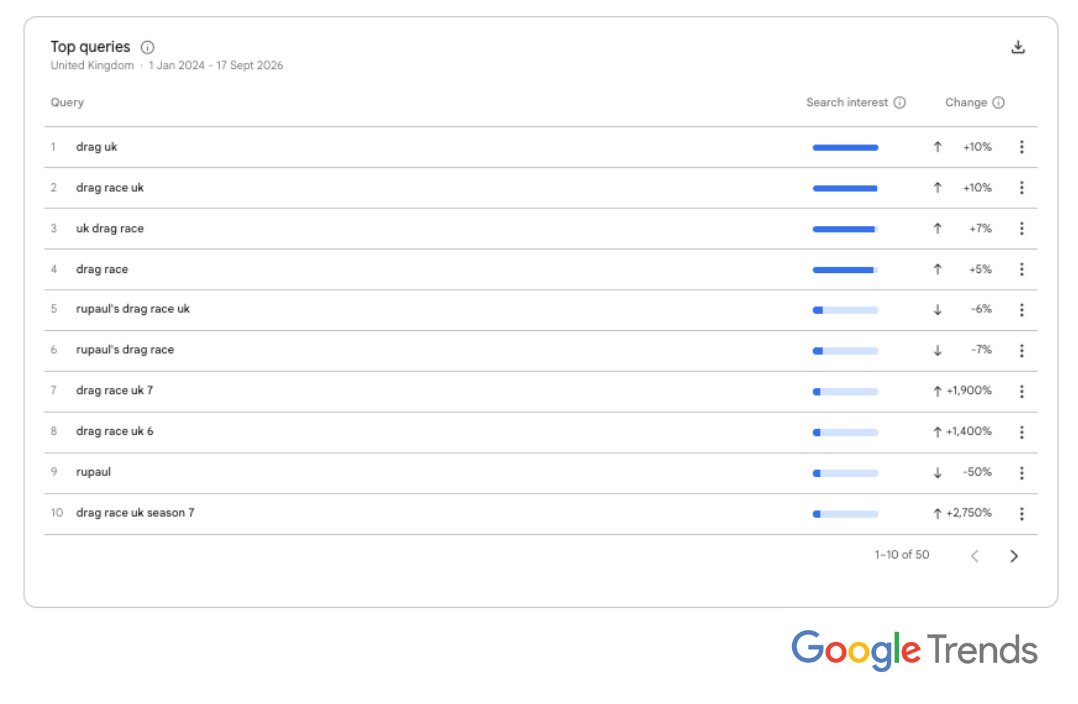
The related queries are revealing too. Broad searches such as “drag uk” and “drag race uk” are up 10 per cent, while “uk drag race” is up seven per cent. Searches for “drag race uk 7” rose 1,900 per cent, “drag race uk 6” rose 1,400 per cent, and “drag race uk season 7” jumped 2,750 per cent. That is not for SURE not the actions of a cultural relic.
None of this means Drag Race is perfect, obviously. The world’s biggest LGBTQIA+ television franchise is commercial, repetitive and can sometimes frustratingly narrow about the drag it rewards. But across eight UK series it has put same-sex marriage, trans and non-binary lives, HIV, family rejection, class, race, regional identity and the weird, beautiful graft of drag artists before a mainstream audience — then wrapped those conversations around Snatch Game and a filthy Alan Carr joke.
Its BBC incarnation bent around public-broadcasting rules. For years there were RuPeter badges instead of lavish sponsored prizes because the BBC does not run commercial sponsorship in the same way.
We learned pretty early on that RuPaul does not always *get* the British humour, much like the first season of RuPaul’s Drag Race Down Under – but it got better quickly. It acquired a particularly British texture shaped by regional queens, pub drag, pantomime and cabaret, queens loving to sing rather than lipsync – carried into homes without an extra bill attached.
The loss lands harder because the BBC has also cancelled I Kissed a Boy and I Kissed a Girl, its groundbreaking queer dating shows, citing funding pressures. Each decision can be explained on a spreadsheet.
Taken together, they look like the queer corner of the schedule being quietly packed into boxes.
It makes me a little heartbroken to see, tbh. I questioned the decision for Drag Race UK to be on the BBC at the beginning, but over time I did a full 180°.
Oi, ABC & SBS: Think about it
But I reckon Australia should consider picking up the UK’s slack. Drag Race Down Under has lived on Stan here, and the wider franchise increasingly belongs to a maze of subscriptions.
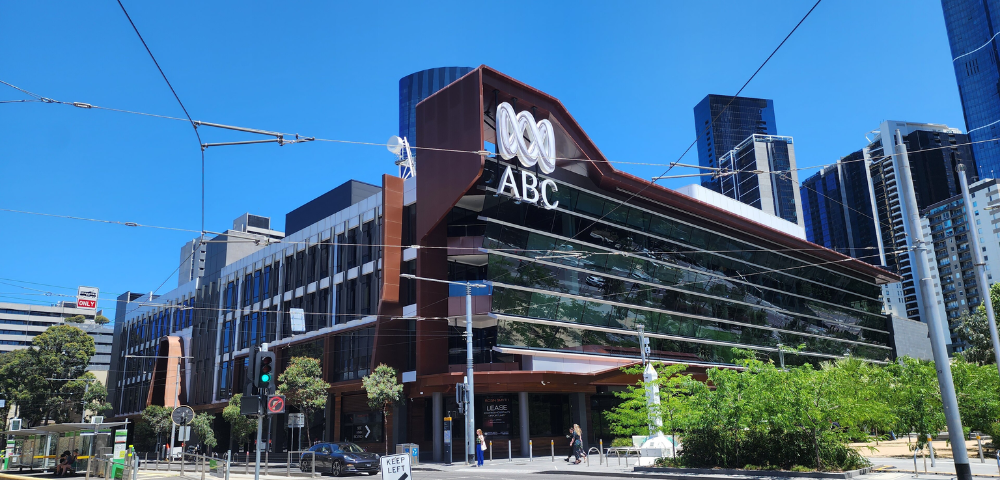
Meanwhile, the ABC describes itself as entertainment that is “freely available on all platforms” and says it must reflect Australia’s diversity, including sexual orientation, in its content.
When I worked at SBS a handful of years ago, I regularly worked on content that spotlighted LGBTQIA+ shows that they aired. I also proudly marched in the SBS float in the Sydney Gay & Lesbian Mardi Gras, which they were airing at the time.
So, my beloved national broadcasters – here is the challenge.
If the BBC has dropped the ‘publicly accessible queer culture’ mantle, perhaps the ABC or SBS should pick the bloody thing up — whether that means pursuing a future home for Drag Race Down Under, or even backing a new Australian drag competition, or making something equally ambitious that puts our queens fron and centre in front of the whole country.
Yes, the format may need to change around public-broadcasting restrictions. Drag Race UK proved that that is absolutely possible. Give us fewer product placements and more RuPeter badges; our talented local drag artists have made miracles from far less.
Because queer visibility that exists only behind a queer paywall is not the same as queer visibility woven into the fabric national life. One asks people to come and find in our own spaces and platforms. The other lets us simply be there, part of the national convo: sequinned, complicated, loud, ordinary, and impossible to hide away.
Support the Star Observer… while you still can
LGBTQIA+ media is under threat. Queer content is censored by tech conglomerates who amplify bigotry and push out AI slop — so we receive less financial support than ever.
When our community is muzzled and intolerance intensifies, we need queer media more than ever. Your donation means we can continue paying queer journalists to write queer news.
Don’t rely on the straight lies of big tech – support Star Observer instead and donate now.

Leave a Reply