


The Divide Between Masc And Butch: Why Lesbians Are Choosing One Label Over The Other
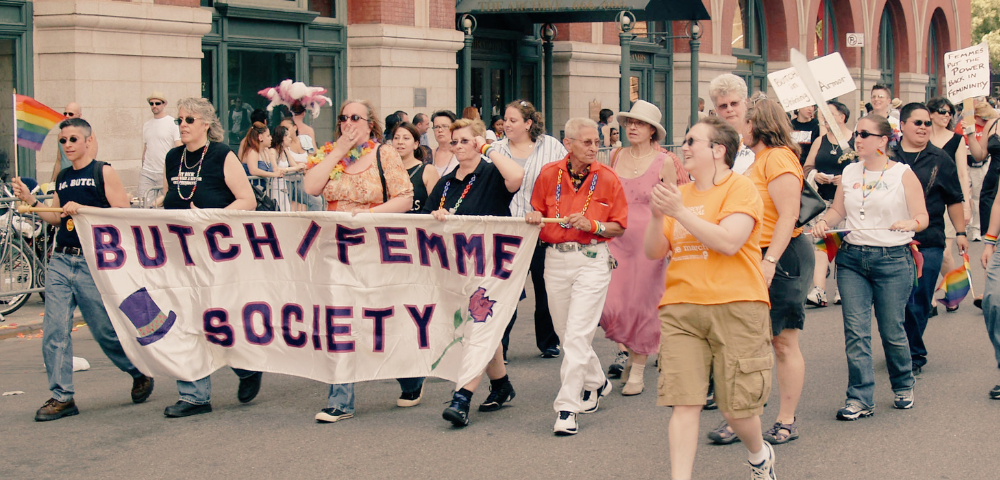
Image: Butch Femme Society. Credit David Shankbone/ Wikimedia Commons
Are you a self-described ‘pretty girl in boy’s clothes’? Or maybe you’ve been burnt by one too many ‘hey mamas lesbians’? Open TikTok and you’ll be bombarded with a series of new-age terms people have coined: the stereotype of the ‘hey mamas’ lesbian, the bedazzled femininity of the ‘girlypop masc’. However, and perhaps interestingly so, there’s a specific divide between who uses these terms and those who prefer the term butch.
A video from US LGBTQIA+ outlet Them has sparked a wider conversation regarding shifting lesbian gender identity. When asked if “masc lesbians can be just as feminine as fem lesbians”, a number of younger, self-identified masc lesbians shifted towards agreement. In contrast, the elder Butch lesbian, 71-year-old Pat Martin, asserted herself as “masculine of centre”.
This video is just one example of the cultural conversation surrounding lesbian masculinity, and how social media has impacted these discussions.
In the queer community, butchness and butchfemme culture has a rich tradition and prominence through lesbian working-class history. Butch is traditionally defined as a person, typically a lesbian or a woman, who takes on a markedly masculine appearance and personality. This may mean that she is more chivalrous, or takes on what is considered a more traditionally masculine role in a relationship, and is yet completely separated from being a man.
In comparison, newer terms such as “girlypop masc” can be used to define a lesbian who is masculine in appearance, but more feminine and effeminate in nature.
Some younger lesbians have expressed discomfort with labelling themselves as butch. There’s the imposter syndrome of not feeling as though you meet pre-existing categories to do so: maybe you don’t look a certain way, or you don’t carry a specific physical strength, and the connotations of what identifying with such a word may mean. “Masc”, in comparison, might feel gentler of a word for those just beginning to explore their gender.
What is butch anyway?
When I look at the television and media from my youth as a Gen-Z queer individual, I cannot pinpoint any example of lesbian masculinity that I saw that felt emboldening and aligned with my own journey. Truthfully, when we are faced with little-to-no media image of what butchness and lesbian gender non-conformance can look like, it is no wonder that younger lesbians are perhaps terrified of what it could mean for them to embrace such terminology.
I grew up in an environment where queerness was accepted and supported, and yet still knew inherently that queer female masculinity was regarded as something else entirely. There was a total lack of media imagery of what butchness could look like, and when I heard the term it was often with an air of disdain, if not outright disgust.
As someone who now self-identifies as butch, it took years of gender experimentation to lead me to this point. I have no childhood pictures of me where it looks “obvious” that I would one day turn out like this. In high school, I shaved my head when I was seventeen, and was filled with guilt at my mother’s horrified reaction. It was only when I was in my early twenties that I cut my hair off again and started dressing in such a way that I could be perceived as masculine, and by this stage of my life, I was convinced that this meant I couldn’t be butch.
Sometimes I joke that it is the time that I spent in New York City as a 21-year-old that made me butch. But a defining point of my adolescence was being asked by my friend Renaissance, in a crowded cafe in the West Village, with their butch partner Gabby sitting next to them, “why do you identify as masc and not butch?” Truthfully, there was no answer I could give that couldn’t be reduced down to feeling like an imposter in the word. Yet over the years, I’d become butch in my centre, alongside my appearance, without realising.
Butchness, for me, means that I wear my queerness in my everyday life, in every corporate setting that I enter, and defines my social appearance.
A sliding scale of butchness
If anything, I’m interested in why younger lesbians who are masculine-presenting are overtly shifting away from the term butch. Terms such as “girlypop masc” and “soft masc” allow younger masculine-presenting lesbians to exist between both worlds. Maybe it means you’re not masculine enough to be associated with one of “those” butches.
Social media has, for me and others, changed this perception of what butch and masculine lesbianism can be, and what it can look like. It has given butches and masc lesbians of all presentations, walks of life, and way of dress an outlet through which to connect with others like themselves. In comparison to the media imagery I grew up with of butchness, which was few and far between if it existed at all, it has allowed for an authentic display of what lesbian gender non-conformance can be.
If lesbian gender non-conformance is to be placed on a sliding scale, with ‘soft masc’ at one end, what does this equate to on the other side? Does this automatically place butchness at a position of aggression and hyper-assertion? The butch lesbians around me are some of the most gentle individuals I know. They are generous by nature, and they take care of those that they love. Lesbian masculinity is not inherently toxic; it is not affront by nature, or aggressive by presentation.
As I look at the broad spectrum of what lesbian gender non-conformance can be, and what social media has enabled us to become, one thing remains clear to me: the importance of recognising everyone in their own journeys, in the formation of community.


Support the Star Observer… while you still can
LGBTQIA+ media is under threat. Queer content is censored by tech conglomerates who amplify bigotry and push out AI slop — so we receive less financial support than ever.
When our community is muzzled and intolerance intensifies, we need queer media more than ever. Your donation means we can continue paying queer journalists to write queer news.
Don’t rely on the straight lies of big tech – support Star Observer instead and donate now.



I have a theory about this as someone who doesnt mind being called masc but I’m not butch. For me butch feels like an identity and masc feels like an adjective and therefore gives more breathing room to slide around with presentation and be more broad. That’s how I feel about it anyway.