


How Australia’s Searches For LGBTQIA+ Pride Flags Have Changed

Image: Silanoc / Wikimedia Commons
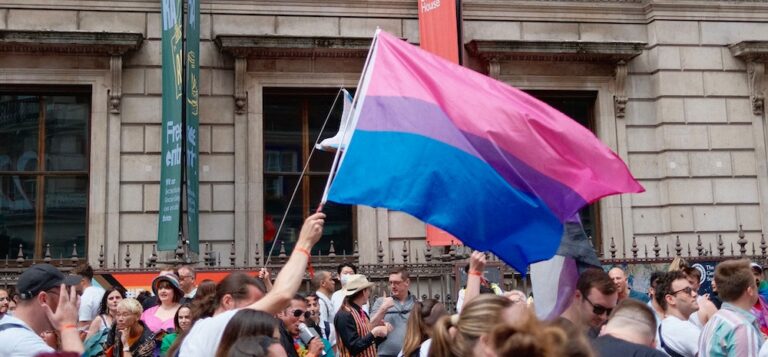
There was a time when spotting a rainbow flag meant something very specific: somewhere nearby was a protest, a queer venue, a Pride march, or perhaps one gloriously unsubtle queer figured out how to install a flagpole in their backyard.
Today, our community has an entire technicolour language of LGBTQIA+ Pride flags, representing identities, histories and political struggles that cannot always be squeezed neatly beneath six rainbow stripes.
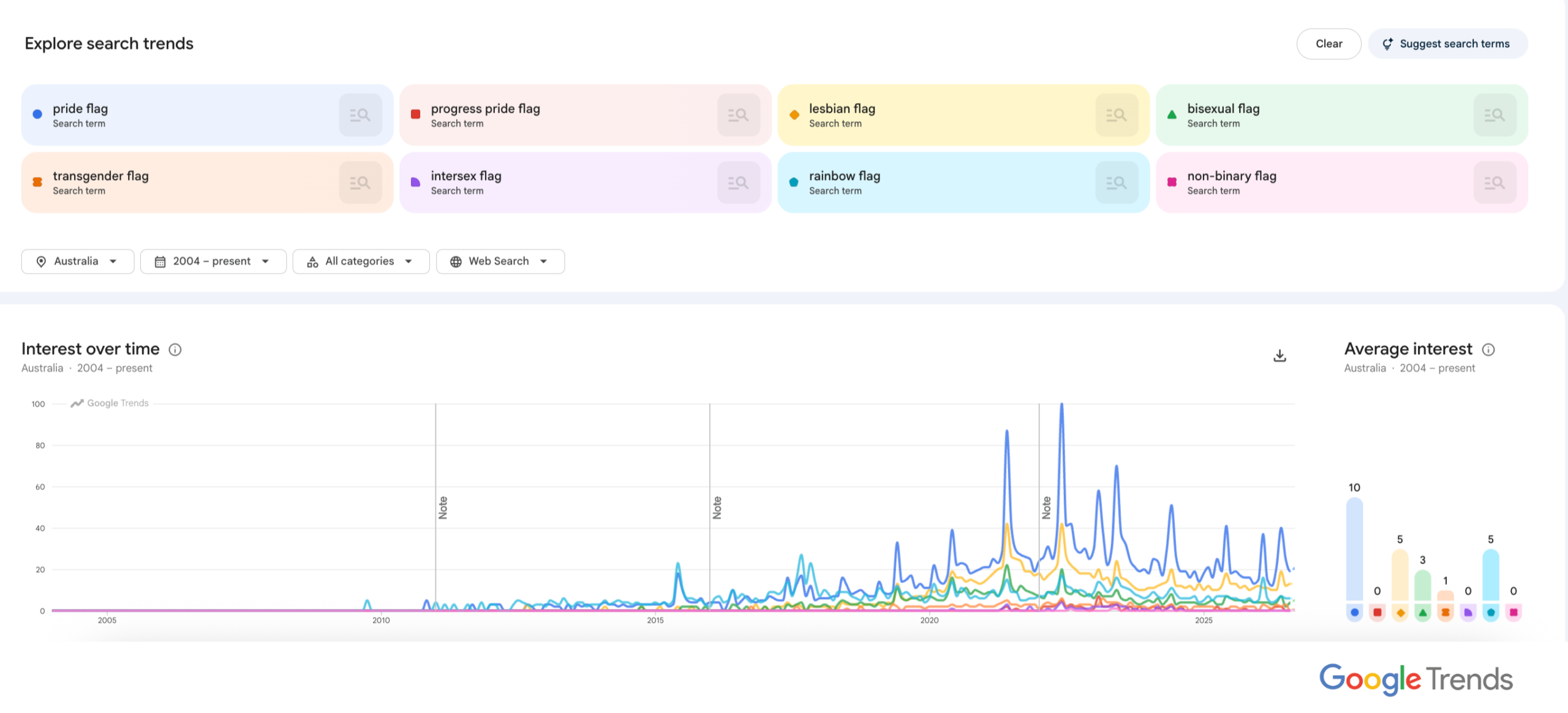
Google Trends data from Australia shows how dramatically our curiosity – and therefore our online search habits – about those flags has grown, particularly since 2018, with enormous peaks during Pride Month and around major moments in LGBTQIA+ history.
A quick caveat before we go galloping into the rainbow: Google Trends measures relative interest, rather than raw search numbers. A score of 100 represents the chart’s single highest point, while zero can mean there was insufficient data — not necessarily that nobody searched the term.
Here’s the data from 2004 ’til today:
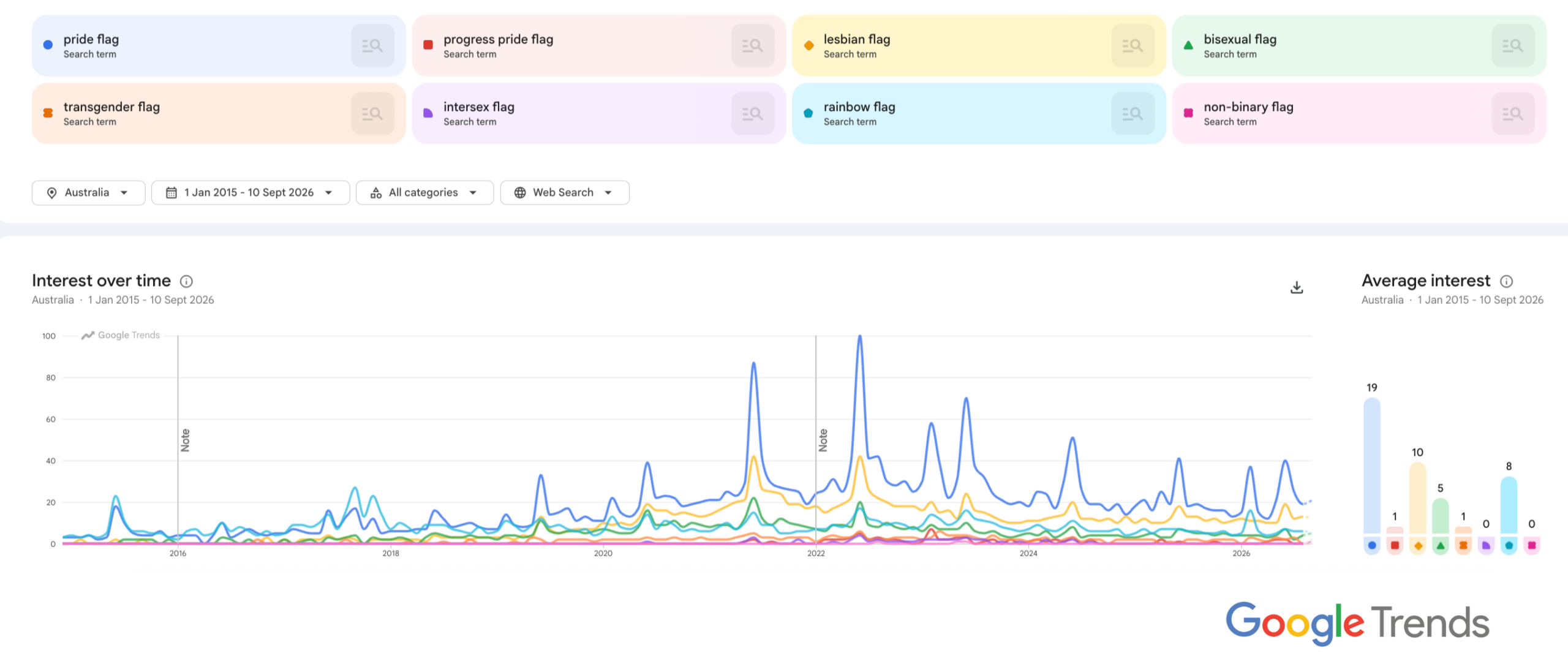
 And here’s a closer look at 2015 – 2026, the period with the largest spikes of data:
‘Pride flag’ searches have surged Since 2019
“Pride flag” is comfortably the most searched term in the dataset, with interest beginning to climb noticeably around 2018 and 2019 before shooting upwards during the early 2020s.
The graph’s two largest peaks arrive around the middle of 2021 and 2022, almost certainly reflecting Pride Month, when flags take over shopfronts, workplaces, social media and, inevitably, corporate logos. Interest has fallen from those extraordinary highs, but remains substantially above its pre-2018 baseline, with clear annual rises continuing through 2026.
The phrase is often used interchangeably with “rainbow flag”, although it can now refer to everything from Gilbert Baker’s original design to the Progress Pride Flag and the many identity-specific flags flying alongside it.
Rainbow Flag searches spiked during marriage equality debate
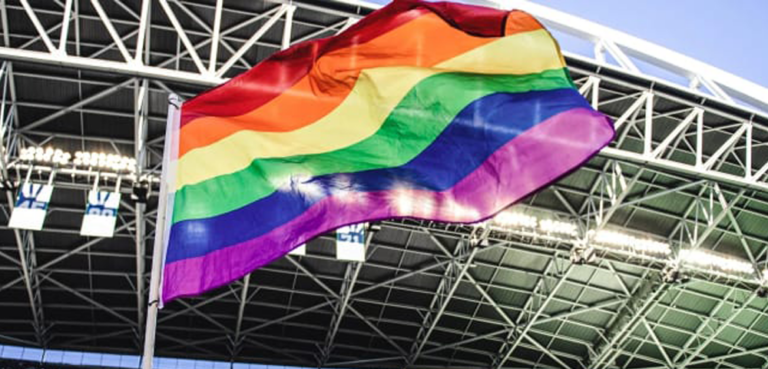
The rainbow flag was created in San Francisco in 1978 by artist and activist Gilbert Baker, alongside collaborators including Lynn Segerblom and James McNamara. Its original eight stripes represented sexuality, life, healing, sunlight, nature, magic and art, serenity, and spirit; production practicalities later gave us the familiar six-colour version.
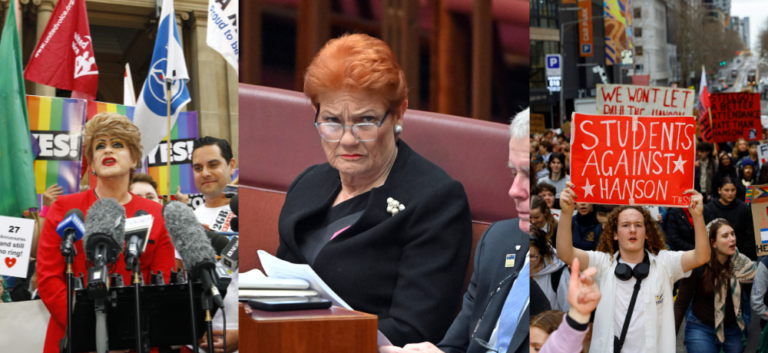
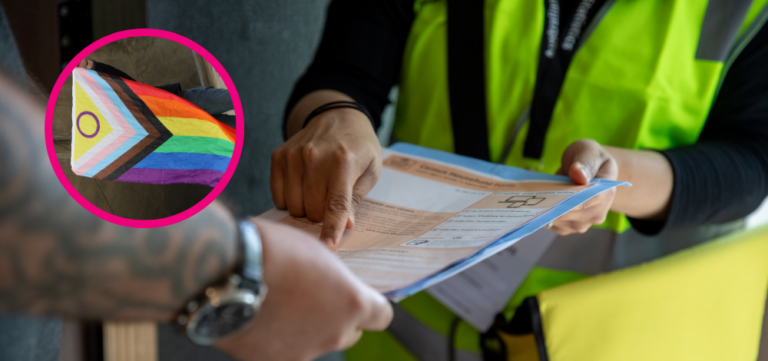
Australian searches for “rainbow flag” enjoyed a dramatic surge in 2017, far larger than anything preceding it. That timing aligns rather neatly with the marriage equality postal survey, when rainbows appeared absolutely bloody everywhere as LGBTQIA+ Australians and our allies campaigned for a Yes vote. The survey ran from September to November, with 61.6 per cent voting in favour of equality.
Search interest has since settled into regular peaks, usually around Pride Month, while remaining stronger than it was a decade ago.
Progress Pride flag searches begin rising after 2018
Non-binary designer Daniel Quasar created the Progress Pride Flag in 2018, placing black, brown, light blue, pink and white stripes in a chevron over the six-colour rainbow. Those additions centre LGBTQIA+ people of colour, trans people, people living with HIV and those lost to AIDS, while the forward-pointing shape represents progress still to be made.
Fittingly, the Google data shows virtually no searches before the flag existed. Interest begins appearing after 2018, then grows through the early 2020s, with bumps around 2021 and Sydney WorldPride in 2023, when the design was splashed across Sydney — including on the Opera House sails.
Its average remains low beside the broader “pride flag” search, but that partly reflects how recently the term entered our vocabulary.
Lesbian flag searches became surprisingly huge
Of every identity-specific flag examined, the lesbian flag is the runaway winner, with average search interest twice that of the bisexual flag and well above “rainbow flag” across the 2015–2026 graph.
That may be because there is no single universally accepted lesbian flag, and its history is delightfully complicated. The 1999 labrys flag featured a double-headed axe, black triangle and violet background. In 2010 came the pink-striped “lipstick lesbian” flag, which was criticised for centring feminine lesbians while leaving butches and other gender-nonconforming lesbians out in the cold.
The most commonly used design today is Emily Gwen’s orange-and-pink “sunset” flag, created in 2018. Its colours represent gender non-conformity, independence, community, unique relationships with womanhood, serenity, love and sex, and femininity. Both seven- and five-stripe versions are widely flown.
Australian searches began accelerating almost immediately after that redesign, before hitting their largest peaks around Pride Month in 2021 and 2022. Searches have cooled since then, but remain far higher than they were before 2018 — suggesting the internet helped the newer flag move from Tumblr into the queer mainstream with astonishing speed. Hell yeah, Aussie lesbians!
Bisexual Flag searches rise during Pride & Bi Visibility Month (now)
Bi activist Michael Page unveiled the bisexual flag in 1998 to give bisexual people greater visibility both within the LGBTQIA+ community and beyond it. Its pink, purple and blue stripes represent attraction to the same gender, multiple genders and different genders — although the language used to describe those colours has evolved alongside our understanding of bisexuality.
Searches climb steadily from 2017, with recurring spikes around June and smaller rises that may align with Bisexual Awareness Month (which is happening right now) and Bi Visibility Day on the 23rd.
Interest was strongest between 2019 and 2023, before declining somewhat. Still, searches remain well above their mid-2010s level, which feels especially significant for an identity so frequently told it is confused, invisible or somehow not queer enough.
Transgender Flag searches reflect growing visibility
Trans activist Monica Helms designed the transgender flag in 1999 and first flew it at Phoenix Pride in 2000. Its blue and pink stripes use colours traditionally associated with boys and girls, while white represents intersex people, those transitioning, and people with an undefined or neutral gender.
“Transgender flag” records lower overall interest, but becomes more consistently visible from 2020 onwards, with sharper bumps during 2022 and 2023.
Those rises may reflect Pride Month and Trans Day of Visibility, but also the growing political fixation on trans people. Not every search spike is celebratory; sometimes people go looking for our flags because our lives have once again been dragged into a hostile public debate.
Intersex Flag searches remain smaller, with significant spikes
Australian intersex advocate Morgan Carpenter created the intersex flag in 2013: a purple circle on a yellow background, with colours deliberately chosen to avoid gendered pink-and-blue conventions. The unbroken circle represents wholeness, completeness and bodily autonomy.
Beside the wider terms like ‘pride flag’, search interest for intersex flag looks relatively small – but pulses of search interest become visible after 2020.
The flag’s inclusion in Valentino Vecchietti’s 2021 Intersex-Inclusive Progress Pride Flag likely helped introduce it to a wider audience, while also making a very clear point: intersex people are not a footnote to our community.
Non-binary flag searches slowly finding their place
Kye Rowan created the non-binary flag in 2014 for people who did not feel fully represented by the genderqueer flag. Yellow represents genders outside the binary, white people with many or all genders, purple genders combining or existing between male and female, and black an absence of gender.
The Trends line remains tiny, but searches begin appearing more frequently in the early 2020s, alongside growing public understanding of non-binary identities.
Taken together, all those jagged little lines climbing up the graph tell a story much bigger than which bit of coloured fabric people happen to be typing into Google. The rainbow has never gone anywhere, nor should it, but over the years we have kept sewing more of ourselves into the picture — adding new colours, digging old symbols out of our history, creating flags in bedrooms and community groups and strange little corners of the internet, then watching as they escape into the world and begin appearing at marches, outside venues, across bedroom walls and around the shoulders of some nervous young queer person who has only just found the words for who they are.
There is something deeply lovely about that, I think: that our community is still changing, still arguing, still making a glorious mess of the colour palette, and still finding new ways to look at one another across a crowded street and say, without needing to speak at all, yes darl, you belong here too.
Support the Star Observer… while you still can
LGBTQIA+ media is under threat. Queer content is censored by tech conglomerates who amplify bigotry and push out AI slop — so we receive less financial support than ever.
When our community is muzzled and intolerance intensifies, we need queer media more than ever. Your donation means we can continue paying queer journalists to write queer news.
Don’t rely on the straight lies of big tech – support Star Observer instead and donate now.



Leave a Reply