


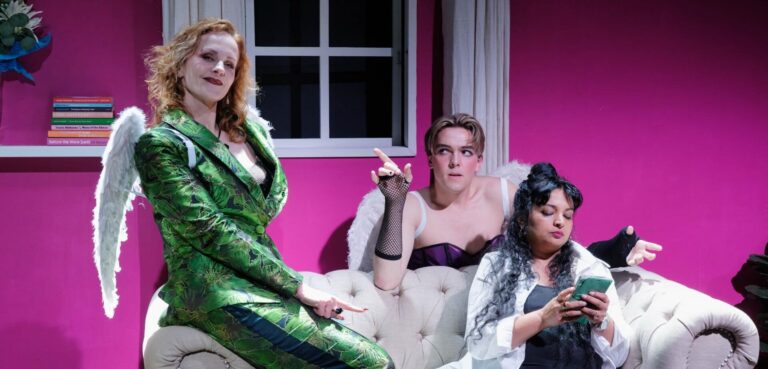
Qtopia Sydney Announces New CEO: We Sit Down With Cecily Hardy

Qtopia Sydney has just announced Cecily Hardy as its new CEO.
For Cecily Hardy, the history held inside Qtopia Sydney has a family connection. Raised in a queer family, its newly appointed CEO is the daughter of someone who marched in 1979, a year after police arrested participants in the first Mardi Gras.
Now, she’s taking the reins of a cultural home inside the former Darlinghurst Police Station where those protesters were detained – there’s certainly some poetry to that.
Hardy arrives with 20 years of making ambitious art happen, including six years as CEO and Executive Producer of Legs On The Wall, followed by roles at the Festival of Dangerous Ideas and The Ethics Centre. She also helped produce the Namatjira Project, which secured the return of Albert Namatjira’s copyright to his family.
More recently, she stepped in to help Divine Playhouse navigate its controversial shutdown. The precariousness of Sydney’s queer spaces is something she’s encountered up close.
“Qtopia Sydney exists because people fought to make sure our stories would be remembered,” Hardy says.
Her ambition is to make Qtopia somewhere our communities keep coming back to, with room to gather, create and feel safe, as well as encounter the histories that brought us here.
Star Observer was lucky enough to have a chat with Cecily, sit down and really get to know her. So, if you don’t already know her – meet Cecily Hardy.
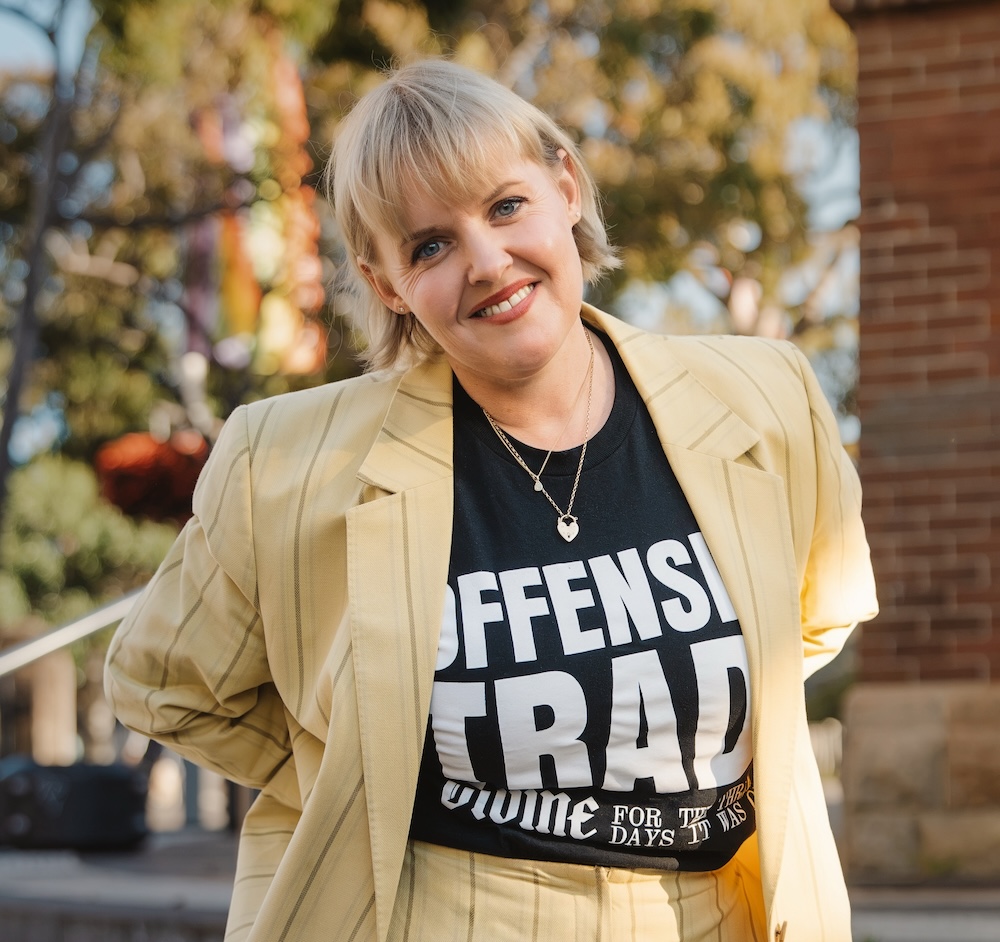
In conversation new Qtopia Sydney CEO, Cecily Hardy
Star Observer: First of all, congratulations. It sounds like you are such a perfect fit for the role. I’m really excited to see what you do with it.
Cecily Hardy: I’m glad that you think that, because I do think that. You sit outside an organisation and go, “If only they had a woman like me.” So, congratulations to the board for being bold and brave and insightful.
SO: I love it. Have faith in yourself, right? I was really interested to read that you’re not only a member of the community, but you also grew up in a queer family – you’re the child of a 79er.
Cecily: I’m the child of someone who marched in 1979, after ’78 and all of that had happened. That has always been such an interesting thing in my young — and becoming an old woman — life, because she was a very young queer, lesbian woman from the country who’d been kicked out by her family.
For her, it was that whole eye-opening thing: they knew what they were in for, and they still did it, because there was this sense amongst everyone, collectively, that the time was now. It was that kind of tipping point in terms of not backing down, and what it felt like historically.
The other reason why that’s always spoken to me, is because I have really deep, ongoing respect for the 78ers, but I also have deep, ongoing respect for the ’79ers, and those who marched in ’80, ’81 and ’82. So much of our story has continued to face really extreme adversity at times, which isn’t only tied to ’78, but is tied to that entire story.
SO: Absolutely. Star Observer was born in 1979 because they felt the same way. It was like, “We’ve got to do it. We need this now.”
Cecily: That’s right.
SO: Okay, so big question – what made you want this job? It’s a big job.
Cecily: It is a big job, but it does speak a bit to what we started with, and that is that I just knew I was the right person for the job.
There are other people who would also do a really amazing job, and I hold the baton for them in a way, because I’ve come from a place of being very collegiate and recognising the amazing operators within our community.
I come from a place of working shoulder to shoulder with those who keep getting us where we need to go, keep representing, keep turning up, and keep doing it when it’s hard, or when no one’s watching, or when it’s not about self-promotion.
From my perspective, I knew I was one of the right ones for the job because Qtopia is a unique thing. It isn’t actually one thing, and it hasn’t been born that way. There are some fundamentals that are so important to what it is and need to be protected, but in its current form, it is a hybrid, multi-venue, multi-art space that also needs to be a haven for community.
It’s a haven. It is a bit of a rare bird, because you’ve got to be culturally aware, you’ve got to be artistically astute and forward-reaching. You’ve got to be community engaged and respectful, and see the past, but also not get stuck in your generational box and see that we have emerging audiences, too.
We have to engage with them, and we have to respect them. They’re not old, and they haven’t been around forever, and they don’t know their history, but they’re still important.
All of these factors make up this beautiful, beautiful beast of a place, and therefore it needs someone who can try to get all those things. The other side of that is that no one person can be perfect and amazing at everything. But I think it’s also about a sensibility and a willingness to see those things and to value them equally.
SO: Absolutely. That’s a big list. Like I said, big job.
Cecily: That’s right. It is a big job, and there are challenges ahead for us. Some of that is about being realistic about what you can achieve and what you can do. It’s not about under-delivering, or stretching yourself too far, or trying to be everything to everyone.
It’s about clear communication with the community. It’s about transparency and accountability, and it’s about saying, “We see you, we respect you, we want to represent you. We’re going to do it in this way because it means that we can give a bit of love to everybody,” rather than trying to spread ourselves too thin, not really being able to articulate or communicate effectively who we are, and then leaving some of you out.
From my perspective, that’s probably the worst thing. If we communicate with our community, they know what we have the capacity to offer, and they can get on board.
SO: And they’ll be thrilled to see you succeed as well, if you’re communicative with them.
Cecily: I hope so. I really do. I hope that it means people can come on the journey and feel like we want them to be there. It doesn’t matter if they’re not in this month’s exhibition. They know that the intention is there.
They know that something will be for them, or something will be for another part of the community that they might not turn up for, but they bloody love that it’s there.
SO: Absolutely. Okay, you’ve got a really interesting résumé – correct me if I get anything wrong. You’ve led all these big cultural organisations and programs, but you’ve also been a TV host, a professional actor, an auctioneer and a marriage celebrant?
Cecily: I can’t even lie to you. All those things are true. If you Google me, you’re going to find that. That’s the only reason why I put TV host in there, because when you Google me, it’s one of the first things you see. I was like, “I’m just going to get in front of that.”
SO: You’ve just got to.
Cecily: Right. Like so many of the people that you profile every day, I have an interesting background. I grew up in squat housing in Newtown in the ’80s. I had a lesbian mother. I thought all people had lesbian mothers and a dad. I actually thought all kids had lesbian mothers until I went to school. I thought everyone had their mum, their mum’s girlfriend, and then their dad, who was kind of on the side but lovely and loved your mum, but she was a lesbian.
My dad was a self-taught but very good auctioneer, and he passionately created his own little auction business. That went for many years and became a bit of an iconic little Sydney auction house.
When you’re young and selfish and you think, “I don’t need to do that,” then one day you wake up and realise that actually they’d love it if you just paid them a bit of respect. So as a result, I started being an auctioneer for my dad and learnt the trade. I was the youngest female auctioneer in Australia, and that includes cattle auctioneers. Some of them are really hardcore. They talk fast and they’re rough, but I love them. They’re amazing.
I was following my very young woman dream of an acting career, and I did do professional acting for a while. But I think I just realised that I wanted to do more — and this is not being disrespectful to my actor friends — than sit around waiting for the phone to ring.
I got a bit of a taste quite early on for producing and community engagement, and how developing your own projects gave you real agency and enabled you to do work that felt like it was really something, in terms of combining art practice and social change, I suppose, and impact work as well.
That’s really what led me towards things like working with the Namatjira family and winning their copyright back while touring that award-winning theatre show. That’s where my hybrid approach really was born. As a result, you’ll see that I’ve honed these abilities in terms of cultural organisation and cultural leadership, particularly in the last five years with Festival of Dangerous Ideas.
SO: And being a wedding celebrant?
Honestly? I was sick of going to shit weddings. [laughs] Honestly. I just was like, “It’s kind of hilarious, but it’s also really shit.”
When the Marriage Act was on the way to changing, I feel like there were other celebrants who will be part of your readership who will feel the same in this community: you’re a queer, and you’re not allowed to get married. […]
Even though these things seem a bit disparate, they actually speak to that same soul that I’ve always had. These are moments in our lives that somehow get made a bit shit by us just not doing them really well, and not treating that ceremony with the respect that it deserves.
I don’t mean being austere. I just mean: taking it seriously and doing a good job of it.
SO: I think that’s a really good way to sum that up, because I was looking at it and thinking, “How could all of these things possibly fit together?” But that actually makes perfect sense.
Cecily: Actually, I’m very useful. Live auctions for fundraising can be a bit hard work, but I’ve been very useful for doing live charity auctions because I can just get the gavel out and go at it.
SO: Love it. And you’ve said you want Qtopia to be somewhere people return to again and again. What would you say to a local queer Sydneysider who has visited once and thinks, “I’ve already done Qtopia”?
Cecily: I think there’s a few answers to that, because it is important to pay respect to what it is and what it’s built, and what this small but mighty team tries to keep living, and particularly the volunteers who keep it alive.
I think it’s finding the balance between having these permanent presences, like the memorial, that you could go to 10 times and still see different names, or still feel a bit different, or sit with it differently.
It’s finding that balance between the things that don’t need to go away, that are permanently there for good reason, and the vitality and the vivaciousness and the vibrancy of having activity that’s been really carefully thought about for different parts of our community.
There is so much activity happening, and often the community doesn’t realise that they could potentially be harboured here and engage in their own activity, or visit, or come to shows. It’s about continuing to grow that sense of the activity that’s taking place and who it’s for.
SO: And coming from Festival of Dangerous Ideas, you’re used to tackling some difficult conversations. Are there conversations within our own LGBTQIA+ communities that you would like Qtopia to make more room for?
Cecily: The short answer is yes, because I think those places of coming together, of curiosity, of meeting each other on sometimes difficult topics or uncomfortable conversations or interactions where you don’t agree — those are the places that push us forward.
For me, coming from Festival of Dangerous Ideas, I saw that time and time again. It never gets out of date, that intention of: what is happening to us in this world right now? What are we feeling and thinking, and not getting the chance to talk about, not having the forum to talk about, or not knowing how to broach, even though it’s really impacting on us?
As a result, it’s really relevant. There are so many conversations that lots of different people in our community are living in their way every day. Loneliness — the list really goes on. Parenthood within queer communities. All of these things where we don’t actually have much of an avenue.
With all due respect to our leading queer voices, many of whom I’ll try to rope in to come into our spaces, there are also voices we don’t hear from. We often hear from the same voices, and sometimes there isn’t the avenue to dig a bit deeper and find those really relevant voices, or those voices that offer a different perspective that it would be valuable for us to hear from.
SO: And we wouldn’t be able to hear them anywhere else.
Cecily: That’s right. There are a lot of queer spaces being shut down or changed in our towns. This is an opportunity for us to continue to have this alive space that people feel like they can always come to, to see themselves reflected, but also push themselves a bit into what’s happening next, and out of their comfort zone.
SO: Beautiful. A lot of queer organisations, us included, are hitting walls financially, between the cost-of-living crisis, and the world being what it is towards our community at the moment. Obviously, Qtopia would have some financial constraints, and you mentioned fundraising. Do you already have plans in place to grow fundraising and income, or is that an ongoing conversation?
Cecily: It’s definitely an ongoing conversation. It’s something I’ve hit the ground running on. We’re officially on day three or day four of me having my little feet under the desk.
However, I will say Qtopia’s story is a long one, and it needs to be a stabilised one so that it can keep going into the future. It’s been established through this incredible miracle of having this space reclaimed and transformed.
That could so easily not have happened, and this could have turned into a food and beverage place or whatever else, right? Apartments. We need to keep remembering that it really could just not exist.
People fought for it, and it’s not something to take for granted. At the same time, it’s not for everyone in the community to constantly think, “I’ve got to give Qtopia more love and more energy because I’ve got to be grateful.”
It’s had a very short life so far. It’s really just trying to understand how it gets out of an emerging stage and moves into what’s next. How do I stabilise, and then how do we grow and keep evolving?
For me, that’s what fundraising and support are about: our community understanding where we’re at and that story, and that Qtopia is a public and community asset.
From my perspective, it doesn’t belong to any one segment of the community. It doesn’t belong to whoever’s staffing it. It doesn’t belong to me as the CEO. We are all here as these conduits to keep this shared asset going.
There are going to be some big improvements happening in the future, and we will look to the community to be on board with that journey. But it goes back to what I said to you before: the key to that is communication and sharing the story so that we can be on the story together.
SO: I’ve got one last question for you: if we were to sit down again a year from now, what would you like to be able to say you’ve changed?
Cecily: That’s such a good question. I have already experienced, in the last couple of days, that there are a whole bunch of individuals who feel really familiar with this place and really comfortable coming here, and they’re drawn here.
There is a large volunteer cohort at Qtopia that, in my experience, is much bigger and much more regular than a lot of the other institutions or activities that I’ve been part of.
I would really love for us to have been successful in extending that group: those individuals from different parts of the community who feel like this is a space they feel welcome and comfortable coming to, and that they want to come to.
They’ll look at the website and go, “What’s happening in the Qtopia precinct over the next six months or the next year? Maybe not everything is for me, but I actually love that it’s there, and this thing is for me. Maybe I can take my mum to that, or I can go to those life drawing classes, or I can enjoy my queer comedy, whatever it is. Or I can come and see some beautiful artwork that I’m not really going to get the opportunity to see anywhere else in Sydney in this way.”
If we’re on the journey of doing that, then that’s a big success from my perspective, because that’s it doing what it’s supposed to be doing.
SO: It’s nice to hear more about the volunteers as well. Qtopia’s almost like a home away from home for people. That’s really lovely.
Cecily: It really is. I think it’s really important to acknowledge that, because for some reason volunteers sometimes get disregarded. They’re not the ones in the big opening-night photos often, but actually they’re the reason why these exhibitions have stories to tell.
SO: It’s lovely to hear, and I’m looking forward to seeing everything that you do. Thank you so much for talking to me.
Cecily: Thanks, Chloe. Hopefully, in a year, we’ll be having that conversation. Let’s book it in now.

Support the Star Observer… while you still can
LGBTQIA+ media is under threat. Queer content is censored by tech conglomerates who amplify bigotry and push out AI slop — so we receive less financial support than ever.
When our community is muzzled and intolerance intensifies, we need queer media more than ever. Your donation means we can continue paying queer journalists to write queer news.
Don’t rely on the straight lies of big tech – support Star Observer instead and donate now.



Leave a Reply