


Meet Mitch Brown: The AFL’s First Out & Proud Bisexual Player
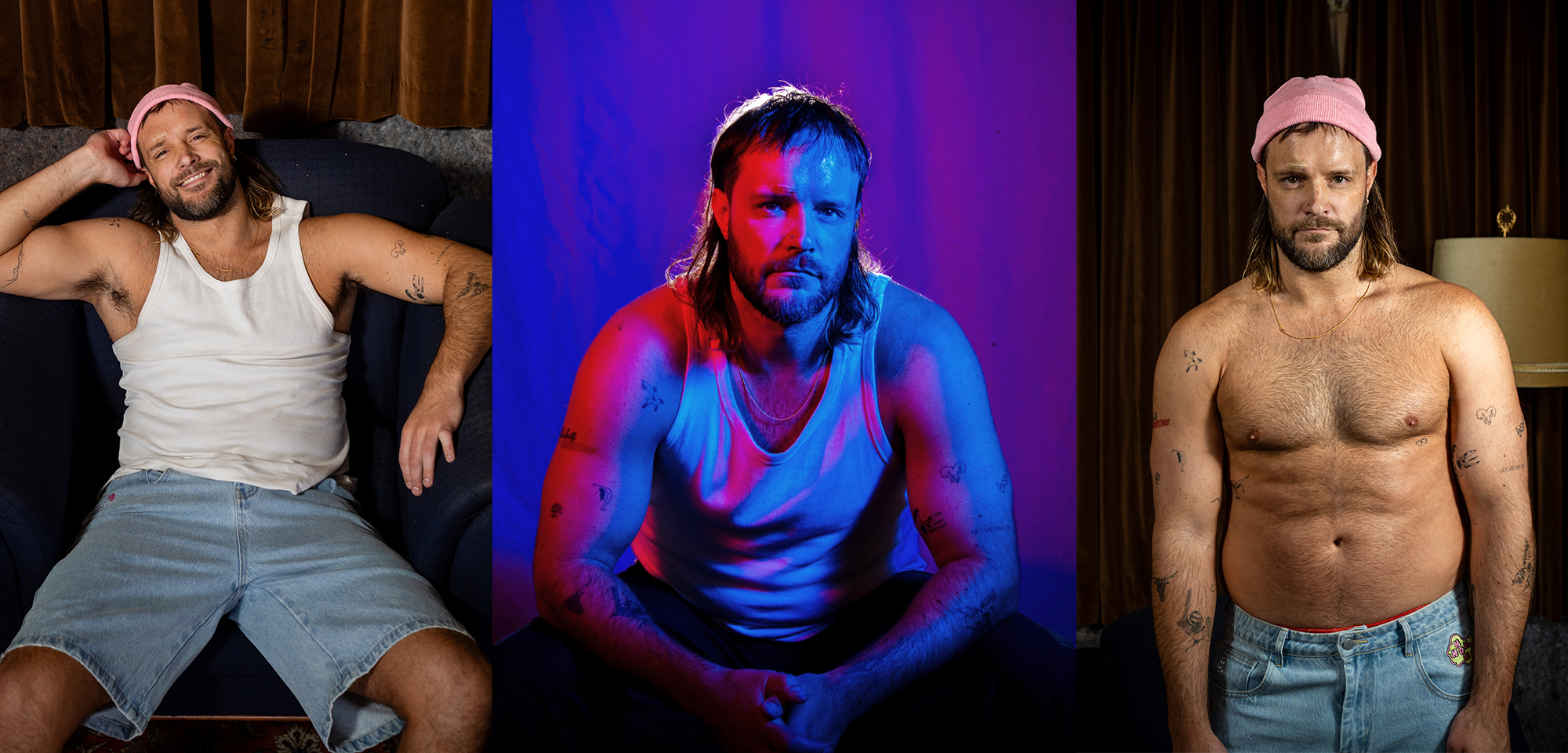
Image: Photos: Alex Zucco
The first thing you notice about Mitch Brown is how kind he is. And not the ‘media-rehearsed’ type of kind — just that down-to-earth, human sort of kind.
When we meet for our photoshoot, he walks into the room — already lit up with shimmering bisexual lighting — and the first thing he does is crack a huge grin, and tell me how honoured he was that Star Observer wanted to interview him.
By the end of the afternoon, it would feel less like an interview, and more like mates having an animated chat about life, love, sport, pride, and our respective experiences of bisexuality.
As we sit down, Mitch explains that he’s still taking in the magnitude of what’s happened in the six weeks since his story broke.
A former West Coast Eagles defender, his coming-out story hit Australia like a seismic shift. Because in the entire history of the AFL, not one male player, current or former, had ever publicly come out as gay or bisexual.
And now, here sits Mitch Brown: humble, thoughtful, funny, and brave enough to crack open the silence.
Mitch Brown: the queer “custodian” for the AFL
It all started while he was on holiday overseas with his partner, Lou. He saw a video of some journalists talking about homophobia in sport, in the wake of Adelaide Crows player Izak Rankine being the latest in a long line of players to use a homophobic slur during a game.
“I saw this video… [of journalists saying] in 129 years of men’s AFL, not one player has ever come out publicly as gay or bi,” he explains.
I shake my head. “129 years is crazy, hey.”
“It’s fucked,” Mitch nods emphatically.
“Statistically, there has to have been queer players,” I say. “They just haven’t felt comfortable or safe enough.”
Mitch nods. “Yeah, exactly,” he says. “And since coming out, I’ve actually had the opportunity to speak with a few of them — guys who played back in the day.
“They told me what it was like, how hard it was, and that they wished they’d had the courage or the environment to do what I’ve done. Hearing that has been really powerful. It’s made me even more determined to keep doing the work, to help make it safer for others.”
He pauses, thoughtful. “So I dropped into the DMs of [journalist] Sam Koslowski. I was like, ‘Hey, I saw this. This is who I am. This is the time. I’d love to chat. I don’t know how to do this — can you help?’”
That message set everything in motion. Very soon after, he’d done what no AFL player before him had dared: told the world exactly who he was.
“For me,” he says, “my job now is about custodianship. If I can help make the men’s competition a little bit safer in the meantime, so people can turn up and feel like they can bring their whole selves, feel like they belong — then I’ve done my job.”

As we talk, his empathy becomes obvious — it’s bone-deep. He’s not performative about inclusion; he truly feels it.
I ask if his goal was to become the role model he himself needed when he was a young, closeted bisexual teen.
“I often think back to little Mitch,” he says. “He was hypersensitive — really on the lookout for, ‘Is this place safe for me?’”
Throughout his younger years and his time in the AFL, he remembers locker rooms and social events where slurs flew casually. “You’d hear jokes — you know, a gay person being the punchline — and that was enough to tell me, this isn’t safe,” he says quietly.
“You get good at pretending, at suppressing. You learn to protect yourself, even if it’s bad for you.”
The public response to Mitch Brown coming out
When I ask about the reaction to his coming out, he smiles. “Overwhelmingly good — so positive. Especially from the queer community. I’ve felt like I’ve been invited in in so many different ways.”
He’s been speaking at panels, meeting young queer people, and reconnecting with retired players who never had the chance to be open. “Like I said, there’ve been conversations with guys who played back in the day,” he says again, “and that’s been really special.”
But he’s candid about the silence from current players. “But there weren’t really too many current players that were prepared to publicly support the queer community when I came out,” he says. “You know, they’d click like, a retweet maybe — but not much more. I got some really amazing personal messages privately — but part of me was like, you know… stand up. It would’ve been nice during this massive moment.”
He shrugs gently. “I know there’s still fear there — fear of being associated with queerness. But that’s what needs to change.”
Bi now, gay later
We dive into biphobia, and Mitch doesn’t hold back — he may have only been out publicly for a few months, that doesn’t mean he hasn’t felt the effects of biphobia his entire life.
“People say that,” he sighs. “Or they assume my partner and I can’t be monogamous. They just can’t get their heads around it.”
“Oh yeah! I’ll never understand why people refuse to believe bisexuality is real — it’s not rocket science,” I laugh. “Have you heard the term bi now, gay later? I’ve copped it, but Bi+ men tend to cop it so much more.”
“Yeeeep,” he says, rolling his eyes sarcastically. “It’s like, I know myself. I’m definitely bisexual. I’m self-assured. I know what I love, and I’m not scared of it.”
He shakes his head, half-laughing. “It’s so weird — people can accept a straight man being attracted to multiple women, but not a bi man loving one person while still being attracted to more than one gender!”

When he talks about his partner Lou, his whole face softens, and he speaks with such tenderness and true adoration.
“She provides a safe space for me to share anything,” he says. “Her reaction is so safe. She’s been incredible — she’s been just as big a part of this as me. I’m just the one that gets to talk.”
Their relationship, he says, feels stronger than ever, and Lou has been his rock through this experience. “She’s seen every part of this. The good, the scary, the vulnerable. And she’s just been solid.”
Mitch Brown isn’t standing out, simply ‘stepping up’
Another thing I notice about Mitch is how eager he is to learn — he doesn’t pretend to know it all, nor does he want to. He’s genuinely excited to be invited in by the community, and wants to take every opportunity to listen and learn.
At one point during our chat, I use the term ‘code-switching’, and Mitch enthusiastically asks if I could explain what it meant. I explain it’s when queer people shift parts of themselves (like appearance or manner of speaking) depending on who they’re around — for safety, comfortability, mental wellbeing; all sorts of reasons. He nods thoughtfully. “That makes sense,” he says. “There’s maturity to that, I think.”
That humbleness runs through everything he says. I ask how he feels about people making snarky comments online — about him just wanting his 15 minutes of fame, for example.
“I believe that I’m not standing out,” he explains. “I’m just stepping up to be with the queer community, and with the advocates and allies who’ve been fighting in this space for so long.”

‘I’m proud of who I am — the good, bad and ugly’
As we near the end of our chat, I tell him how well he’s doing — how grounded and clear he seems for someone who’s been through a massive life shift just a handful of weeks before.
He laughs and thanks me. “This has been such a nice interview,” he says. “It’s been like therapy — helping me reflect on such a hectic time.”
“[Since coming out] I’m talking better. Thinking better. I’m less anxious, I’m meeting amazing people. It just feels like I can finally be me.”
He grins. “I’m proud of who I am — the good, bad and ugly. The people who love me for that? They’re my people.”
Brown was chiselled, physically and emotionally, through his formative years within a sporting code defined by heteronormative (and often, reductive) ideals of manhood. And now, he is helping to reshape what masculinity truly is; showing Australian men that vulnerability can be powerful, queerness can be strength.
And all by standing up, and verbalising who he is. While he may be a “custodian” for the next queer generation, Mitch Brown’s coming out is undoubtedly a powerful moment; queer Aussie history in motion.
And he’s the right man for the job. He’s still playing the role of defender — but now, a defender of the next generation of queer footballers, and a champion of Bi+ excellence. And he’s overjoyed to be stepping up to stand with our community.
Queer joy, in pink, purple and blue.
All photos: Alex Zucco.



Support the Star Observer… while you still can
LGBTQIA+ media is under threat. Queer content is censored by tech conglomerates who amplify bigotry and push out AI slop — so we receive less financial support than ever.
When our community is muzzled and intolerance intensifies, we need queer media more than ever. Your donation means we can continue paying queer journalists to write queer news.
Don’t rely on the straight lies of big tech – support Star Observer instead and donate now.
![“For [&] By The Community”: Junipero Founder Erin Duncan On The Importance Of FLINTA* Spaces](https://www.starobserver.com.au/wp-content/uploads/2026/10/Untitled-design-7.png)


