



OPINION: Hate Of All Types Is On The Rise – We Need A Royal Commission To Address It All

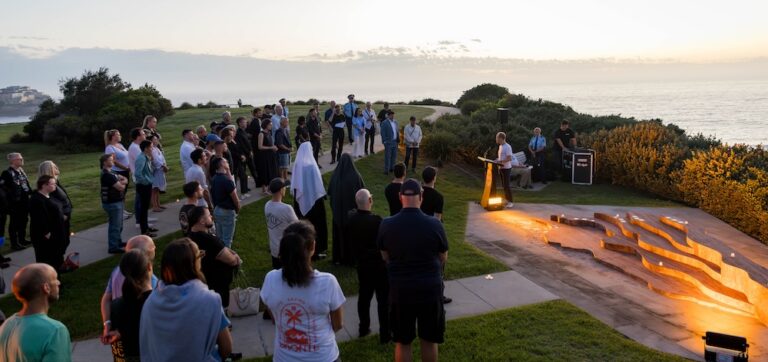
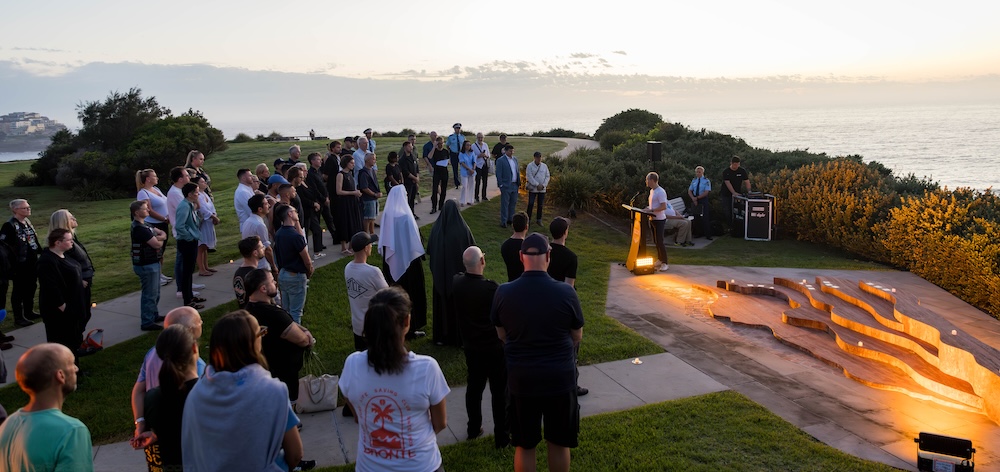
Image: Bondi Memorial:Rise. Image: ACON/Facebook
I learnt a long time ago that people like me were fair game. I have been bashed because I am gay, more than once, in full view of a city that preferred not to look. Those attacks still shape how I move through the world: scanning crowds, policing affection, wondering whether a stare is just disapproval or something more dangerous.
Jewish friends describe a similar sick vigilance. Fifteen people were murdered at a Hanukkah celebration simply because they were Jewish, at a place that should have been safe. The attack was explicitly antisemitic, and it demands the most serious national response we have.
Right now, an open letter is being circulated titled Australian Members of the Rainbow LGBTQIA Community Call for a Federal Royal Commission into the Bondi Beach Terrorist Attack, reportedly drafted by Dayenu and Julie McCrossin. It asks LGBTQIA+ people to back a Federal Royal Commission that looks only at antisemitism. The question for our communities is not whether antisemitism matters; it is whether other forms of hate matter less.
I absolutely support a serious national response to antisemitism and Jewish safety, including a forensic examination of what went wrong before, during and after Bondi. There must be detailed scrutiny of that attack and of how antisemitism is being addressed across Australia. What troubles me is how that response is being framed: as a bespoke Royal Commission for one community, at the very moment others are also living with lethal hate.
If Bondi deserves a Royal Commission, so did the 88 suspected homophobic murders around Sydney’s coastline that queer communities fought for decades to have taken seriously. Instead of a Royal Commission, we eventually received a Special Commission of Inquiry with limited powers, conducted with great tenacity and integrity by Justice John Sackar, while the full weight of a Royal Commission remained out of reach. At the same time, Aboriginal and Torres Strait Islander peoples are still dying in custody more than 30 years after their own Royal Commission, and Muslim and Arab communities are reporting surging Islamophobia.
A single-issue Royal Commission into antisemitism sends a powerful signal: that Jewish safety warrants the nation’s most powerful investigative tool, while other communities must make do with lesser processes. That is not the logic of equality; it is the logic of hierarchy. A Royal Commission that focuses exclusively on one minority community, however gravely harmed, risks deepening the very divisions it is meant to heal.
The open letter to the Rainbow community invokes yellow Stars of David and pink triangles to describe our shared persecution. But inside the camps, gay men were at the bottom of the hierarchy, often abused by other prisoners; some were not freed when the camps were liberated, but sent back to prison under the same laws that criminalised them before the war. It took decades for Holocaust historians and memorials to even acknowledge this history, and in many places it is still an afterthought. That history is why a single-issue Royal Commission today feels uncomfortably like history repeating in softer tones. When we invoke those symbols now without that nuance, it can feel less like solidarity and more like selective remembering.
The deeper problem runs through the whole system. Hate does not live in neat silos. A country that shrugs at homophobia is rarely one that is safe for Jewish people. A society that treats racism against First Nations people as background noise is unlikely to draw a firm line against Islamophobia or anti-Arab bigotry. The same worldviews – that some lives are worth less, that some people are “asking for it”, that whole groups can be blamed for the actions of a few – slide easily from one target to another.
If we only look at antisemitism, we risk missing the ecosystem that sustains it: the same ecosystem that produced the 88 suspected homophobic murders, that allows deaths in custody to continue, and that shrugs at everyday abuse of queer, Muslim and culturally diverse people. If we want to dismantle that ecosystem, we have to look at all of it.
There is another option. Instead of one Royal Commission into antisemitism alone, we could have a single, properly empowered national Royal Commission into hate. Its mandate should be broad enough to examine:
- Antisemitism
- Anti-LGBTIQ violence, including the history symbolised by those 88 murders and current harassment and bashings of gay men, often using apps to entrap
- Islamophobia and anti-Arab and anti-Palestinian racism
- Racism against First Nations people, including deaths in custody
- Racism against culturally diverse communities
The point is not to make antisemitism matter less. It is to make everything that matters – Jewish, Muslim, LGBTIQ, First Nations and other communities targeted by hate – matter equally in the eyes of the state. If “never again” is to mean anything, it must apply equally.
Such a Royal Commission could:
- Map how hate is defined, recorded and prosecuted across jurisdictions, and why some attacks are recognised as hate crimes while others vanish into generic assault statistics
- Examine the performance of police, security agencies, schools, universities, media and digital platforms in responding to hate, regardless of who is targeted
- Develop common national standards so that a bashing is treated as a hate crime whether the victim is Jewish, gay, Muslim, First Nations or culturally diverse
- Confront the long arc that runs from colonisation, to the 88 murders, to deaths in custody, to Bondi – and ask why some victims have always had to fight harder to be believed
A wide-scope Royal Commission could, and should, still contain a detailed, dedicated examination of the Bondi attack and of contemporary antisemitism. What it would change is the message: that the standard we set for Jewish safety becomes the standard we demand for everyone. The level of hate that currently warrants our highest investigative tool would become the benchmark we insist on for all communities facing serious hate.
Designing a national inquiry is a governance decision as much as a moral one. It is a choice about whether we use our most powerful tools in ways that reinforce hierarchies of victimhood, or in ways that build a coherent, shared response. Anyone considering signing or promoting the current letter should pause and ask a simple question: are we comfortable demanding the very best for some communities and something less for others?
If the answer is no, our job is not to reject the idea of a Royal Commission, but to insist on a better one – one that treats every community’s safety as equally worthy of the nation’s highest attention. Not asking for antisemitism to matter less, but asking for everything that matters to be treated with the same seriousness. If we are serious about reducing hate-motivated harm, we need institutions that every community can trust. That means raising the bar for everyone, not just for those with the loudest voices, the best-resourced organisations, or the most developed reporting systems.
So no, I cannot sign this version of the letter that asks for only some of us to be protected. But I am ready to sign, write and organise for something bigger: a Royal Commission that honours Jewish grief, faces our unfinished histories of queer and First Nations violence, takes Islamophobia seriously, deals with racism against culturally diverse communities and insists on a future where no community has to argue that its dead are worthy of inquiry. That is the standard of equality our communities deserve – all of our communities.
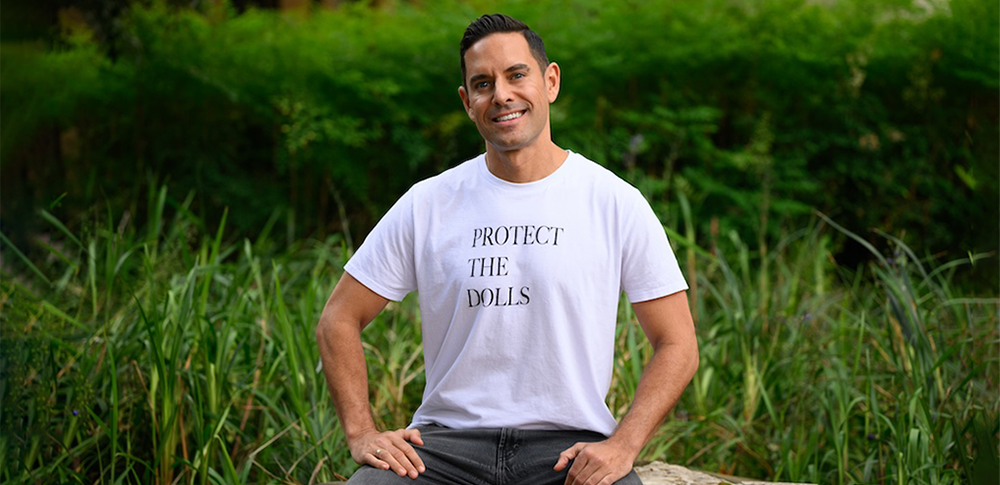
Mark Baxter is a Sydney-based governance and risk professional with extensive C-suite, board and advisory experience across Australia, the UK, Europe and Asia. He is the Founder and Executive Chair of the Australian LGBTQ Board Executive Inclusion initiative (ALBEI), and advises companies and boards on risk management, governance and authentic, diverse leadership to enable ethical growth.




Mark Baxter nails some very serious issues. It’s an excellent article. However, I find it curious that in the age of Andrew Tate he did not mention misogyny. It’s an old and embedded hate, and as Baxter says, hate does not happen in silos. Perhaps people feel that existing commissions and policies are addressing misogyny, but the same could be said for the other forms hatred takes. Misogyny is a murderous hatred that needs deep exploration.