
‘Jimpa’: An Effective Look At The Realities Of Queer Joy
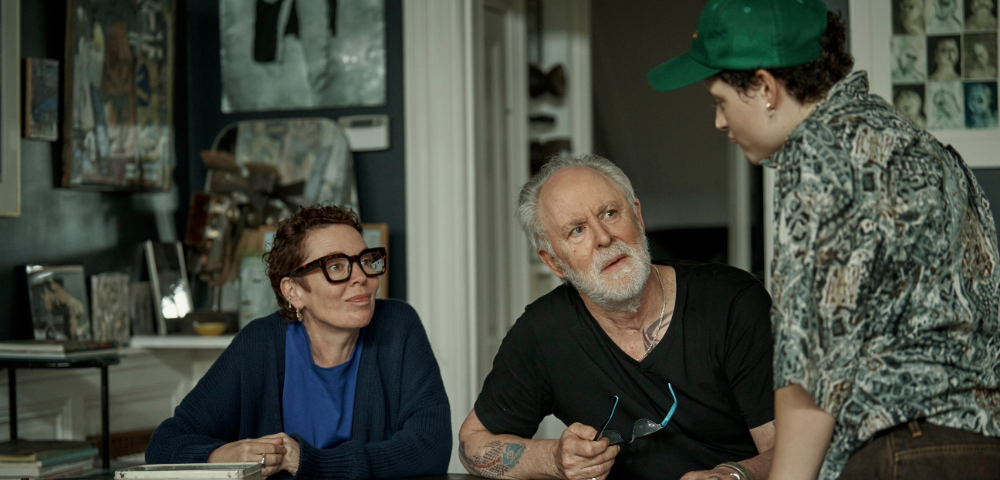
Image: Photo credit: Mark De Blok, courtesy of Kismet
Family can be a complicated thing, can’t it? The ties that bind us to those related to us are unbreakable, for better and worse. But how much sway should those ties have over us, and how should they dictate the relationships we have to our family members? This is one question asked by Sophie Hyde’s Jimpa, an emotionally warm if flawed drama that puts particular emphasis on the relationship of family ties to queerness.
The film follows Hannah (Olivia Colman), a director trying to create a film about her father Jim (John Lithgow), a gay man who moved away from his family to Amsterdam in the 70s. Hannah obviously still has emotions about it to work through, which are brought to the surface when she, her husband and non-binary teenager Frances (Aud Mason-Hyde) go to visit Jim – otherwise known as Jimpa to Frances.
However, Frances has decided that they’d like to live in Amsterdam with Jimpa, a decision that somewhat confounds Hannah. She hopes that the Jimpa in Frances’ head will not match with the reality of Jim as a person and cause them to change their mind… but old wounds have already started to open for everybody.
The greatest strength of Jimpa as a film lies in its performances, which feel strikingly alive and tender in the hands of both veterans and newcomers alike. The lynchpin lies with John Lithgow in a bold, complicated late-career performance that creates a vivid portrait of Jim as a character through vignettes of queer joy. He is bold, outspoken and just a bit politically incorrect, but Lithgow’s performance makes it simple to see just how much life this man has lived.
It feels obvious to say that Oliva Colman is great – some sort of spotty accent work aside – but a real highlight of Jimpa is Aud Mason-Hyde, the director’s real-life teenager who more than holds their own in scenes with acting titans and veterans. It’s a great performance that depicts non-binary identity with the kind of real care and sensitivity that can only come from lived experience.

Jimpa is emotionally affecting, but overexplains itself
However, this is also where some of the problems with Jimpa begin to arise. Though the film has undeniable emotional depth, it has the habit of undercutting it with regular overexplanation in its script. Various concepts and stories are outright explained to characters (and by proxy, the audience) throughout Jimpa, meaning the film settles into a fairly predictable rhythm for much of the second act.
Though I understand that concepts such as compersion in the context of polyamory and even the nuances of non-binary identity need to be conveyed with care to an audience, I found that Jimpa did not regularly use its pleasant cinematography to convey these ideas through imagery. Even most visual flashbacks seem to be accompanied or quickly followed by dialogue explaining them.
The repetitiveness of the script is one of the sorest points, making the film regularly feel overlong in its chosen method of delivery. I feel it could’ve been tightened a little and, with a little bit of restraint, could have made the character of Jim feel a bit more aloof in a way that could’ve benefited the film’s ideas about queerness and family.
And those ideas in Jimpa are genuinely interesting: in familial relationships, what is selfish and selfless? Do such labels even apply when it comes to doing what’s best for yourself? Such concepts may be adversely affected by a surprisingly unsubtle sensibility, but the obviousness of Jimpa means that it’s simple to understand the message it’s delivering, and that is ultimately still worth hearing.



Support the Star Observer… while you still can
LGBTQIA+ media is under threat. Queer content is censored by tech conglomerates who amplify bigotry and push out AI slop — so we receive less financial support than ever.
When our community is muzzled and intolerance intensifies, we need queer media more than ever. Your donation means we can continue paying queer journalists to write queer news.
Don’t rely on the straight lies of big tech – support Star Observer instead and donate now.