



The Official Stonewall Monument Is Now On America’s Endangered Places List
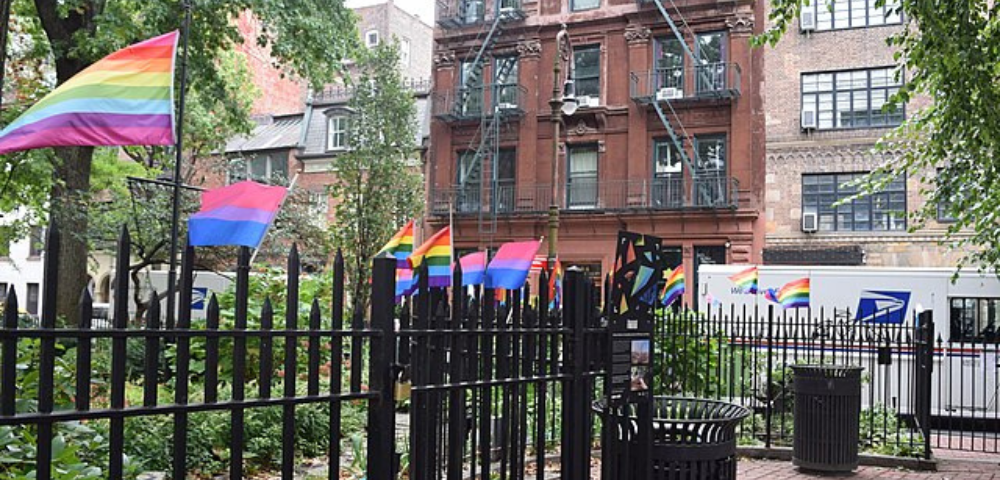
Image: Pride flags in Christopher Park, Stonewall National Monument, October 2025. Credit Wikimedia Commons
Stonewall, the birthplace of the modern LGBTQIA+ rights movement has been placed on a major preservation watchlist, with advocates warning that attempts to erase queer and transgender history in the United States are placing the legacy of the Stonewall uprising under threat.
The National Trust for Historic Preservation this week added the Stonewall National Monument to its 2026 list of America’s 11 Most Endangered Historic Places, citing growing concerns over political interference, censorship and the removal of LGBTQIA+ historical material linked to the site.
The decision comes amid escalating debate across the United States surrounding LGBTQIA+ visibility, particularly the treatment of transgender history within government institutions and national parks.
Stonewall monument added to endangered places list
Established in 2016 by Barack Obama, the Stonewall National Monument was the first US national monument dedicated to LGBTQIA+ history. Located in New York City’s Greenwich Village, the site commemorates the 1969 Stonewall uprising, when patrons of the Stonewall Inn fought back against a police raid in an event widely recognised as a catalyst for the modern gay liberation movement.
According to the National Trust for Historic Preservation, recent federal actions connected to the monument, including the temporary removal of the Pride flag and erasure of references to transgender and bisexual participants involved in the uprising spurred the decision.
The National Trust argued the issue was not limited to symbolic changes, saying gaps in educational resources and altered government language could reshape public understanding of the uprising.
“This comes at a time when the LGBTQ+ community finds itself under sustained assault from a number of federal government actions,” the organisation stated, referencing broader concerns over the removal of LGBTQIA+ content from federal websites and the rollback of diversity initiatives.
Carol Quillen, president and CEO of the National Trust for Historic Preservation, said preserving the complete story of Stonewall remained critical.
“Fifty-seven years ago it took incredible bravery for LGBTQ+ New Yorkers to stand up to the harassment from authorities that they had grown accustomed to,” Quillen said.
“Today, bravery is again required to ensure the full story of the Stonewall Uprising is told at the National Monument, including the roles of transgender and gender-nonconforming people in the events of 1969.”
Advocates warn against rewriting queer history
Ken Lustbader, co-director of the NYC LGBTQ Historic Sites Project, said the monument represented far more than a tourist destination.
“Stonewall National Monument, the first national monument dedicated to LGBTQ history, is a tangible reminder of the LGBTQ community’s role in shaping American culture and society,” Lustbader said.
“Its full story must be protected from erasure because LGBTQ people are, and always have been, part of the American experience.”
Eric Marcus, executive director of the organisation Making Gay History, also warned against diminishing the significance of the uprising.
“The Stonewall Uprising of June 1969 changed the course of history,” Marcus said.
“Failing to preserve and amplify that history in the place where it happened would be an affront to their memories and an insult to the LGBTQ community.”
The endangered listing comes as advocacy groups prepare to mark a decade since Stonewall received federal monument status, a milestone many expected would focus on progress and visibility.
Kristen Sykes, Northeast Regional Director for the National Parks Conservation Association, said preserving the monument’s educational integrity was essential.
“The events at Stonewall changed our history forever and continue to inspire us today,” Sykes said.
“Censorship in our national parks is wrong — it goes against the very values of our democracy and ideals our parks represent.”


Support the Star Observer… while you still can
LGBTQIA+ media is under threat. Queer content is censored by tech conglomerates who amplify bigotry and push out AI slop — so we receive less financial support than ever.
When our community is muzzled and intolerance intensifies, we need queer media more than ever. Your donation means we can continue paying queer journalists to write queer news.
Don’t rely on the straight lies of big tech – support Star Observer instead and donate now.



This story shows a disturbing dimension highlighting the backsliding on many progressive achievements.
Since Stonewall, there have been advances worldwide, as well as in the United States and here in Australia.
To highlight the positives, there has been marriage equality and improvements in recognition of LGBTQIA rights in family law. There is representation of LGBTQIA characters on mainstream media, in film and on television.
Law reform has occurred and many offences have been abolished and convictions quashed. There has been much progress. We must remember the positives.
However, we must be vigilant and willing to resume the fight. We must ensure the past is remembered.
In many countries homosexuality is a capital offence, and the LGBTQI community is persecuted. The US is regressing, this is one example, also the controversy now around the Pulse Nightclub memorial.
Hopefully, this is a temporary development, associated with Trump and MAGA. This monument must be protected.