

Read LGBTIQA+ Commissioner Joe Ball’s Powerful Speech On Trans Healthcare & Supporting Trans Youth
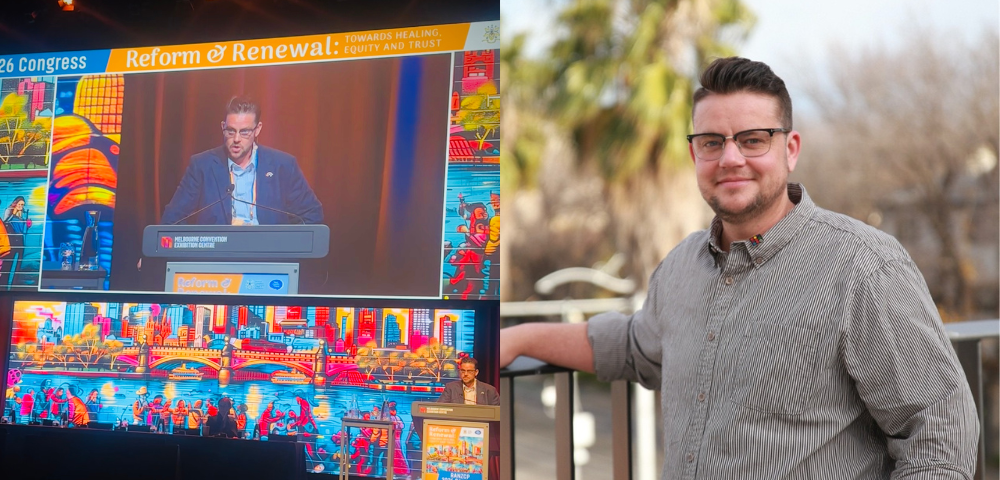
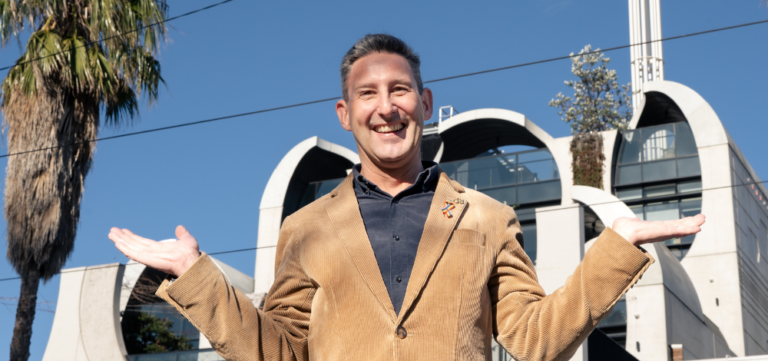
Image: Photos: Supplied
This week, Victorian Commissioner for LGBTIQA+ Communities Joe Ball addressed the 2026 Royal Australian and New Zealand College of Psychiatrists (RANZCP) Congress.
While the annual conference made headlines this year for its interruptions, the Star Observer team wants to spotlight that the more important story is Ball’s incredibly powerful speech on trans and gender-diverse healthcare, and how we can support families and reduce harm for trans young people.
You can read the Commissioner’s speech in full here:
The year is 1975.
Jayne is 10 years old. She’s living in the Stubbs Terrace Children’s Psychiatric Hospital in Perth.
For six months, she is under 24-hour surveillance. One night a week, she is allowed to go home.
Her condition?
That she was a little boy who wanted to be a girl.
Jayne was like many children. She had a family, routines, a sense of who she was — even if she didn’t yet have the language for it.
But something about her raised concern.
Her parents were told something was wrong. That it needed to be corrected.
They were referred into psychiatric care. Care that promised answers. Care that promised help.
And then something happened that changed the course of her life.
Jayne was admitted as an inpatient.
She was separated from her family. Her behaviour was monitored and corrected.
She had to use the toilet with the door open to prove she was standing. Her clothing was inspected daily. She was only allowed to play with boys.
In 1987, Robert Kosky published a study in the Medical Journal of Australia documenting eight children like Jayne. She believes she is the J described in the study.
The study suggested that what was then called “gender disorder” could be corrected through this kind of intervention.
Today, we would describe many of these practices differently.
Conversion practices.
Coercion.
Or more simply: child removal.
Last year, I met Jayne.
She is a transgender woman.
She was not fixed.
She survived.
The title of my talk is Holding the Centre.
It is not what you might imagine,
It is not about the political centre.
It is about who should be at the clinical centre. It is about returning to person centred care.
It is about keeping the child at the centre of care.
It means the child in front of you doesn’t get turned into a theory, a trend, or a stand-in for a broader debate.
It means understanding that the child in relationship — especially with their family.
And it means holding onto that, even when things get noisy.
Jayne’s story didn’t stay a story.
It became data. It became evidence.
That is still being misused and distorted today.
It has continued to shape how transgender children are understood and treated.
We must remember – evidence isn’t neutral just because it’s published.
The Kosky study was built on separation, surveillance, and an expectation that the child would change.
That’s not a neutral clinical setting.
So we need to ask: what kind of evidence are we dealing with when the conditions themselves are coercive?
If you remove a child from their family, restrict how they behave, and decide in advance what the outcome should be — you’re not just observing development.
You’re directing it.
And there’s another part of this history we need to hold.
In early 20th century Berlin, the Institute for Sexual Science, led by Magnus Hirschfeld, was doing careful, respectful work with people whose identities didn’t fit dominant norms. It was the world’s first gender clinic.
It offered care. It built knowledge. It treated people with dignity.
In 1933, that body of work was destroyed during the Nazi book burnings.
Books burned.
Research lost.
Lives erased.
With some of the patients ending up in concentration and death camps.
The Nazis didn’t need a policy or a review on transgender people. They simply burned the research, closed the clinic, and erased the question entirely.
So when we talk about “the evidence base” in this space, we are not starting from a clean line.
Some of it was produced under coercion.
Some of it was erased altogether.
That leaves gaps. And it can leave distortions.
Because flawed research often starts from a flawed premise: that trans people are not real, and that difference must be corrected.
But history — and culture — tell a different story.
Gender diversity is not new. It is not Western. It is not a trend.
Across this region, it has always existed.
Here in Australia, many Aboriginal and Torres Strait Islander communities recognise sistergirls and brotherboys.
In Aotearoa, takatāpui has long described diverse identities and relationships. Across the Pacific, identities such as faʻafafine and fakaleitī are part of cultural life.
These are not emerging categories.
They are enduring ones.
They remind us that gender diversity is part of human diversity — across time, across cultures.
We’ve seen this before.
Homosexuality was once classified as a disorder.
It was removed from the Diagnostic and Statistical Manual in 1973. And by the World Health Organisation in 1990.
Not because people were changed.
But because the understanding did.
The same lesson applies here.
The question is not whether diversity exists. It’s whether our systems recognise it — or try to suppress it.
We often say: listen to the child.
But that’s getting harder.
Because the child in front of you is increasingly being weighed against something else: rising numbers, sudden increases, the language of contagion. No child is a disease, and transgender children are not a disease.
And we have seen this statistical phenomenon before, from two different angles.
First, consider the history of left-handedness. In the early 20th century, the recorded rate was near zero. This wasn’t a biological reality; it was the result of a correction policy. Children had their hands tied. They were shamed. When the shame stopped, the numbers spiked. It looked like an epidemic, but it was actually just the sudden clearing of a shadow. It was the statistical manifestation of safety.
But there is a second, more sobering parallel in clinical history: the depathologisation of homosexuality.
Before 1973, the medical and legal systems had a massive amount of data on gay and lesbian people. Why? Because they were under constant surveillance. They appeared in police ledgers, in psychiatric intake files, and in the rates of horrific conversion experiments.
When homosexuality was removed from the DSM — when the condition was deleted — that specific stream of data effectively disappeared.
By the late 1980s, a researcher looking only at psychiatric inpatient records might have concluded that homosexuality was going extinct. But we know the truth was the exact opposite. People didn’t stop being gay. They simply stopped being patients and inmates.
They moved out of the clinics and the jails and into the community. They moved from being data points of a disorder to being citizens with a life.
This is the double-edged sword of clinical data.
When we see a spike in trans young people today, some call it contagion. But history suggests a different interpretation.
We see them more because we are no longer hiding them in hospitals like Jayne.
We see them more because they are finally appearing in our clinics seeking support rather than being dragged into them seeking a cure.
A population trend is not a diagnosis.
A spike in visibility is not a spike in pathology. It is a shift in the relationship between a marginalised group and the systems meant to serve them.
Let’s also be clear, there is no national registry of Transgender children, children on puberty blockers or children’s admission to gender clinics. And now these numbers are further interrupted by the interruption of care in QLD, NT and over in NZ where there are bans on puberty blockers.
However it can be safely assumed — the numbers are higher than 2 decades ago. But that does not, on its own, tell us something has gone wrong. It tells us that the cost of being known has finally started to drop.
And even perfect data would not tell you who this child is. What they are feeling.
What they need. What will reduce harm.
When the abstract outweighs the child in front of you, you’ve already moved away from the centre.
This brings us to families.
Parents have always been part of social movements.
From Save Our Sons during the Vietnam War, to PFLAG and Transcend Australia today.
Parents come with love.
With fear.
With questions.
Our role isn’t to take sides.
Our role is to improve outcomes for the child.
But not all advocacy is the same.
Today some genuinely concerned parents form coalitions to protest against the existence and access to medical care for trans people.
Often these parents are referred to just “as parents”.
But that label doesn’t tell us very much.
It doesn’t tell us whether they even have transgender children.
It doesn’t tell us whether those children feel safe or supported. It doesn’t tell us what those relationships look like.
It doesn’t tell us that they are cajoled by broader well funded lobby groups.
Understanding the positionality of a parent or parents who are protesting on this issue is important, because I am fervently in support of parents’ role in this issue. But the presence of a parent, on its own, isn’t what protects a child.
The relationship is.
Jayne’s parents wanted the best for her, but instead they had their child removed by a psychiatrist.
Not all advocacy reduces harm. Some of it creates distance between children and the people they need most.
That’s why I support organisations like Transcend.
Because they focus on helping parents stay in relationship — even when it’s difficult, even when they don’t have all the answers.
And we know this clearly: children who have strong, supportive relationships with their parents have better mental health outcomes.
So the task isn’t to centre parents.
It’s to support parents to stay connected to their children.
Because when that happens, harm reduces.
And we need to keep perspective.
The leading cause of death for young people in Australia is suicide.
Data released last week from Orygen shows a climbing suicide rate in girls and young women, with cost and poverty as the leading barriers to help-seeking. These children are not hypothetical. They are in our clinics now.
These are urgent, widespread issues.
Yet culture wars can narrow our focus, creating moral panic around a small cohort of children, while broader systemic issues go under-addressed.
Trans young people are not an abstract debate.
They are children working out who they are, where they belong, and whether they are safe.
And the evidence we do trust — current, ethical, grounded in practice — tells us this:
When they are supported, when they are affirmed, when they remain connected to their families, their mental health improves.
Their risk reduces.
That isn’t radical.
It’s consistent with what we know about all children.
Jayne was separated from her family in the name of care.
Her experience became evidence. Evidence that suggested children like her could be changed.
But she is still here.
Still a transgender woman.
So we have to ask: what did that system actually produce?
Understanding?
Or suppression?
Care?
Or coercion?
We like to think we’ve moved on.
But here is the test.
When the culture war reaches your clinic, your inbox, your practice — what do you do?
Do you move closer to the child?
Or do you step back?
Because we’ve been here before.
We’ve treated visibility as a problem. We’ve tried to contain difference. We’ve let fear — dressed up as evidence — create distance.
And when that happens, the child moves out of the centre.
When we move the child out of the centre, harm does not always announce itself.
Sometimes, it masquerades as care.
Holding the centre is a choice.
To keep the child in view. To keep their relationships in view. To keep their dignity in view.
Even when the data isn’t perfect. Even when the debate is loud.
Because the goal is not to control the numbers.
The goal is to reduce harm.
And harm reduces when the child in front of you is seen clearly, supported properly, and not treated as evidence of something else.
Jayne wasn’t fixed, because she didn’t need and she couldn’t be fixed, she needed to be in a loving family and her parents needed support to understand her.
Jayne survived.
The question is this:
Will the frameworks and the systems we build today require children to survive them — or will they finally allow them and their parents to be supported by them?
Thank you.




Support the Star Observer… while you still can
LGBTQIA+ media is under threat. Queer content is censored by tech conglomerates who amplify bigotry and push out AI slop — so we receive less financial support than ever.
When our community is muzzled and intolerance intensifies, we need queer media more than ever. Your donation means we can continue paying queer journalists to write queer news.
Don’t rely on the straight lies of big tech – support Star Observer instead and donate now.