


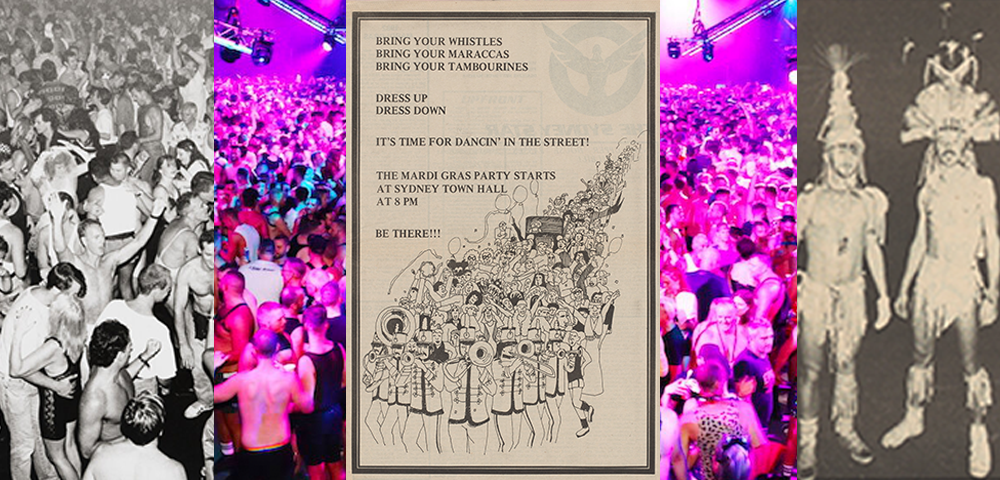
Image: Star Observer Archives, Star Observer Collection via City of Sydney
I only ever see Jonathan on a dance floor, usually at one of the parties maligned as ‘commercial’ or ‘mainstream’ by those who like to draw rigid boundaries around our queer lives. Every few months I catch him out of the corner of my eye. His eyes twinkle as he pokes his head around a stranger’s sweaty shoulder, revealing himself under the strobing lights. Only a hackneyed stereotype will do: his jawline is chiselled, but it frames a beaming smile. We are soon a puddle of exuberant intimacy.
Nick is another of these evanescent friends. Our encounters always occur, shirtless, well on our way to dance floor ecstasy. He’s impossible to miss, well over six foot and covered in tattoos. In other contexts this might feel like a body built to repel, but I’ve only ever known him as a sticky muscular embrace. He always whispers in my ear with the tone of your naughty cousin, ‘let’s get putrid.’ The last time I saw him across a thronging mass of muscular gay boys, it was a day party in the Domain. Sweaty in the sunshine for once. His unsettled expression gave my dancefloor weave a bit more urgency than usual. I reached him and his sunglasses came off to reveal misty eyes: ‘I just started crying when I saw you, what is going on? Fuck I love you.’
I have no idea when I met Jonathan or Nick. The dancefloor defies tidy chronologies because time stretches and contracts in a pleasurable confusion. I can’t marshal my memories into a legible story of deepening affections. I can’t remember our meet-cutes. Was it at I Remember House, perhaps Thick N Juicy? Rather, these intimacies feel as if they have always been there. They are like your favourite Aunt at Christmas, who reliably turns up every year to tell cheeky stories about your Dad when he was a wild teenager.
Nick’s tears tell me something. As do the slightly uncertain ways that Jonathan and I relate when we occasionally bump into each other around the streets of Darlinghurst, where our everyday lives unfold. We are all, I suspect, surprised by how meaningful these relations feel. Perhaps that’s because these connections can’t be translated into a coherent story with a corresponding social etiquette. It’s almost as if we don’t quite believe these friendships are real, and then are shocked by their emotional purchase. A few parties ago, Jonathan came bounding up to me: ‘I was thinking about you when I was getting ready.’ I melted. This was recognition I didn’t know I wanted.
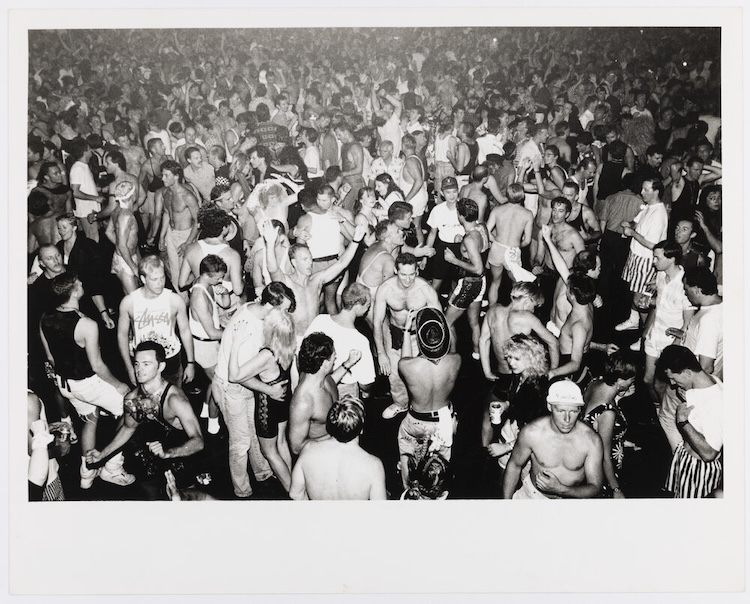
SGLMG’s announcement of the ‘suspension’ of the Parade After Party sent ripples of discontent around Darlinghurst, and indeed, beyond it. There are a lot of feelings going on: loss and anger central amongst them.
In some ways, for those who care about the Party, this response had been building for a while. The constant postponement of announcements and an apparently changed format for 2026 already had the online commentariat agitated. The initial move was explained by SGLMG as an attempt to provide a way to enjoy the party for those whose patterns of life mean they might not want to ‘really get going’ at 2am or who might struggle to move through a Hordern Pavilion packed with heaving, muscular, cis-male bodies. The official explanation for the suspension of the Party this year was a little more promiscuous – budget blowouts and apparently unforeseeable problems with the ‘headliner’ were cited along with an assertion that the Party might no longer fit the needs of the community it claims to represent. Comments sections are full of disappointed partygoers decrying the cancellation as a mismanaged betrayal. Others see the outcry as a storm in a self-indulgent tea-pot. For those disappointed by the cancellation, though, something very real seemed to have been taken away.
Contests and divisions about and within the Board, and what Mardi Gras ‘stands for’ were clearly playing out in these responses. The stakes of those contests are familiar ones, and they matter. The history of the SGLMG is, in some ways, a long history of near collapses and budgetary crises. This seems to be the fate of an organisation attempting to deliver a dizzying assemblage of events that ‘represent’ diverse queer lives and needs. The budget is big, there are not that many paid staff, salaries aren’t amazing, there is a lot of volunteer labour to be corralled, and there are many folks who have a deep attachment to the event they manage: this is a tough gig.
Contests over ‘gay Christmas’ are always debates about how queer politics and community building is conducted, and about the assumptions that silently govern the terms under which those projects unfold. How (or whether) Mardi Gras tarries with the politics of settler-nationalism, and whether it can attend to gender diversity in anything more than a tokenistic and gestural manner disrupt the (always potent) tendencies Mardi Gras has towards deeply troubling normativities. They are debates about how the social infrastructures maintained by SGLMG determine who gets to feel the warm embrace of communal feeling, and the failures of that word – ‘community’ – to live up to its promise. These questions, and their irresolvability, provide the political atmosphere in which this latest furore has unfolded.
As an historian, though, I also was struck by the fissure this decision represents in the history of Mardi Gras. There is an historical lineage of After Party dance floors that has been suspended, but I hope not wrecked.
I’ve been thinking a lot about dancefloors over the past few years, about what happens on them and their queer possibilities. As an historian of queer life in Australia. I’ve been interviewing folks who lived, danced, played and worked in and around Darlinghurst in the worst years of the AIDS crisis. The dance floor has been a big part of these stories, even as I trace the history of an unbidden catastrophe.
This seems like an odd conjunction, given the careful decorum with which we now treat that history. Even more strange given, at the time, AIDS felt to some like an historical retribution for recently won pleasures and possibilities. That Darlinghurst had, in the late 1970s, been described as a ‘gay ghetto’ granted these distorted explanations the psychological potency of historical analogy. The ‘ghetto,’ once a playful evocation of historical forms of concentration and exclusion, now felt a target of viralised extermination.
We usually tell the AIDS story in the political registers bequeathed to us by the political activists and community leaders who did the hard work of mobilising, organising and commemorating for a community suddenly disoriented by a plague. This work deserves deep gratitude. In my research, however, rather than interviewing activists and community leaders, I’ve instead spoken with folks who saw the clubs, bars, and gyms as their precious community spaces, and who probably rarely attended a political meeting. They watched queer politics out of the corner of their eye, and probably spent more time talking about who was playing at the Midnight Shift next Saturday. I’m trying, in my own small way, to take their experience of the AIDS crisis as seriously as we might treat the history of ACON and the activists who powered it. Their stories don’t have the polished coherence of political intentionality. Their ideas are looser, and more full of contradiction. While they may have had less impact on the political response to AIDS, the meanings they made from it are no less historically significant. They perhaps tell us more about a poetry improvised in the dance of everyday life.
It seems illustrative that their memories of those years weren’t tidied up into the expected stories we often tell about a community who came together during the crisis. They have a lot to say about exclusion, a lot to say about exhaustion, and also a lot to say about wit and humour. I can still recall the larrikan twinkle that accompanied a description of the AIDS Quilt, that near sacred object of queer grief, as the ‘doona of death.’ My interviewees have toggled between emotional registers in ways that refuse satisfying narrative coherence.
They have also talked a lot about the dance floor, both as social space and as metaphor. These folks narrate their queer lives by remembering dance floors. I recognise the urge, as well as the difficulty one has defining what happens upon them.
Some talked about ‘growing up under the mirror ball,’ others about how the dance floor was an ‘affirmation of community’ that unleashed energies for the week ahead. Others leaned heavily on metaphors about people ‘disappearing from the dance floor’ as deaths in the neighbourhood became nearly impossible to bear, sliding seamlessly into memories of shared grief within those spaces. This was much more psychologically and historically profound than the description of partying so often mobilised in AIDS histories. In these histories the drug fuelled dance floor often represents an escape from grief or perhaps even its unhealthy suppression and denial. But my interviewees did not see the dance-floor as an escape, nor as as balm. Their dance-floors were generative, both socially and metaphorically.
Why the cancellation of Mardi Gras Party feels all too familiar
While these interviews have astounded me in their wondrous incongruities, the recent spat about the After Party looks, to an historian, deeply familiar. For example, contests over the placement of the parade, its timing, and who should be in it are part of its tradition – as are disagreements over where meagre resources for community building should be directed. These began in the early 1980s, when the decision was made to move the parade from Winter to Summer to encourage participation. Some activists saw this as a shameless commercialisation of their political mission.
Once the dizzying scale of Mardi Gras became dependant on corporate and commercial sponsorship, forces have pulled it toward a becoming a parade and festival that reflects and promotes the fantastical lives of shiny white gays. In the 1990s it was their ‘pink dollars’ that aroused the neoliberal fantasies of some of the SGLMG Board, its corporate sponsors and those in government who could see the value of the event as a ‘tidy little earner’ for the state. More recently, these comforting homonational tendencies have found alignment and legibility in companies that celebrate Mardi Gras by serving a few cupcakes with rainbow icing in late February to satisfy their diversity credentials.
Groups like Pride in Protest intervene into the belligerent norms that always threaten to turn Mardi Gras into a smooth bastion of uncritical (specifically white and gay) pride. The defensiveness with which these interventions are greeted is deeply recognisable and deeply frustrating. There is palpable exhaustion from those who constantly get bumped to the back of the community bus, as they remind those who claim its wheel, once again, of the tunnel vision produced by their privilege.
At the same time, though, there seemed to be some other emotional and political motors driving the response to the cancellation of the After Party. These responses cannot only be explained by the politics of community and the kinds of communal life these politics enable, even as this suspension was explained by repeated references to apparent community needs.
Mardi Gras Party: Where the fleeting & the emotional meet
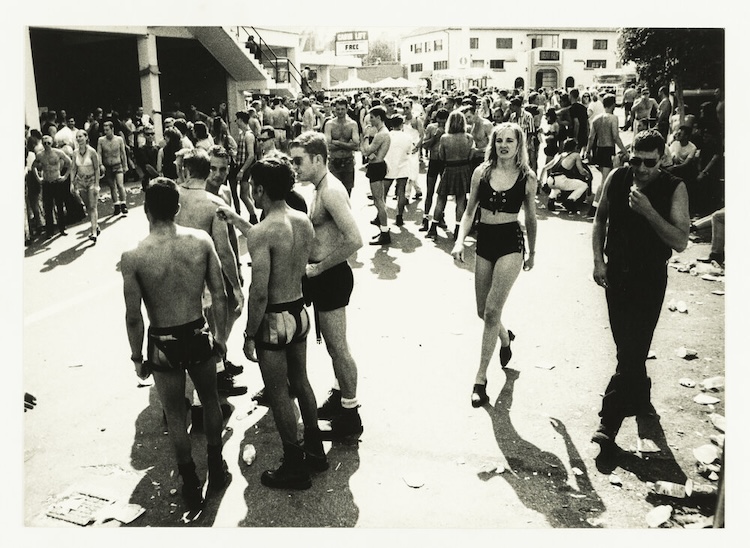
Deep loss haunted the edges of the response, a kind of illegible and unstated attachment to the relations that unfold on the dancefloor itself. For a long time now, the Mardi Gras After Party has been bought to a close, for me and a few friends, dancing outside as the dawn breaks. Perhaps I’d bump into Jonathan or Nick in this moment as they emerge, blinking, from The RHI and then The Horden. The joy of this moment only multiples through a cacophony of quick hugs and bum pats as folks leave the party. I always then waddle back to Darlo with my friends to figure out what we might have left in us for the remainder of the weekend.
I suspect many of us have their Nicks and Jonathans, who they perhaps only see once a year on this particular dancefloor. In fact, I know we do. There are folks who only connect in this space, an annual return that is given is purchase by its repetition. Sometimes these are ‘party friends’ whose lives were once more entangled, other connections have only ever taken place under the strobing lights, but they are also decades old. This party is a palimpsest of queer stories, to which we added a layer every year, energised and animated by our memories as we did. The dance floor isn’t just a set of encounters in the ecstatic time of the dance-floor present, it’s a set of encounters repeated over historical time.
I was undone in one of my interviews when a man who seroconverted in the late 1980s brought out a photograph of him and his three closest friends, blinking in the dawn light, engaged in that same ritual (someone had clearly snuck in a camera in the years when they were banned at the party). I recognised the depleted but euphoric expressions on their faces. ‘I buried all three,’ he whispered, ‘they were my best friends.’ The recording of this interview captures a set of muffled sobs and microphone thumps as we embraced. I cried with him in the interview, I cried again when telling this story to my own dawn-ritual friends.
I had been dancing in the footsteps of this man and his friends for years, unknowingly and yet somehow also anchored by our shared lineage. This little tradition will not unfold this year. This year, we won’t find our ways from disparate dance floor clusters to giggle as the sun slowly reminds us that time does not, in fact, stand still – even as we gleefully wring every last drop of joy out from the party.
I don’t envy the folks at the SGLMG right now, they are trying to implement a communications strategy to fabricate consent in the context of a set of potent emotional investments. This task is made even more difficult by the poverty of options to describe what happens on those dance-floors and why they matter for those who feel this loss acutely.
A friend of mine ran headlong into a mess of political and psychological investments when he entered the chat in the comments page of the Mardi Gras announcement. He was pissed off, having planned a return to Sydney from the US this year. Someone gave him a bit of a rhetorical slap, suggesting that he was a superficial global gay if he was organising his life around a gay dance party – this, his critic wrote, wasn’t ‘community.’ This dismissal, I think, is not unique. Though my friend tartly replied that this party was, in fact, where he gets to see so many friends once a year. It is an easy reflex to decry the dance-party as simply meaningless pleasure.
Indeed, that 1980s distinction between ‘commercial’ (superficial) and ‘political’ (meaningful) still echoes in our own queer worlds. I’ve felt its velvet sting when I talk about my favourite parties – which, it would seem, have too many shirtless cis-men and not enough ironic self-awareness to be deemed meaningfully queer. Naming your favourite parties inevitably invites an assessment of your queer bona-fides, or perhaps even can become a performance of them. We would do well to remember though, that, berating one and other for not enacting our queer sociabilities in the right way or at the right parties, is not the same as doing something concrete about the forces that materially and consequentially limit our queer lives beyond them.
These are potent stakes percolating underneath these debates. It’s a puddle of political, social, and psychic investments in which we offer comparisons in order to make our queer identities feel solid. Words like community, commercial, superficial, and political do a lot of work – they turn our experiences, both pleasurable and not so, into stories we tell about our queer place in this world. Indeed, dancefloors can also be full of moments of rejection and misrecognition. I’m quite certain, and still a little ashamed, that once, on sighting Nick, my excited trajectory across the dance floor clattered a few bodies that I tactlessly barrelled aside. My boyish enthusiasm turned my body into, for others, a meaty bludgeon. The next day, and still now, I worry about the ways in which my enthusiasm was also unthinking entitlement.
I know there are some legitimate wounds powering the dismissals of the dancefloor. But, these critiques of the shallow pleasures of the dance floor, or, of certain dancefloors as more shallow than others, miss something crucial about what can occur in these interstitial entanglements.
This is where stories about everyday life are recounted on the dancefloor with lips touching my ears, and fingers in the waistband of my jockstrap. These moments dance between the sexual and the social, between the substantial and the ephemeral. The disclosures that have been made in these moments astound me. Cancer diagnoses, relationship breakdowns, career ambitions, and all the other big ticket items we expect to know about our good friends. I know so much about these dancefloor partners, even if I struggle to remember their surnames, and only ever see them when we come together under the disco ball. This is a history of barely named rituals, of pleasures made deeper by their variable repetition. By seeing them as the proper subjects of queer history (and thus also of queer investment and consideration) we can properly understand the lineages that entangle and connect us, both across and within time. We can dance in memory if we choose to.
Recently, I was in just such a conversational embrace with Jonathan when I told him about my work, probably a little less coherently than I might have in other contexts. Like any historian in the thick of their work, I was expansive – perhaps embarrassingly so. I described this research as an attempt to explore the experience of living in Darlo, bumping into friends and forging a queer world, and to give this set of strange and unwieldy intimacies the significance they clearly have for so many who have lived and live here. Twenty minutes later he came bounding back to me, I think misty eyed, ‘I can’t wait to see our lives taken seriously.’
Dance floors like Mardi Gras Party matter
The dance floor matters, sometimes in ways we struggle to explain, and even more to communicate to those who don’t enjoy or experience its unbridling pleasures. That essays like this one could be published in the emotional and cultural wake of the AIDS crisis, suggest that a few decades ago, we were more willing to try. Like the memories of my interviewees, in the context of the AIDS crisis, it seemed more possible to make a claim that something politically and socially generative can be unleashed from these spaces. In my research, then, I am trying to think about, from and with the entanglements produced by these spaces.
But, at the same time, its critics have a point. I have a body and, in the right lighting, a face that means folks like Jonathan and Nick will see me. More often than not, this swirling mass of bodies feels like an embrace. I can usually ease into the writhing snarl of flesh on the dancefloor rather than experiencing that human knot as an impenetrable mass of dismissal.
But, it’s hard to have a conversation about the heavily weighted dynamics of exclusion when they occur in a space often described as superficial and fleeting.
It’s even harder to make sense of loss when the object of this mourning is powered by pleasurable disassociations and ecstatic exuberance.
But perhaps we might be better at attending to the significance of the slights and exclusions that occur within them if we had a language and a story that acknowledged this significance, and that important things happen here. By speaking with and to the survivors of the AIDS crisis, who placed the dance floor at the centre of their memories, I’ve felt emboldened to try. The dance floor matters – even as we struggle to narrate its relations and what they mean to us.
Leigh Boucher is an Associate Professor of History at Macquarie University, as well as a bit of a Darlo party boy. His latest co-authored book is Personal Politics. He is now researching the social and political history of the AIDS crisis in Sydney’s inner east. A podcast telling this story will be released on 17 February.
The Star Observer Archives feature high resolution scans of every Star Observer issue dating back to 1979 — that’s 1,652 issues comprising 61,373 pages — and is a truly phenomenal resource of Australia’s LGBTQIA+ history. You can check out the Star Observer Archives HERE.


Support the Star Observer… while you still can
LGBTQIA+ media is under threat. Queer content is censored by tech conglomerates who amplify bigotry and push out AI slop — so we receive less financial support than ever.
When our community is muzzled and intolerance intensifies, we need queer media more than ever. Your donation means we can continue paying queer journalists to write queer news.
Don’t rely on the straight lies of big tech – support Star Observer instead and donate now.




I know times don’t stand still and it’s up to us to keep up which is not easy in the current landscape.
I just wish that some of the wisdom offered up in terms of what works and what doesn’t was taken a lot more serious. Once Sleaze was removed which was the financial buffer for MG This left a rather large financial void.
Having said that the amount of money Sydney generated was second to none. This should of always been at the top of the negotiating table. Securing venues with a proven track record makes for a more powerful prese tation. Incorporating critical positives point form ex. Stagnating the venues closing times was and is one such point.
As far as headline acts go, given that the act was suppose to be a secret it’s not going to generate additional ticket sales. So the attendance numbers are dwindling Dwindle with it Not dwindle of the map. It’s way to historical to be just pushed aside.
Reduce the number of venue’s Negotiate better costs involved Put relevant DJ’S on the bill , don’t get as much lighting , Tender out specifics , There’s a host of areas where funds can be saved.. In the early days performers would just pop up , Drag queens , fire dancers , Sylvester (had to include him)
Mesmerising dancers all would just appear and do whatever to whatever music was playing. Limiting the bar was a big negative, I would be more than willing to throw a plethora of ideas to keep this part of our history alive.
What a well written and very informative essay by Leigh Boucher. He not only summed up the entire community’s feelings and concerns about the cancelation of the Mardi Gras Party, but he’s delved into the history of the event and it’s psychosocial benefits to the LGBTQIA+ community, including AIDS survivors.