



Hey Wayne Carey! If Mitch Brown’s Black-Tie Outfit Offends You, That Sounds Like A ‘You’ Problem
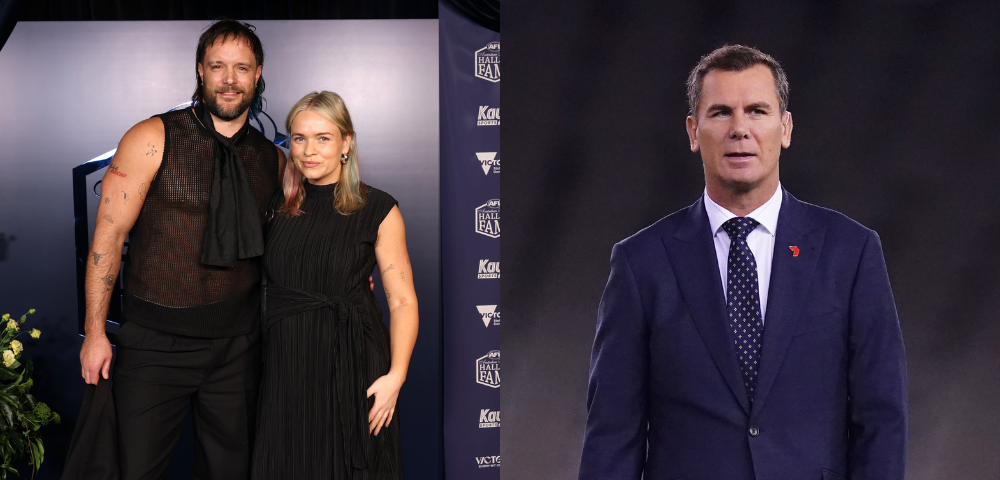
Image: CON CHRONIS/AAP (L), SCOTT BARBOUR/AAP (R)
What is more predictable than straight men seeing a queer bloke wear something interesting and acting like civilisation is under threat? This week the target was former AFL player Mitch Brown, who wore a suit with a black mesh top and silk cravat to the AFL Hall of Fame dinner, prompting collective pearl-clutching from football radio shock jocks.
Both Brown and his partner Lou Keck looked stunning, elegant, polished; prioritising self-expression while remaining entirely appropriate for the event. But apparently a man deigning to play with silk and sheer materials at a black-tie event is now a matter of national concern.
Wayne Carey posted “Mitch Brown HOF outfit seriously??” while Garry Lyon declared that “a mesh singlet ain’t the go” for black tie. Tim Watson reportedly questioned whether Brown should have even been allowed into the room – a truly staggering take.. The whole thing is embarrassing for them.
The thing that has been driving me slightly mad is the way these are raving, you’d think Brown had rocked up in assless chaps (which I’m sure he could pull off, tbf). But he didn’t.
He wasn’t disrespectful to the dress code, didn’t look sloppy or look out of place. The outfit was formal and fashionable, and was clearly considered, tailored and intentional. It’s the sort of fit you’d expect to see on a red carpet, at a fashion event, or frankly on anyone who has spent more than five minutes looking at menswear that isn’t from Tarocash.
Another of the weirdest parts of this is that they’re acting as though “black-tie” is some sacred and unchanging institution. It’s not. Fashion changes; social expectations change.
They might want to learn their fashion history too. If they’re trying to say a black-tie dress code is unchangeable from its original meaning, then technically majority of the attendees at this event were being ‘disrespectful’, because traditionally ‘black-tie’ meant wearing a tuxedo, not just a generic black suit.
But, this has evolved. In recent decades, ‘black tie’ just kinda means formal with dark colours; effectively meaning men just wore a basic black suit. Thankfully, we’ve moved on from that. Contemporary menswear – including for formal and black tie dress codes – includes sheer fabrics, unconventional tailoring, jewellery, draping, texture, even skirts. That’s not some fringe concept anymore. That’s mainstream fashion.
Yet every time a man steps even slightly outside the box even a little, these commentators react as though society itself is hanging by a thread.
It’s 2026 – men do not have to spend the rest of eternity dressed like middle managers attending a corporate awards night.
What really sits underneath all of this, though, is the assumption that because some people feel uncomfortable with something, that thing must therefore be inappropriate.
Discomfort and harm are not the same thing. Plenty of people feel uncomfortable when they encounter something outside their own experience. Some people are uncomfortable around drag queens if they’ve never met one before. Some people seem to break out in hives at the sight of a man wearing pearls, makeup or, heaven forbid, sheer tops.
But none of that automatically makes the thing they’re looking at inappropriate.
It simply means they’re encountering an idea of gender or self-expression that doesn’t neatly fit into the boxes they’ve built for themselves from a society that has anti-queerness baked into it. But that’s not something queer people should have to apologise for, or shrink ourselves around.
Maybe that’s why this whole thing has irritated me more than it probably should. Because every queer person I know has experienced some version of this conversation. Not necessarily about a mesh top at the AFL Hall of Fame, obviously, but about our appearance and self-expression.
The shirt that’s “a bit much”. The haircut that’s “sending a message”. Relatives feeling uncomfortable because you chose to wear a suit to a wedding instead of a dress. Queer people learn pretty early that clothing is never just clothing in the eyes of people who are invested in policing gender and sexuality, and no matter how carefully you try to adhere, somebody will inevitably decide you’ve crossed an invisible, arbitrary line they invented five minutes ago.
Queer history is full of examples of exactly this.
Women wearing trousers were once considered scandalous and inappropriate. Throughout much of the twentieth century, butch lesbians and gender non-conforming women were harassed, refused entry to venues, even arrested because they weren’t dressing in ways society deemed acceptable. In the decades before gay liberation, drag queens or people whose clothing challenged heteronormative ideas about gender were often the first targeted during police raids on queer bars.
But the clothes were never really the issue. Ingrained homophobia, biphobia, lesbophobia, transphobia, etc, meant we were always going to be a problem.
Which is why I find all this talk about “respect” for a dress code of all things so bizarre and frustrating.
We’re talking about a sporting culture that has spent 130 years actively making LGBTQIA+ people feel unwelcome. A culture where queer players have repeatedly spoken about isolation, fear, and feeling like they didn’t belong. A culture where, until remarkably recently, coming out publicly as anything other than straight felt impossible for many athletes. For many closeted players in these kinds of hyper-masculine sporting codes, it still feels impossible.
That is the actual issue here, not the fact a queer man dared to wear something more interesting than a basic poly-blend black suit and white shirt.
Brown himself explained on his social media that returning to these traditional spaces while being fully himself felt empowering.
“I feel great, coming back to these spaces and being who I am and not wearing what you’re meant to wear is all part of my self expression,” he told Sport Confidential. “Dipper came up to me and said I wish I could wear that.”
THAT should have been the story. The fact that a male AFL player could show up authentically, comfortably and confidently in a room that historically hasn’t felt welcoming to people like him could have, and should have, been celebrated as a marker of progress.
These ex-players and radio hosts, some of whom haven’t exactly been beacons of respect and honour in their careers, could have chosen to celebrate this moment. Or just – call me bonkers for suggesting such a wild notion – not said anything at all?
Instead we’ve ended up with commentary that, whether they agree with this or not, has screaming undertones of homophobia and biphobia.
The priorities are absolutely cooked.
Dont get me wrong, people are allowed to dislike fashion. I’ve disliked plenty of outfits in my life. We all have. Every single person reading this has looked at a celebrity on a red carpet and thought, yeeeuch.
The difference is that most adults understand a very simple concept: you can just shut up. Personally, my mother taught me ‘if you don’t have anything nice to say, don’t say anything at all’ when I was a toddler.
You can dislike someone’s outfit and simply say nothing and continue living your life. You can think somebody looks not-great and choose not to turn it into a national conversation.
Which brings me to my final point: I admittedly don’t love hearing the opinions of straight men literally ever – but one of things I don’t care for their opinions about the most is fashion. Of course there are outliers, but traditionally, fashion just ain’t a strength for the straightie-180 fellas. So I don’t particularly want fashion advice from the average straight man at the best of times, but I certainly don’t want it from a group of basic-as-hell football radio hosts carrying on as though they were personally victimised by a bloody mesh top.
Fashion is subjective and self-expression is personal and queer people have spent generations fighting for the right to express ourselves openly without having to seek approval from the most conservative people in the room first.
If Mitch Brown wants to wear a mesh tank top and silk cravat to the AFL Hall of Fame, good for him. He looked fabulous. And despite the bitching and whining from the peanut gallery, the world will keep turning.
And if a bisexual man’s outfit is genuinely causing you more distress than the barriers LGBTQIA+ people still face in Australian sport, then maybe it’s time to stop worrying about what people wearing and start paying attention to what actually matters.







Leave a Reply