
“Bisexual Or Pansexual?”: We Answer All Your Online Search Qs On Bisexuality & Pansexuality

Image: via Facebook
Google knows a lot of things about us that we would probably rather it didn’t. It knows what weird medical symptom we convinced ourselves was terminal at 2am, which celebrity’s dating history we suddenly became extremely invested in, and, apparently, when a whole bunch of Australians started wondering whether they might be bisexual or pansexual.
And honestly? Fair.
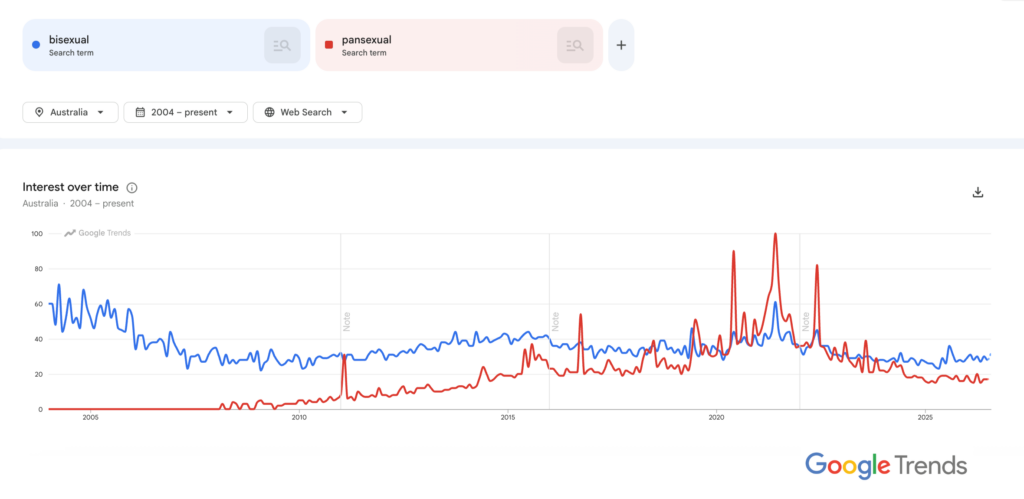
We decided to look at the Google Trends data for Australia on the latter, and it shows a pretty fascinating change in the way we’ve searched for the terms “bisexual” and “pansexual” over the past two decades here.
Back in 2004, searches for bisexual were already well established. Pansexual, meanwhile, barely registered at all. It starts appearing with any consistency around the late 2000s, builds slowly through the early 2010s, then really takes off through the second half of that decade.
By around 2020, search interest in pansexual was regularly competing with bisexual, with some enormous spikes over the following few years.
Things have settled somewhat since then, but pansexual remains a vastly more familiar search term than it was 15 or 20 years ago.
And people are still trying to work out precisely what both words mean.
Among rising searches connected to bisexuality in Australia are “pansexual”, “bisexual women”, “am I bisexual”, “bisexual meaning” and “what is bisexual”. Meanwhile, some of the biggest searches connected with pansexuality are basically the same question asked ten different ways: “pansexual meaning”, “what is pansexual”, “pansexual define”, “define pansexual” and “what does pansexual mean”.
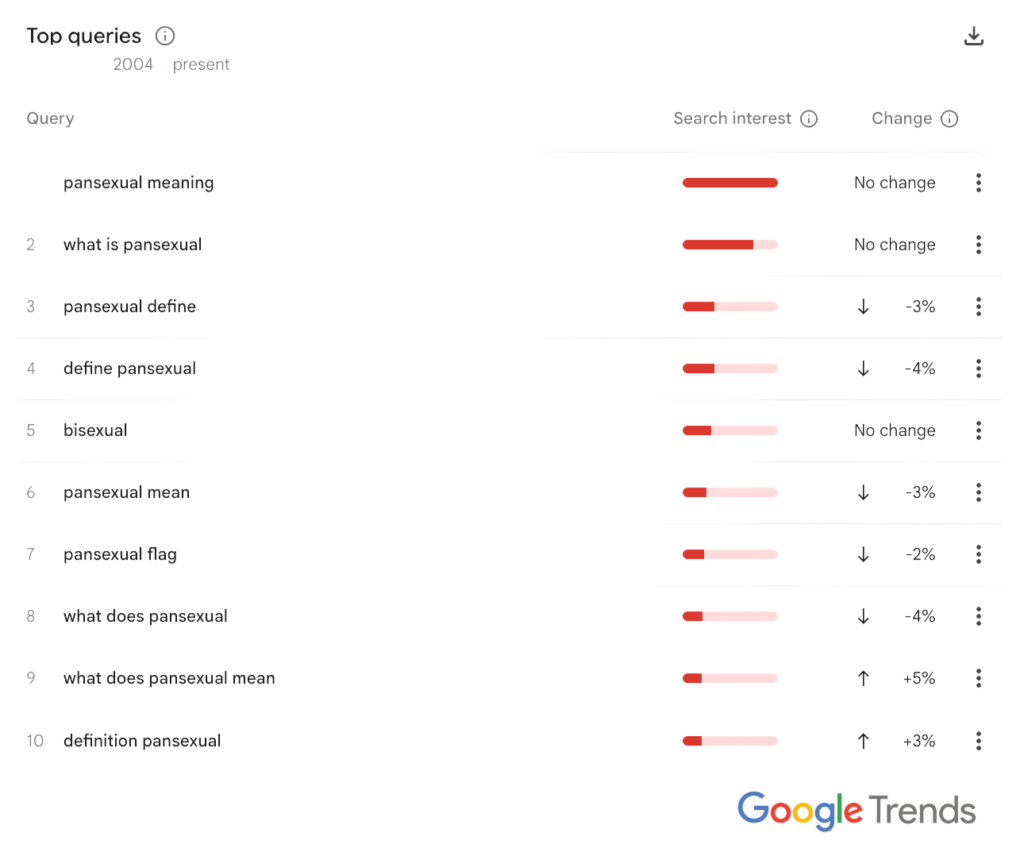
Which tells me two things: sexuality is complicated! And apparently none of us trust the first result.
Which I totally get – I identify as bisexual, and I absolutely did my share of frantic internet research while trying to figure myself out when I was younger.
I chose the word bisexual for myself before pansexual had really entered mainstream vocabulary. By the time pansexual became a term I heard regularly, bisexual already felt like mine. It had history for me. It held years of figuring myself out, coming out, occasionally having to come out all over again (because bisexuality can sometimes have the fun little superpower of becoming invisible depending on who you’re dating).
My understanding of bisexuality has also never excluded trans or non-binary people. For me, “bi” has always meant attraction to two or more genders — or, another common formulation, attraction to genders like your own and genders different from your own. That broader understanding has a long history in bisexual communities.
Technically, the way I experience attraction could probably fit comfortably underneath the definition of pansexual too. But I’ve used the word bisexual for myself since I was 13, and I like my word, it makes me feel comfortable. Which is all we can really ask for, of these simple words trying to cover the complex experiences of an enormous amount of individual human beings.
What does bisexual mean?
Okay, keep in mind that all of this is complex and nuanced, and everyone’s experience is totally unique. But at its simplest definition, bisexuality means having the capacity for romantic, emotional and/or sexual attraction to more than one gender.
It does not necessarily mean only being attracted to only two genders, or only cisgender men and women. This may be the case for some, but its certainly not for all.
That misconception largely comes from interpreting the “bi” in bisexual to mean two genders. Bisexual communities have long used much broader definitions: activist Robyn Ochs, for example, famously describes bisexuality as the potential for attraction to people of more than one sex or gender, without requiring that attraction to happen simultaneously, equally or in exactly the same way.
Someone might be attracted to women and non-binary people and identify as bisexual. Someone might be attracted to men, women and non-binary people. The gender of their romantic partners might be very important to someone, or not super important to another.
They can all still be bisexual.
And no, being bisexual does not make somebody transphobic or imply they only recognise two genders. That misconception needs to be packed into a bazooka and fired directly into the sun, imho.
What does pansexual mean?
Again, different for everyone. But at its simplest definition: pansexual describes someone who experiences romantic, emotional and/or sexual attraction to people of all genders, or regardless of gender.
The prefix “pan” means “all”, and this is where the most commonly understood distinction comes from: while bisexuality describes attraction to multiple genders, pansexuality is commonly described as attraction in which gender is not a determining factor.
That does not mean pansexual people are attracted to literally everybody they meet. Please. We all still have standards. (Fire this myth into the sun too, please and thanks.)
It simply means somebody’s gender does not limit the genders towards whom that person can experience attraction.
What is the difference between pansexual and bisexual?
Here’s the deeply unsatisfying answer for anybody hoping sexuality has a neat little taxonomy: they overlap. A lot.
Bisexuality generally means attraction to more than one gender. Pansexuality generally means attraction to people of any gender or regardless of gender.
Neither identity is inherently more inclusive, more progressive or more enlightened than the other.
The difference, ultimately, is often about what a word means to the person using it.
And queer people know better than most that words carry history. For example: I’m also perfectly comfortable calling myself queer. I love the word, actually. But there are LGBTQIA+ people older than me who understandably want absolutely nothing to do with it, because for them “queer” wasn’t an identity they joyfully chose or reclaimed — it was something screamed at them in school corridors, pubs and streets.
Neither response is wrong. Words accumulate memories. We choose the ones that fit around us best.
For me, bisexual is one of those words. Maybe another person with almost exactly the same experience of attraction chooses pansexual. Great. Nobody needs to convene the Queer Supreme Court to determine which of us filled in the sexuality paperwork correctly.
Am I bisexual/pansexual?
Oh darlin’, I can’t answer that for you.
But what I can do is offer the advice I wish I’d been given: stop searching online, and go out and actually meet bisexual or pansexual people, go find the the local LGBTQIA+ community. Talk to us. Listen to us. Learn about our experiences.
If you resonate when you hear bi/pan people’s stories, or the stories of other LGBTQIA+ people, you will learn more about yourself and your feelings. Or you might find a cute fellow bisexual to pash, and that will also teach you something. Either way – you’ll learn something!
Is Ariana Grande bisexual?
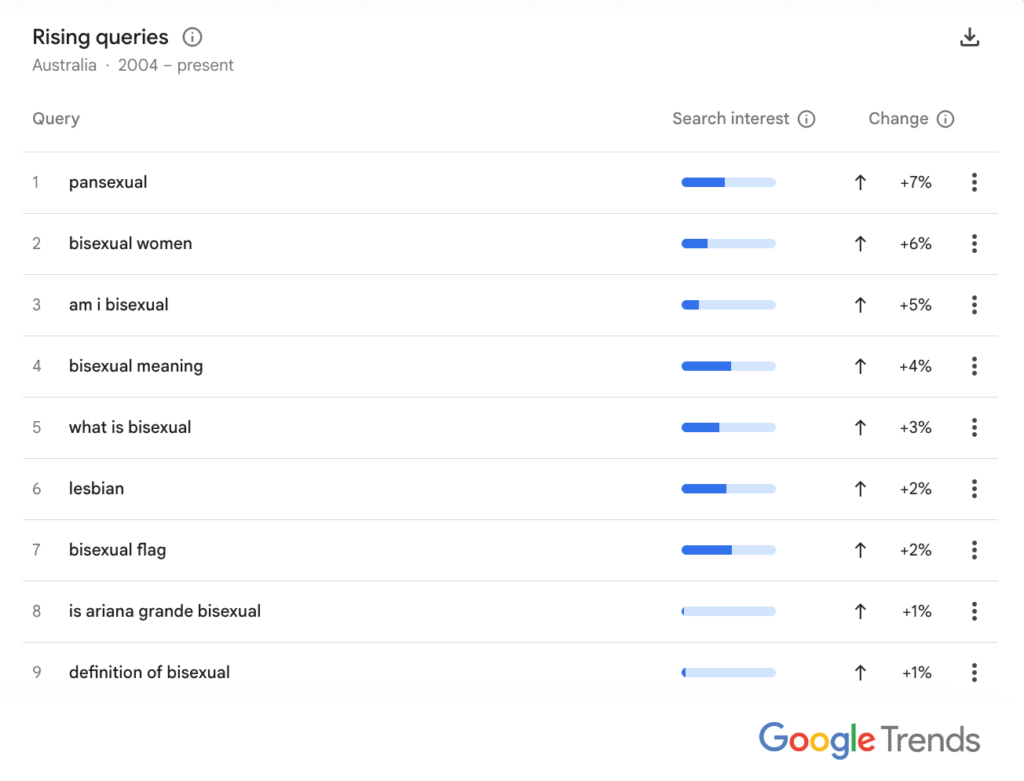
Ah. Google – you messy, girl!
This is genuinely among the rising queries connected to bisexuality in the Australian Google Trends data, hahahaha.
The answer is: we don’t know. Ariana Grande has not publicly identified herself as bisexual. But speculation about it really kicked off in 2019 after Grande and Victoria Monét released Monopoly, in which Grande sang about liking women and men. Asked about the resulting discussion over her sexuality, Grande said she had never labelled herself and still didn’t feel the need to.
And that’s basically the perfect place to end this entire explainer.
Labels can help us find language for feelings we couldn’t previously explain. They can connect us to histories, cultures and communities. They can make a scared young person searching on their phone suddenly realise there are millions of people out there who feel something like what they feel.
But nobody owes us one.
Bisexual, pansexual, queer, something else entirely, several at once, or no label whatsoever: the word solely belongs to the person using it.
Now go, learn, search, talk to the queers. Happy searching!
Support the Star Observer… while you still can
LGBTQIA+ media is under threat. Queer content is censored by tech conglomerates who amplify bigotry and push out AI slop — so we receive less financial support than ever.
When our community is muzzled and intolerance intensifies, we need queer media more than ever. Your donation means we can continue paying queer journalists to write queer news.
Don’t rely on the straight lies of big tech – support Star Observer instead and donate now.