


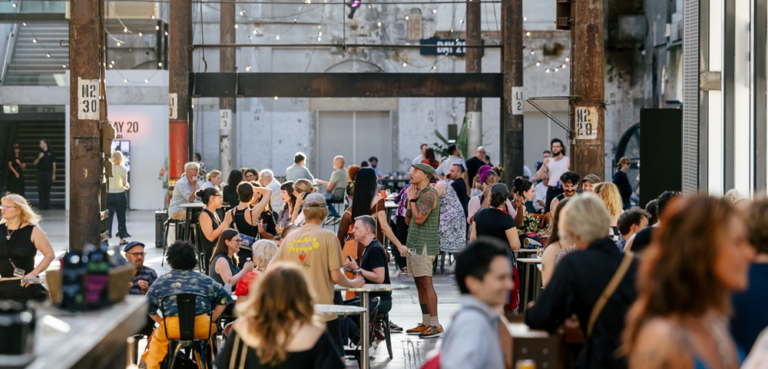
Sydney Archbishop Launches Petition Calling For Divine Playhouse Government Funding To Be Cut

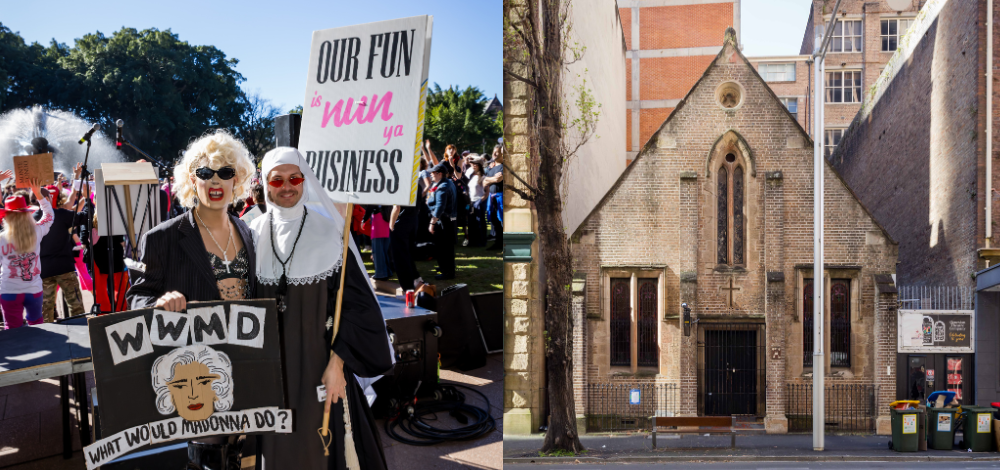
Image: mage: Credit Composite Anna Hay/sydneycatholic.org
Sydney Archbishop Anthony Fisher has launched a petition calling on the NSW Government to withdraw public funding from Divine Playhouse, reigniting the controversy surrounding the LGBTQIA+ arts venture as it prepares to return for a series of events at Sydney’s Museum of Contemporary Art.
The Catholic Archbishop has written an open letter to NSW Arts Minister John Graham objecting to public funding associated with Divine Playhouse and its upcoming UNHOLY / DIVINE program, arguing its use of Catholic imagery, terminology and rituals amounts to the denigration of his faith.
It comes just weeks after Divine Playhouse announced its return following the dramatic closure of its original Kent Street venue in July, when protests from Christian groups were followed by the termination of its lease.
Now the Archbishop is taking aim at its resurrection.
In his petition, Fisher says the Catholic Church recognises and upholds freedom of artistic expression, but argues that does not mean governments should financially support every form of artistic expression.
“No believer should be expected to accept the use of their sacred beliefs as material for ridicule simply because it is presented as artistic expression,” Fisher writes.
“Freedom of artistic expression is important, but it does not follow that every artistic project must be financially supported by public funding.”
Archbishop targets Divine Playhouse funding
At the centre of the renewed dispute is a $100,000 grant previously awarded through Create NSW to support Divine Playhouse programming.
When Divine Playhouse originally opened at 420 Kent Street on July 8, the project had significantly larger ambitions. Founder Kat Dopper previously told The Star Observer the venue had planned to support more than 1,500 artists, producers, performers, technicians, promoters, creative businesses and staff over the course of a year, with more than $650,000 expected to be invested into the independent arts sector.
Those plans were thrown into chaos almost immediately after the venue opened.
Now Fisher argues the return of Divine Playhouse through the MCA’s October program has failed to address the concerns raised by some Christians during the original controversy.
“At the time, we were told that the NSW Government may have been misled about the intentions of the group when the grant application was made,” Fisher writes in his open letter.
“An examination of the funding was promised, yet no satisfactory public explanation or outcome has subsequently been provided.”
He claims Divine Playhouse has instead returned and “appears to double down” on the material that sparked the original backlash.
The three-event UNHOLY / DIVINE program will take place at the Museum of Contemporary Art Australia on October 8, 22 and 29.
The first event, MOURN! WEEP! WAIL! An Unholy Funeral – The Death of Divine!, will stage a mock funeral for the original Divine Playhouse, before BLISS! DEVOTION! ADORATION! An Unholy Rebirth – Resurrection and Joy follows later in the month.
The series concludes with PLEASURE! VICE! DESIRE! A Delicious Indiscretion – Forbidden Fruits, Confessions and Naughty Arts.
More than 50 independent artists are involved across the program, which the MCA has described as celebrating “the power of difference, dissent and divine mischief”.
Fisher, however, objects to the program’s continued use of religious language and symbolism.
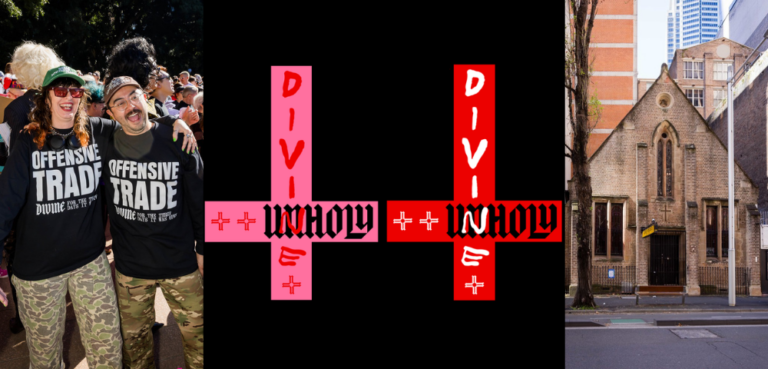
“The promotional material for events planned at the Museum of Contemporary Art Australia in October features three inverted crosses and promises Adoration, Confession, Hymns and Processions,” he writes.
“These are not merely incidental references to Christianity.”
He argues they involve the “deliberate appropriation” of Catholic symbols and rituals and describes their use as a “sexualisation and denigration” of material sacred to Catholics.
However, the Archbishop claims that his petition is a question of government funding rather than an attempt to prevent Divine Playhouse or its artists from staging the events.
He asks whether it is “ever appropriate for public funding to be allocated to the appropriation, sexualisation, ridicule or deliberate degradation” of the beliefs, symbols or rituals of any religious community.
“The Government cannot credibly call for religious tolerance and social cohesion, while quietly funding intolerance and division based on religious belief,” Fisher writes.
“For many members of the community, the issue is therefore not simply the existence of a controversial artistic production. It is the fact that public money is being used to support programming that deliberately mocks and degrades Christians.”
The petition calls on Graham to undertake that government funding will not be allocated to the ridicule of religious belief.
“Our faith is not a prop, a punchline or a source of sexual entertainment,” Fisher concludes.
However, news.com.au reports that a representative of the Minister for Arts, John Graham, has responded to the request, distancing the department from the current shows planned at the MCA.
“It has long been the Government’s position that independent arts organisations make their own decisions about programming and artistic content” they said in a statement provided to the outlet.
“The MCA is an independent organisation and its programming decisions are a matter for the MCA”.
“The Create NSW grant has been fully expended and is not being used for this MCA event. No NSW Government funding has been allocated to this specific event”.
Divine Playhouse controversy started almost immediately
The Archbishop’s intervention is the latest development in a dispute that has followed Divine Playhouse almost from the moment its doors opened.
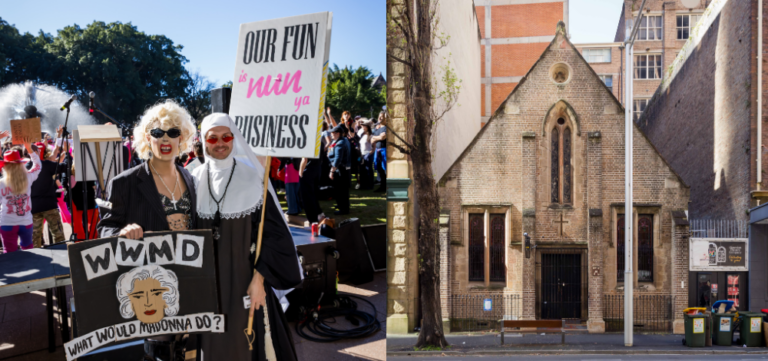
Founded by Heaps Gay creator Kat Dopper, the original venue opened inside the former St John the Evangelist Church at 420 Kent Street in Sydney.
However, the building had not functioned as a church for generations. It was deconsecrated in 1932 and later became home to the Genesian Theatre for decades.
The project was initially announced as Unholy Playhouse, before organisers changed the name to Divine Playhouse following concerns from members of the Christian community.
Despite the name change, Christian groups including Fit for the Kingdom and the Prodigal Sons protested outside the venue on its opening night, with approximately 70 people gathering outside.
The groups also objected to the project’s $100,000 Create NSW grant.
Days later, landlord KCSYD Pty Ltd, part of the Revelop property group, issued action against the venue over what it described as “offensive trade”.
Divine Playhouse subsequently cancelled its events before its lease was formally terminated, leaving Dopper just three days to remove months of work from the venue.
“It’s over. Our lease terminated, our artists cancelled, our venue being cleared out,” Dopper told The Star Observer at the time.
“We believe this termination was unlawful and unjust. I am devastated. I am angry – for us, for our artists, for this city and its people.”
Dopper argued the controversy had implications extending well beyond one LGBTQIA+ venue.
“If a landlord’s personal beliefs can shut down an arts venue, no stage in this country is safe,” she said.
“Who decides what art is acceptable? Right now, the answer is whoever owns the building.”
Thousands rallied behind Divine Playhouse
The closure subsequently triggered a significant show of community support.
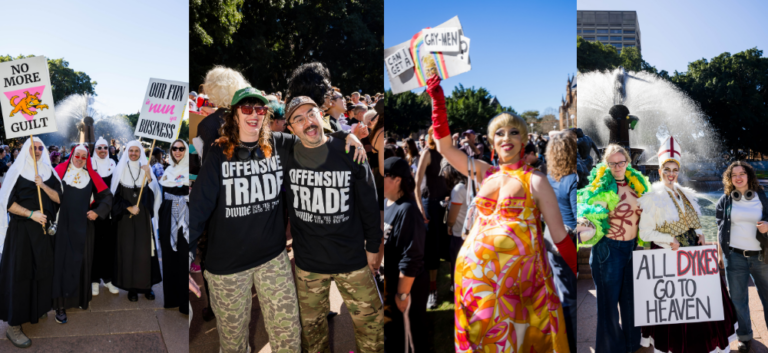
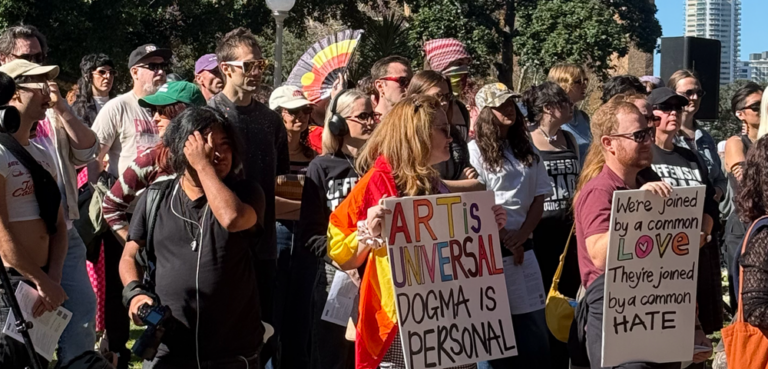
On July 25, an estimated crowd of more than 2,000 people gathered in Sydney’s Hyde Park for a peaceful Divine Playhouse “sing-in”, where attendees performed songs including Madonna’s Like A Prayer and John Farnham’s You’re The Voice.
Ahead of the demonstration, organisers declared the rally was “not just about one venue”.
“It’s about the future of arts and culture in New South Wales and who gets to decide it,” they said.
“They can sing? Well we can sing louder. Divine will rise again.”
At the rally, queer performer Aunty Jonny Hawkins argued that the controversy was ultimately about the LGBTQIA+ community occupying and interpreting religious spaces and imagery.
“It was never about the name. It was never about the church. It was never about faith. It was always about us being queer,” Hawkins said.
“Let them keep the building. We don’t need a building to be a community.”
Support for Divine Playhouse also extended beyond the rally.
A petition calling for government assistance to help the project find another home attracted more than 20,000 verified signatures, while supporters raised tens of thousands of dollars to help cover losses and legal expenses.
Sydney Lord Mayor Clover Moore also defended the importance of artistic freedom while acknowledging the right of religious groups to peacefully voice their objections.
“If we want to be a truly global city, we must stand with those who invest in culture, support independent venues, and defend both freedom of belief and freedom of creative expression,” Moore said at the time.
Divine Playhouse will continue their planned performances at the MCA this October Tickets are available through the MCA.
Support the Star Observer… while you still can
LGBTQIA+ media is under threat. Queer content is censored by tech conglomerates who amplify bigotry and push out AI slop — so we receive less financial support than ever.
When our community is muzzled and intolerance intensifies, we need queer media more than ever. Your donation means we can continue paying queer journalists to write queer news.
Don’t rely on the straight lies of big tech – support Star Observer instead and donate now.



Leave a Reply